Back to the Exitinterview main page.
(Most Recent Entry First - Reverse chronological order)
(Click Here for a Re-Listing of Journal Entries by Subject Category)
NOTE and DISCLAIMER: (It should be obvious, but) anything written in these journal entries that is not otherwise documented is my own opinion, based on the statements and behaviour that the people involved have chosen to make public or has otherwise appeared in public venues. (To the lawyers: There. Satisfied?)
14 April 2024
In virtually every television sitcom since the 1970s in which a police officer stops a motorist or otherwise appears in an investigation, the officer is played by a black actor. When there are two officers, one of them is black, and he does the talking. If a sitcom scenario involves a courtroom scene, most often the judge is a black woman. (Oh, by the way, in many, many situations when our sitcom heroes end up in a hospital emergency room, the nurse on duty is played by Vernée Watson. Don't get me wrong: Vernée Watson is great whenever she appears onscreen. But every hospital in America?)
What we've got here I'll call "cliché casting". It's rather like "cliché advertising". Whenever decisions have to be made about whom to use to portray whatever role is needed at a given moment, the decision of whom to hire is made for that moment, without consideration of the 'big picture' of fairness, balance and inclusion. Hiring a black actor to play a police officer or judge is inclusion of minority talent. Doing so every time such a role comes up is, I reluctantly conclude, reverse racism, a form of bigotry that is unfair to everyone, including the black actor (no matter how much she or he wants or needs the job).
For the casting director and producers it's the easy way out of the pressure of including minorities. Unfortunately, it's also stereotyping, which is ultimately counterproductive, like most for-the-moment, band-aid solutions.
30 March 2024
In recent months, virtually all television commercials have been featuring women, often to the complete exclusion of men. When men are included, they are the fools, or jackasses, or clueless morons while the women are the experts, the saviours, the guardians of wisdom.
I get it. Women make up the majority of consumers, people who buy products and services. It makes marketing sense to depict the type of people who will spend money for you. Buyers spend more if they "see people that look like them".
I don't like it. There's a serious flaw in Amerikan society that scores of scholars and other would-be socially conscious people have been writing about. It's usually referred to as the 'Boy Problem' or 'Boy Crisis'. (Do a Web search on these terms; you'll find a ton of information, though precious little that suggests workable solutions.) In a nutshell, it's the alienation developing boys feel when they can't find any meaningful path into adulthood. Boys look at society and don't "see people that look like them".
My suggestion for a solution is this: move more men into society - and into television commercials. What I really mean is return men to visibility in all aspects of society, not just sports. This is NOT to say that television commercials, or any other social category, should be all male. As an 'equality feminist', I could never put up with that. My vision is that commercialism, sports, crime reporting, community achievements . . . all aspects of society . . . especially education should reflect a balance of genders.
People in ethnic minorities rejoice when they look at society and "see people that look like them". It's almost a cliché these days, and more power to them. Let's start hearing boys and young men say the same.
25 March 2024
"Gay liberation" - whatever that means, or used to mean - is drifting toward being a movement of females. Or, more to the point, away from a true and complete diversity that allows each and every person to develop in her or his own, unique way, without roadblocks. This, unfortunately, is what happens when you let a society like ours (Amerikan) accept you. Sooner or later, they get you to conform (most likely so that corporations and governments will have an easier time getting you to accept their products and programs.)
Let me say this in a more direct way, so as to piss off more readers: Being LGB&c. in the 2020s is acceptable if you're Lesbian (i.e., female), and/or willing to commit to the recently-sanctioned 'gay marriage' compromise, and/or transgender. (Note that in XXIst century Amerika, transgender almost always means male-to-female transgender. No-one has ever cared if girls act like boys. Tomboy? Feh.
Left out of the above list are boys who are comfortably masculine and, for whatever reason, like girls 'just as friends'. One might refer to these as 'brokeback boys'. In very short:
- Gay boys are not all feminised boys. Some are rodeo riders.
1 March 2024
Women's control over [American] society is due for recalibration. 'Control feminism' must yield to the 'program' that I signed on for, and still support vigorously: 'equality feminism'. Until the age of (true) equality settles in, the "Boy Problem" that scores of scholars (including myself) and social commentators have been writing about will not get better. Simply put, when/if women are in control and all advertising is woman-oriented and all boys and young men see as they are leaving their (female- dominated) homes and schools to enter society is women, those young males will falter in their search for real, live, realistic role models and will remain confused and alienated.
The latest observation that confirms the increasing control of women in our society is the proliferation of 'smart home' and similar devices for phones, cars, doorbells, you name it - all the social media-related gadgets that corporate America is using to debilitate our privacy and keep tabs on us. All of these devices, at least so far in my experience, have female names and speak with female voices.
Examples: Siri (Apple); Alexa (Amazon); and now we have the Mila Air Purifier [!] (Vitality Ventures Company Ltd.), advertised online as "The mother of all filters." (By the way, the Mila Web site notes that she "works with Alexa." I should have seen that coming!
In fairness, some devices have gender-neutral names, such as Google Assistant, Amazon Echo, Google Nest (all trademarks, of course). My point is this: so far I have not found any - any - with even remotely 'male' names.
How can boys and young men find a place in such a society?
2 October 2023
How about this for relevance in the MAGA era of battling cable news outlets, social media sabotage, and civil-war-level disagreements about The Truth:
- The continuous revision of history to suit the insights or prejudices
of the present is craven and nefarious - an enterprise suited to
characters in "1984" or to demagogues.
OK, right on, right on. Now, hold onto your TV remote controls. Here's the bibliographic reference for the footnote: Philip Wylie [Philip Gordon Wylie] (1902-1971). Generation of Vipers. New York: Rinehart & Company, Inc. 1955 (Revised edition, originally published New York: Farrar & Rinehart, 1942), "Introduction [for the 1955 Edition]", p.ix; the reference to "1984" is, of course, George Orwell's dystopian prophecy published in 1949 (London: Secker & Warburg).
That's right, we've had this succinct criticism for nearly seven decades. Why are we still ignoring, even changing, history? Because we can? Not good enough. Stop, already. I call on all the forces of (true) progress and scholarship to stamp out and reverse revisionist history. Are ya with me?
11 July 2023
The great double-standard in American education of the late XXth century is clearly illustrated in an episode of Family Matters that I viewed recently. Hey, don't judge me - I've been watching as much of Steve Urkel as I can in the past couple of months; face it: Jaleel White as the prototypical nerd was a comic genius.
In the episode, "It's a Mad, Mad, Mad House" (19 February 1993), Eddie Winslow (Darius McCrary) tells his Math teacher, Miss Connors (Debra Jo Rupp) that his unacceptable acting out in her class is due to 'problems at home'. She falls for his lame, opportunistic excuse, and visits the Winslow home, finding it a mess (and not knowing that its temporary disarray doesn't reflect Eddie's reality at all). She feels sorry for Eddie, and gives him a full-body, emotional hug.
If Eddie's teacher had been a man, he would have been arrested on the spot.
The great tragedy of American education in the late XXth (and now XXIst) century is the demonisation of caring, nurturing male teachers - and men in general - and the dependence on mostly women to teach children of both genders. Women teaching students of both genders is not a bad thing. The bad thing is doing so while men are excluded from the balance.
10 July 2023
The Morning News featured a segment today reporting a watchdog group's finding that the electronic 'gadgets' in late-model cars are observing the driver's behaviour, collecting data, and sharing with other vendors and marketing agencies. The watchdog even found that conversations you have over built-in mobile telephones can be saved and shared. Quelle surprise!
How 'bout another 'news flash' exclusive from me? Your home cable box, internet router and cell phone are doing the same thing for your cable/internet/phone provider. Why do you think they call them 'smart' phones?
Buddy, your days of privacy in America are long gone. Big Brother has gotten 'too big to fail'.
7 July 2023
A local fast-food chain here in the Western United States is now marketing a hot-sauce-infused sandwich called the Diablo Burger. What do you think they're charging for it?
$6.66.
This simply cannot be an accident.
3 July 2023
[NOTE: hiatus due to six week trip to Europe, then six week recovery from stress of the trip]
Yesterday, on CBS Sunday Morning, former vice president Mike Pence showed his true intellect, as he responded to a question about his policies, or something: "Nothing could be further than the truth," he blurted out. Well, Mike, what can I say. You said it all.
18 February 2023
[Full disclosure: I probably should say up front that I dislike babies, though I don't think that matters much to the present rant. In general, I get annoyed with any human being I can't reason with.]
I've noticed a significant uptick in interest in the business - and I mean business - of gender reveals. It's rooted, of course, in the feminist boost of interest in women's role in reproduction, some of which is helpful and productive (no pun intended, I think). My problem is that it goes too far. Way too far. My favourite recent story is about the family, on the way to their G.R. party, when a very young boy playing with a sword pops the balloon full of pink confetti. (www.youtube.com/watch?v=eTkBtH0Hy7s; YouTube is full of similar, very funny situations)
All this hoopla just reminds me of a puzzlement I've had ever since Ricky Ricardo got the news that his first child was a boy in I Love Lucy, "Lucy Goes to the Hospital" (19 January 1953; Yes, I saw the original broadcast! Yes, I know that's the same year Elizabeth II was crowned. So I've been around a while.) When the nurse tells Ricky the news, everyone erupts in cheers and congratulations, as if having a boy - not a girl - was a cause to celebrate. The puzzlement is that people react - then and now - in exactly the same way when the news is "it's a girl".
I could understand if the announcement was something like, "She's healthy" or "He's here, and he weighs 9 pounds." But mindlessly cheering either gender equally? The only explanation I can come up with is that everyone is relieved it's not a monkey.
14 February 2023
I once thought former Ambassador to the United Nations Nikki Haley might just be the savior of the Republican party, despite her baffling support of Donald Trump in all but a few instances. (She criticised him, for example, after the Capitol insurrection on January 6, 2021.)
Last week, when it was announced that she was announcing her candidacy for president of the United States, even though her former golden boy (Trump) also was running, I actually was encouraged.
Until the last line of her social-media announcement, when she said,
- "I don't put up with bullies, and when you kick back, it hurts
them more when you're wearing heels."
This is sexist garbage, the stomach-level claim that what America (or business, or communities, or everything) needs is a woman's touch, a female perspective.
Women have controlled public education (elementary/secondary) for a couple of generations now. Public education sucks the big one, let me tell you (as an educator). Society has effectively excluded men from meaningful participation in child-rearing at all levels since the stranger-danger scares of the 1980s, leaving women as the responsible guardians. Boys are adrift with only plastic action-figure role models and unattainable sports or music career fantasies to end up alienating them before they get started. Some girls share these problems as well. Girls are brought up as entitled, by mothers who themselves feel entitled, not having to earn their place in society and isolating themselves from most human contact by living in and through their 'smart' phones. And some boys share these problems. And the conglomerates making money off these kids are ecstatic.
My stubborn opinion is that what everyone/everything needs is true equality of women and men in society, and the last thing we need is the control of either sex over the other. Control assures another swing of the pendulum and the inevitable backlash. Equality allows forward progress.
So, Nikki Haley, with one cutesy reference to feminine attire (heels), you have lost this supporter forever. (Not that I would have voted for you, as you seem to want to remain a Republican, which is already a deal-breaker for me. C'est la guerre.)
7 February 2023
With the marginalisation (not complete yet, but sincerely hoped-for) of Donald Trump, I thought we were through hearing people describing others in terms of their own faults and foibles. Trump routinely did this by telling us "the Democrats" (an automatic insult when spoken by him) were colluding with foreign powers, engaged in high corruption, and lying to us. (Everyone knew that it was Trump doing all these things, and more.)
The Republican response to the State of the Union address, delivered by newly-nepotised governor of Arkansas Sarah Huckabee Sanders, hinged on this astonishing statement:
- "The dividing line in America is no longer between right or
left. The choice is between normal or crazy."
No matter who is wonky on the Democratic side, how can she call them 'crazy' and her side 'normal' with people currently in office from her own party such as Matt Gaetz, Marjorie Taylor Greene, Josh Hawley, Jim Jordan and George Santos (a pseudonym)?
Pretty much the whole picture she painted of how she saw Democrats was a paint-by-the-numbers portrait of her own party. Sanders is well on the way to being "more of the same" instead of the fresh, new voice she tried to portray.
5 February 2023
For many years now, television news organisations have been exploiting the phrase "BREAKING NEWS" to 'trick' viewers into watching their coverage. Sometimes the news so labeled is two or three days old. But, if it works, don't fix it, right?
Lately, a new 'trick' is beginning to be overused:
-
We warn our viewers that this video may be difficult to watch.
Let me translate that code for you:
-
In case your interest is flagging, we are about to show something
that, like a train wreck, you won't want to miss.
Just how stupid do you think we are? Oh, right. That stupid.
21 January 2023
Lots of chatter lately about security loopholes (risks? chasms?) in TikTok, ChatGPT and other new-and-improved social media scams has led me to a new level of suspicion about social media in general.
What if TikTokChatGPT&c. are being 'outed' by the original, Big Daddy social media companies - e.g., Twitsverse, Facefriend, oh, you know the list - as a red herring to draw attention away from the real privacy hole through which all our data - medical, financial, social, travel, younameit - is already being ported to the Cloud for safe keeping.
I'll say it again, not for the last time:
O TEMPORA O MORES (--Cicero).
18 December 2022
A political writer for the Los Angeles Times was on television this morning (very early) talking about the current problems besetting the Los Angeles City Council. (The nature of those problems is not relevant here.) Just a few days ago, five (5) women were sworn in as new members of the 15-person Council, after a recent election, bringing the number of women to six (6), with one seat currently vacant.
The Times writer had the chutzpah (it's Channukah, after all) to blame the Council's current dysfunction on "toxic masculinity", a slur that went unchallenged by the program host who was interviewing her, and which she never explained nor gave evidence for.
"Toxic masculinity" is a real thing, of course, and when observed (and backed up with evidence), should be challenged and minimised.
Using the term without backup, however, is a form of "cancel culture", a technique of silencing or neutralising opposition merely by characterising them with a term that automagically summons a negative public reaction. (Donald Trump has used this technique all his life. Often it results from what psychologists might call projection.)
So, if "toxic masculinity" (as a term) is weaponised, in the spirit of the equality I've been fighting for over the last four decades, allow me to coin the term "toxic femininity" or, more accurately perhaps, "toxic feminism". Also a very real thing that needs to be squelched before it gets any worse.
What's good for the goose, and all that.
15 December 2022
Regarding the recent "dropping" of Netflix's highly commercialised and over-hyped Harry and Meghan documentary, particularly those who base their support for the Sussexes' side of the story on their observation that Meghan was obviously distraught.
Meghan Markle is an actress.
I'm just sayin' . . .
P.S. In my view, "dropping" is more appropriate that I thought. I wish I had claimed the pun was intentional.
P.P.S. Everything else aside, I am fully nauseated by the frequency, nay inevitability of people's comments along the line of, "If Diana were still here . . ." Retch!
12 December 2022
My sense is that 'we' (i.e., those of us who care about optimum child and adolescent development) might be using some counterproductive tactics to encourage the diversity that is essential to healthy functioning. In my view, nurturing true diversity is the cornerstone of social progress.
It seems the usual approach is in-your-face insistence that society accept people as they are, no compromise, no retreat, like many of the liberation efforts of recent decades:
- "My way or the highway."
- "I am woman, hear me roar."
- "We're here, we're queer, get used to it."
Unfortunately, it seems this often sets up a reactionary backlash, and the pendulum keeps swinging.
Encouraging diversity in non-combative ways, on the sly, under the radar may just be a better approach. Slip it in (and be sure to keep slipping it in) while they're not looking, like politicians do when they attach their pet projects to big, splashy bills that draw attention away from their real agenda. It may seem tricky, but when diversity is the goal, the end absolutely justifies the means.
The details will need to be worked out by better minds than mine, but it just might work.
15 November 2022
I'm not the first to notice that America is divided like never before. Why is that?
- Society has been changing too fast. While forward progress is essential, techniques used in fast change usually are not amœnable to future stability.
- The either/or mentality - conquer and replace - has been the dominant social psychology. Other approaches, such as the legendary "Adopt, Adapt, Improve" of the Round Table Club, which derives from a 1927 speech by the Prince of Wales (England), might dilute the rigidity of either/or. Even better, though it takes much longer, is the mediæval Christian approach, in which they built their institutions by starting with the pagan, agrarian patterns of the indigenous people, gradually replacing old holidays with new ones (celebrated at the same time), previous beliefs with fresh ones, and so forth. (One charming, indeed brilliant example of this incorporation of old into new can be seen even today, centuries later, in the ceiling bosses [intersections] in Norwich Cathedral, where images of the Green Man - a local spirit revered in the pre-Christian villages - are placed, inconspicuous but completely visible.)
11 November 2022
Today - Veteran's Day in the United States of America - it is appropriate to honour those who served in the Armed Forces above other people and occupations.
The rest of the year, special honour for veterans, to the exclusion of other deserving public servants, is not as honourable. In XXIst century America, in fact, honouring those who served in uniform has become code for social pressure to support conservatism. It is the latter-day child of White Supremacy, in that it glorifies the status quo over progress and change, in order to benefit the 'haves' over the 'have nots'.
Communities who fly banners with photographs of individual service members, present and past, who are residents of the town are fooling no-one: the community is advertising itself as a conservative stronghold where liberals are not welcome to do anything but visit and spend money, then go back where they came from. Immigrants? Poor people? Forget it.
Honouring veterans is a good thing. It must be balanced with honouring nurses, ditch diggers, teachers, soup-kitchen volunteers - any number of other occupations that are under-paid and essential to a community's well-being.
31 October 2022
The problem with calls for action to address climate change is that the appeals are framed as being necessary to save the earth. That concept is too big for most earthlings to comprehend. Nobody has had the real-world experience of the end of the world, leaving most people of limited vision without motivation for the sacrifices needed. "If it's really a problem, let someone else deal with it. I'm busy."
The problem, of course, is that action to address climate change really is necessary to save the earth. An (extremely) inconvenient truth, to paraphrase Al Gore.
26 October 2022
What's wrong with Texas? Let me just choose one thing to keep it simple (so that even Texans will understand).
Young men and women, due to the fierce loyalty and the inevitable conformity that is required for maintaining social acceptance there, might never discover the wonders of Irish Whisky.
25 October 2022
The 'feature' of human male anatomy commonly referred to lately as 'the junk' - the central feature of the male body.
You're sceptical? Take a scholarly trip through Western sculpture of the last three millennia. Consider in particular the Barberini Faun. Or Michelangelo's David. I challenge you to take one look at him and not remark to yourself, "Well, I notice he's not Jewish."
For the record, this 'feature' does not seem to be the central point of interest of any other species.
Hey, I call 'em as I see 'em.
18 October 2022
I read today of a Sheriff's Department psychologist who is alleging gender discrimination as the basis for her transfer from her former position. I spotlight this with no intention of criticising the psychologist's action against her Department, only to highlight the irony - or maybe the chutzpah? - of the legal reasoning.
If I may quote from their online reportage (www.nbclosangeles.com/ dated 16 October 2022):
-
Jones went on medical leave in April 2020 because of stress and that
same year she was reassigned to the coroner's office, a move that
has "destroyed and crippled" her chances of advancing
within her field as a psychologist, the suit states.
Ya think? A psychologist in the Coroner's office. What kind of progress can she expect of her clients there???
16 October 2022
The central problem with social media - too bad, since they're here to stay - is that they allow no debates nor discussions, only arguments. And with the inbred anonymity and lack of accountability, no-one can ever win the arguments. They are the shouting matches of the 21st century.
The only solution going forward is to facilitate in-person social activities, venues in which people can get close enough to smell each other. (Pheromones, dear, not necessarily odours.) With the restoration of in-person bodily cues, starting with visual, humanity just might be restored a bit.
7 September 2022
As the commercial season (September through next May) gets going this time around, popular advertising is settling into the trends we will be seeing during this cycle. I've written before about interracial couples, which I consider a good development, except when advertising exploits it for profit. I would prefer that society simply accept interracial couples, not use their likenesses to attract attention.
The main 'development' of this season seems to be the all-girl commercial. I certainly don't object to advertisements in which all the significant 'players' are females, especially for products that are mainly used by females. I start to get suspicious, then hostile when I don't see any all-guy commercials, and livid, even, when products or services that are bought and used by all genders are advertised only with all-female casts of characters. At the top of my rage list are all-female commercials for educational institutions and learning assistance (i.e., fancy, expensive tutoring to boost school performance).
It is particularly difficult, yet I believe important, to criticise features of society that are good and proper in themselves, except for the fact that their counterparts are defective or missing. Said differently: there's nothing wrong with a portrayal of females helping kids learn, except when there are no portrayals of males doing the same.
I continue to support equality, and reject the control of any aspect of society by one group, gender, faction, political party or person.
26 July 2022
Bumpersticker seen on the back of a car in Southern California today:
- If it ain't King James it ain't Bible
Sure, it's a bit reverse-iconoclast but, in all fairness, the car had Kansas plates, which explains a lot.
Not that the Religious Right needs, or can withstand, explanation.
5 July 2022
Grand Canyon University is running an advertisement (they are a for-profit educational institution) that promises (much) more than it could ever deliver. Their claim borders on false advertising:
- Carry your family in your heart and you will accomplish what you want.
Hog shit. Even if you were lucky enough to be reared in a non-abusive family, what about those parents who try to mould you into a good little Christian, or a dutiful Asian, or any other parent-idealised stereotype when you might rather be a beatnik, or poet, or musician, or slacker, or any number of other alternative life forms.
For many (of us!) carrying our families in our heart, to the exclusion of our heart, would have been death, and we were lucky to find a way to avoid such disaster.
For the record, the 'subtitle' of GCU's Web site is: "Private-Christian-Affordable". I mean, obviously.
24 June 2022
The Supreme Court, probably known in the forseeable future as the Trump Court, has overturned Roe v. Wade and its supporting decisions, for the first time in American history removing a constitutional right that it (the Court) once granted. This was done despite the assurances given by the Trump nominees (Gorsuch, Kavanaugh and Coney Barrett) that Roe v. Wade was established law and precedent under stare decisis. So much for telling the truth in a job interview, eh?
The majority decision stated that other recently-granted rights were not in jeopardy, since Roe, as it involves a human life, is different. Justice Thomas's concurring opinion, however, specifically stated that other rights, such as gay marriage, contraceptives or same-sex intimacy in private (consenting adults, of course) were on the (symbolic) docket for future 'revision'.
A question for Justice Thomas: part of the reasoning that allowed the overturn of Roe and its progeny was that abortion was not mentioned specifically in the Constitution, and regarding it as equivalent to other Constitutional guarantees of privacy (such as unreasonable search and seizure, or the ability to avoid self-incrimination) was error. What about Slavery? The Constitution doesn't say anything about Slavery. Are we going back to that era by the same reasoning? This question is not that far-fetched. The overturn of Roe v. Wade, the continuing resistance to gun control, the threat of reversing gay marriage and other rights, is part and parcel of the White Supremacy mindset that supercharges the Republican Party these days. If you deny this, you are stupid. There's no other way to say it.
The Conservative movement has just gotten too absurd, far afield from true, traditional conservatism. It's obviously time that this trend be stopped by the adoption of the ERA and the Freedoms Amendments to the Constitution. The ERA, well known for its near-passage a generation ago, simply grants full equality to women. The Freedoms Amendment - my own proposal - takes language from the Declaration of Independence, often quoted as being from the Constitution anyway, and makes it officially part of the law: "All men [i.e., persons] are created equal . . . unalienable rights . . . among these are Life, Liberty and the pursuit of Happiness."
With these having the force of Constitutional law, we can be done with the foolishness such as we saw today, and perhaps the Court could get out of the Culture Wars business and once again become non-partisan.
7 June 2022
-
Newscaster (national network broadcast): ". . . the intense search and effort rescue will continue."
From a technical standpoint, what's happening here is that the words necessary to convey the thought are gathered in the brain and, as long as all the words get spoken audibly, the speaker is satisfied that this particular task is done. No self-review, no quality control, no mea-culpa.
From a social standpoint, what's happening here is that any kind of elegant culture we may have (thought we) had in the past - you know, clear communication, people who care about accuracy, clever turn of phrase, &c. &c. - is very clearly going down the toilet.
As Mr Omar (Ernest Thomas), the sleazy undertaker who lives upstairs in Everybody Hates Chris (TV series, 2005-2009), used to say so often, "Tragic. Tragic!"
4 June 2022
Fanatical belief in the 2nd Amendment (United States Constitution) is a manifestation of White Supremacy. It's as simple as that.
30 May 2022
Don't talk about your goals. Achieve them. Then you can brag.
29 May 2022
Like millions of others, I've had enough gun violence. In fact, I've had enough in the last two weeks (in America) to really piss me off. I know why it's happening, and I believe I know how it can be fixed. I will share my thoughts, as long as I can state up front that I'm reasonably positive the solution will never be implemented in my lifetime. Not in good old Amerika.
The perpetrators are late adolescent males. No-one disagrees with this. It is not a generalisation - it's data. Furthermore, these are universally known to be 'troubled' males. My theory, and I DARE you to prove it wrong, is that to a man, they are boys who are lacking a real-life in-the-flesh male role model who can show them a usable connection to the adult world they are about to enter. When they are unable to see how they could fit into the adult world, they get angry. I probably would have, too, but for a few men who (mostly without knowing or intending) showed me how I could be one of them. I'm not saying I would have shot my classmates in the school cafeteria, but then the shooters are only the tip of this black, desolate iceberg. The iceberg, in a nutshell, is the result of the necessary and long overdue overhaul of society to include women and girls without paying attention to the needs of developing boys to find their place in the new order. In that process, men were excluded from any position, official or unofficial, school, church or family, in which children or teens were being socialised. The truth is well known to every boy that complete, ideal transition into manhood cannot be accomplished by mothers, female teachers and women scout leaders alone.
Repopulation of the child-care landscape with men is the solution. And they've got to be queer men. No, I don't mean homosexuals. Queer men in this context are any men "not conforming to the sex or gender norms of their society." (I am grateful to Ignacio Darnaude, writing in The Gay & Lesbian Review, Vol.XXIX, No.2, p.20 for this spot-on wording.) These men must be included in all social levels and settings, especially schools. I would employ enough male school counselors to handle the number of males in each student body, and enhance their training to include individual mentoring and evaluation of every boy as to his readiness to find a place in society. Not just a job, but a lifestyle, a role, even a passion. Queer men in the past have seen this kind of work as their vocation, and devoted their lives to the boys they helped. The famous ones, such as Father Flanagan of Boys Town (Nebraska), or Bob Mitchell (Hollywood's Mitchell Singing Boys) are the tip of another iceberg, now virtually completely submerged. Again, the inclusion of these names, or the tens of thousands of lesser-known coaches, teachers, youth workers of the past, in no way implicates them as homosexuals (though some no doubt were); nor can we let the moral panic of reaction to the very, very few who made the mistake of explicit sexual behaviour tar and feather all men who would build their careers and dedicate their lives to helping boys.
Here's the summary: late adolescent males who shoot up schools and other venues do so because they are insanely angry that no-one has provided them a map and a place for their adulthood, and millions of their mates who wouldn't go to the firearm extreme feel the same way. The solution is to encourage unconventional men to make it their life mission to connect with boys and provide the maps and vision to incipient men.
As a committed, life-long equality feminist, I'm truly sorry that women can't do this particular job. But the reality can be understood if one considers how ridiculous it would be to think that a man (alone) could show a developing girl how to be a woman. (No, Eliza Dolittle in My Fair Lady was already a woman, and needed instruction in how to transition into higher class, when Henry Higgins became her mentor. Nice try.)
19 April 2022
As I sink oh-so-slowly into the insanity that is the hallmark of old age, I have come to assign strange meanings to the simple face of my (new, larger) digital clock. When I see :13 after any hour, I have a significant feeling of doom, which passes once I notice that it has changed to :14. (Obviously, this is associated with a dim distrust of the number 13 in general. Triskaidekaphobia, I believe it's called, though I'm not really phobic about it . . . just careful.)
There is to my knowledge no word, however, for some recent weirdness. Last night, I glanced at the clock at 9:38, and it looked angry to me. When I see :11 after an hour - particularly 11:11 - I feel a wave of encouragement, again, probably from decades of subliminally regarding 11 as a lucky number. And the hour on the hour - 7:00, 4:00, and so forth - is nothing short of peaceful.
Consider the following sequence:
- 10:10 - stasis, balance
- 10:12 - caution, turbulence ahead
- 10:14 - proceed, the danger past, breathe more easily
- 10:17 - all is well again; proceed with confidence
I think I'll stop here. This is too much like astrology. It's just getting too weird to sustain.
14 March 2022
The Florida Legislature has passed H.B. 1556, and unless I'm totally befoozled by counter-mis-information, Florida Governor Ron Desantis (who thinks he is already the Next President of the United States) is going to sign it. I'm writing, of course, of the culture-war salvo dubbed the "Don't Say Gay" legislation. The language of the law is, to say the least, sweeping: "Classroom instruction by school personnel or third parties on sexual orientation or gender identity may not occur in kindergarten through grade 3." It goes on to place "age appropriate" and "developmentally appropriate" "in accordance with state standards" guardrails on its already vague language. But we all hear the dog whistles, don't we?
Well, I say, good. No more Valentine's day parties, no more comments for toddlers that "You're going to be a lady-killer one day!", or "You'll make some man a fine wife." In short, no more indoctrination into compulsory heterosexuality.
What? The Florida Republikans only want to restrict LGBTQ indoctrination, and not the harmful pressure to assure one's heterosexuality by the end of potty-training?
In that case, I change my mind. I don't like Florida politics. Next, they will outlaw discussion of just how unfair slavery was, and racism still is. What? They've already outlawed that, too?
Maybe I'll move to Russia. What? . . .
5 December 2021
Having returned from Spain (and elsewhere) about six weeks ago, I was trolling the Web looking for some information about one of the parks I visited, and I stumbled on a photo of some graffiti that caught my fancy:
- Why call it tourist season if we can't shoot them?
Gotta love it.
25 October 2021
I've written before about how sports - forgive me - Sports - is becoming the new religion. (Yes, is becoming, not are becoming. Sports is a single, unified phenomenon which, like religion, is made of many separate 'teams'.)
This new religion-substitute was clearly in evidence when a sincere, naïve boy at a Bucs' game held up a sign that read, "Tom Brady helped me beat brain cancer" (and vaulted himself, as well as Brady, into national, knee-jerk attention).
Think about it. Three verified miracles are required in order for the Church to confer sainthood. It looks like Tom Brady only needs two more.
14 September 2021
Today, a television 'reporter' was closing his piece on the current state of the (coronavirus/COVID-19) pandemic, when he uttered the following bon-mot for the ages:
- The best way to be ready is to prepare.
Oh, if only I had learnt that in school!
26 August 2021
There are upwards of fifty (50) people crowding the ballot to replace California Governor Gavin Newsom, should the upcoming recall election result in his ouster. One of these advertises himself in code (as most politicians do, providing what the press have come to call 'dog whistles' to their base, so that they don't have to tell the unvarnished truth about themselves). I'm not going to name him, because I don't want to do anything to advance his candidacy. I'm just going to decode his message.
Next to his name and picture at the end of one of his TV spots, he lists,
- Businessman
- CPA
- Father
In order, these can be understood as,
- I'm rich, you're not; I can afford to offer you [minimum wage] jobs
- My inner circle are establishment white people
- Heterosexual
Oh, by the way, he appears in front of the American Flag, even though he's running for a statewide, not a federal, office. As everyone now knows, The Flag is code for Traditional American Values, which is code for white supremacy.
25 August 2021
I'm very cautious whenever I complain about the way society is going today. It wasn't that long ago - at least it's fresh in my memory! - that I was saying, "You older generation just don't like change, you don't understand us kids."
Having said that, I'm gonna complain. What's different today? The use of technology is (generally) good. The dependence on technology is (usually) fatal.
4 August 2021
Another offering in my ongoing crusade to translate 'code' for the unwashed.
-
When you hear: "This proposal is not a partisan effort."
that's 'code' for: "This proposal is a partisan effort."
15 May 2021
I don't really want to live in a society controlled by women.
In the mid-1980s, I had reached a similar conclusion, that I didn't want to live in a society controlled by men. That's when I began teaching and writing about equality feminism (what I would like to call "constructive feminism", but that's a bit too esoteric for the general public).
In the meantime (i.e., 1980s until now), control feminism (what I would call "defensive feminism" if I were assigning the labels) gradually gained the upper hand, and here we are. Men are effectively excluded from lower levels of education and child care, and boys have only plastic action figures and televised sports heroes to emulate.
- Education in general is a joke which ends up being glorified babysitting with the goal of conformity. This may not be the fault of women, but it is happening on their watch.
- Child-rearing (like dating, marriage and pregnancy itself) has become big business and a political wedge to enact conservative agendas that emasculate (!) privacy protections, producing "entitled" children - followed, of course, by "entitled" adults - who do what they want because they were raised to do what they want.
- Under the control of women, whom I have already noted are empowered by "defensive" feminists, children are protected from society rather than prepared to enter into it. Even worse, children and their environments are being over-sanitised, encouraged (to say the least) by the greed of companies willing to sell their products in the knowledge that eliminating 99% of all household germs seriously limits the ability of growing humans to develop the immune systems that would otherwise guard them against disease in adulthood. The problem is caused by commercialism brainwashing the women in charge of households that nothing can be clean enough unless you're using Brand X, new and improved. I don't even want to touch the subject of over-medication, except to offer one mantra: Ritalin is death.
- Perhaps most damaging of all, young people are allowed, nay encouraged,
to become addicted to electronic media, as they are more easily controlled
when they are not 'bothering' their parents (mothers). This, of course,
gives the mothers more time to spend glued to their 'smart' phones,
doing their part as dutiful American consumers.
They don't even hear their brats screaming (for attention) in supermarkets.
Of course, the balance will shift. Unfortunately, it is possible it will again go past true equality and find one side dominant again, then the other, then the other . . .
Where, I wonder, is the equlibrium that thoughtful (not selfish) reformers keep looking for?
26 February 2021
Donald Trump was elected president of the United States of America (2016) in order to end racism and white supremacy.
How's that for an opener? But think about it: U.S. presidents are elected by the people, acting as a group. The Society - the group - was beginning to have about enough of racism, but was moving too slowly trying to get rid of it, especially as much of it was just below the surface, systemic, not so much overt (as it used to be). Trump - self-involved buffoon as he is - saw his opportunity for self-aggrandizement using dog whistles - which became bully bullhorns - to bring white supremacy back to the surface, where it could be dealt with, and eradicated, more effectively
It was a bit of a gamble (on the part of Society, the group), because white supremacy, once a potent force, just might take hold again, like it did when Hitler (or rather, Germany, the group) tried the tactic in the 1930s. Or, it could lead to the true, multicultural society that the Society - the group - had in mind all along. Now that the Trump experiment has been sidelined, only Time will tell.
18 February 2021
A tragic story and dire situation in Texas has a bizarrely funny twist. The dire situation is the unprecedented ice storm covering Texas and other United States southern areas, coupled with the massive failure of the Texas power grid - which they manage within Texas itself, so as to avoid federal regulation! - leaving millions without power for days.
Some of the millions without power are the animals housed and cared for in the Primarily Primate Sanctuary in San Antonio, Texas. The president of that sanctuary's management board was interviewed today on CNN. Her name is Priscilla Feral.
I'm sorry, and I don't intend any disrespect, but . . . you just can't make this stuff up.
31 January 2021
The new Civil War is taking shape in America. Where before (c.1860) it was North v. South, today (and tomorrow?) it is voting v. violence; earning v. taking; peaceful and orderly v. disruptive and chaotic; take-your-time-and-do-it-right v. gimme-what-I-want-now-or-I'll-shoot. Yes, there is violence on both sides, and yes, I condemn both. I disagree, however, that there are "good people on both sides". Claiming that is a distraction.
This is a classic example of defensive v. constructive motivation (which I've written about elsewhere and often). Those motivated by constructive impulses give and create and build. Those motivated by defensive urges take and destroy.
In this particular struggle (America's political division), Constructive needs time, space and safety. Defensive needs intervention and, sometimes, prison.
23 January 2021
The pandemic (coronavirus, COVID-19) has changed society in some fundamental, long-lasting, and in some cases very positive ways.
Examples:
- advertising has been including depictions of diverse family situations, including interracial couples and clearly-defined lesbian and gay relationships
- portrayals (in advertising and human-interest news spots, and elsewhere) of the place of men in post-modern society have become more and more positive; for instance, men often are shown as good role models and caregivers for younger people, not just bumbling fools who are the object of jokes or disgust
- women have become partners and equals with men as competent doctors. elected leaders and other decisionmakers, earning the full confidence of the public
- the 'face of America' literally has changed with immigrants and established minorities diversifying the previously mostly-white membership of medical workers, politicians, community leaders and, sadly, those who can die from a pandemic
I have noted previously in this space how, like many people, I look hopefully for a new normal. I quoted the Blue Shield TV commercial that encourages us: "When we go back to normal, let's not go back to normal." Let this, in a million ways, be the legacy of the pandemic, the gift of an otherwise devastating virus.
22 January 2021
CNN is running a self-promotional banner (all broadcasters do this, of course) that says,
- CNN is the most watched Cable News Network
OK, fine. I ignore it like I do all TV self-promotions, only briefly wondering, "Who says so?" An unbiased national poll? Probably not. Expert opinions (other than CNN producers)? Not likely. Then it passes, and we're on to the annoying commercial advertising or the news/opinion content that is CNN routine. Fair enough.
Then it occurs to me: CNN is an acronym for exactly what they're claiming to be the most watched: Cable News Network. That's what CNN means.
This mildly disturbing realisation doesn't bother me for long, because, whether or not CNN is the 'most watched' doesn't matter in the least to me. I prefer their programming because it seems to me to be solid, quality journalism and punditry. Also, because it's the only cable news outlet that my cable provider includes in my bargain-basement package.
21 January 2021
A note (in the theatrical sense) to the (now-)former president of the United States of America, on the recently-completed segment of his ongoing reality show: too much drama, not enough comedy.
I'm trusting that next season the comedy will rule - you know, lawsuits, indictment, long, drawn-out public trial, incarceration, that kind of stuff.
20 January 2021
The invocation for today's U.S. presidential inauguration, delivered by Fr. Leo O'Donovan, SJ, may have provided the key to accepting the motto "In God We Trust" in a society that so importantly depends on the separation of Church and State (First Amendment, United States Constitution - the "Establishment Clause"). With only a minimal amount of 'reading between the lines', Fr. O'Donovan stated a concept that is neither Church-embedded, nor religion-specific, but can apply to the social interaction of every human being, including atheists.
-
There is a power in each and every one of us that lives by turning
to every other one of us . . . It is called love.
This fits so snugly into the Christian concept of "God is Love" (I John 4:16, and elsewhere) that it must be the answer. It must be what the (U.S.) Founders - some of whom were not themselves believers - meant when expressing their dependence on God for a country that would eventually embrace Jews, Muslims, Christians, Buddhists, skeptics, agnostics, atheists - even scientists!
If Americans define God as the power in each that connects with every other, then "In God We Trust" transcends Church and religion, and - for the first time in my sentient life - makes sense. And we can still (rightly) object to Christian prayers at High School football games, and displays of the Ten Commandments in State Capitol buildings. Hallelujah!
20 January 2021
First thoughts after the inauguration of Joe Biden as president of the United States of America,
and the relegation of his predecessor to the status of private citizen:
-
Phewwww. That was a close one.
(And I'm not referring to the election.)
18 January 2021
It's being reported that Donald Trump is asking for a full, military sendoff on inauguration day (as he slinks out of town instead of attending the ceremony surrounding Biden's oath of office). He's asking for crowds of well-wishers, bands playing marches, and a 21-gun salute.
The latter made me think that maybe a firing-squad would be more appropriate. I'm certainly not advocating that, just musing on the kind of sendoff he deserves. (Think of the TV ratings! It would bring a whole new meaning to "You're fired!")
29 December 2020
TV producer/writer Chuck Lorre posts a "vanity card" at the end of most of the episodes in his series. I just viewed (again) Number 400, which discusses behavioural change, personal progress, and so forth. In the process, he implies that human beings are "God in drag."
This XXIst century version of the Biblical notion that "God created man in His own image" (Genesis I:27) is nothing short of brilliant.
Lorre, in my mind, is surpassing his TV producer overalls, and is fast becoming a guru, or at least a Teacher. There is no higher calling.
21 December 2020
In an interview today (or maybe yesterday), Pete Buttigieg made reference to "minoritized neighborhoods." As much as I regret saying it, I guess these days even 'good guys' (my opinion) like Mayor Pete are making up new words as they go along.
7 December 2020
In my little corner of scholarship, I have dealt with the issue of sex differences quite a bit. I have learned - as have most people from before the 1970s - that the differences most of us have assumed are probably not inherent differences, but variations based on socialisation, learning, modeling, expectations, and so forth. Nature versus Nurture, and all that.
The real differences, such as they might be, have always intrigued me, not least because they relate directly to my core view of late childhood and early adolescent socialisation - the notion that the ideal role model for youngsters is an older person of the same sex. Kids can grow up relatively healthy without real, in-person same sex role models, but their development is better when these are available - and they instinctively know this, and look for them inside and outside their families. Some stripes of feminism deny this, and some academic disciplines (e.g., sociology) tend to ignore this "common knowledge".
So, let's build a list - one of my favourite time-killing activities - of things that almost certainly define real differences between females and males, starting with the obvious (genitalia, &c.) and then the behavioural. (As a social scientist, I would be negligent if I didn't mention that behaviour manifests on a continuum, and individual variations always disprove any absolute categorisation. In short [see the list below], there are transsexuals, and some women like smoking cigars. Also, this whole discussion is subject to change over time, especially in the age of social media.)
Features and Behaviors characteristic of one gender, and not the other
- menstruation
- visible erections
- beards (Italians notwithstanding)
- smoking cigars
- The Three Stooges (and similar mayhem-comedy through the ages)
- armpit farts (pre-adults only, for the most part)
- building and driving noisy cars (modified mufflers, &c.)
- collecting dolls
- collecting action figures
I will be adding to this list as further entries occur to me, so re-visit occasionally. See ya.
29 November 2020
Lotsa things will be different after the pandemic. Even Blue Shield (the health care insurance company) is encouraging us in their ads: "When we go back to normal, let's not go back to normal." Hallelujah!
One of the bellwethers of a New Day is the appearance in television advertising of people matching nearly all of the components that make up LGBTQ&c. Hallelujah! again.
This makes me wonder about the time-honored, ever-present-in-TV-sitcoms, "Talk" that parents dread having with their boys. (Somehow it isn't so fearful with girls; a topic for another day.) The standard script is some variation of, "When a man and a woman love each other . . .", which is acceptable for those boys who will become 'straight' men. Unfortunately for the other ten percent or so, the usual time for "The Talk" is typically too soon for the developer (so to speak) to know which path he's going to take.
Do the parents of the near future have the cojones (again, so to speak) to modify the intro into something like, "When two people love each other . . .", and then, when getting into the triple-X details, go into all the openings? (Once again, so to speak.)
Talk about a 'new normal' . . .
21 November 2020
Donald Trump has his (very shallow) roots in XXth-century advertising, which is also directly responsible for the demise of Truth in the XXIst century.
As the XXth century dawned, so did popular magazines, driven by the advertising in their pages. People could discard these easily, leaving the majority of their time to contemplate the real world and develop their relationships with real people. Then came radio, then television. At first (early 1950s) advertising accounted for about 4 minutes out of each half-hour (not including product placement in the shows themselves). Today (2020 and beyond), on cable-news television, more than half of the total time is given to advertising 'breaks'.
Of course, it's not the time that kills, it's the content. The essence of modern advertising is the suspension of truth and balance, in favour of enhancing product image. The mechanics of modern advertising is repetition. Bloody, mind-numbing, maddening repetition.
The essence of Donald Trump is the suspension of truth and balance, in favour of enhancing product image. The mechanics of Donald Trump is repetition. Bloody, mind-numbing, maddening . . . If you say it, someone will believe it. If you repeat it often enough, many more will believe it. If this is your 'brand', you can create a host of followers who will literally follow you over the cliff, having just drunk the Kool-Aid. (That last reference was NOT advertising; it was a reference to the Jonestown cult massacre of 1978.)
15 November 2020
In the first season of Young Sheldon (debuted 2017), Sheldon (Iain Armitage) debates Science vs. Religion with the church's Pastor Jeff (Matt Hobby). The debate is convenient for everything from TV sitcoms to politics, and is predicated on a serious limitation in society's thinking: the 'either-or' principle.
Books could be written (indeed, they have been). I won't bother. Here is the Reality in one compound sentence: Science is civilisation's necessary explanation for the observable world; Religion is civilisation's necessary speculation about the weirdness of humans being able to contemplate their (our) own existence, unlike chairs, other animals and rocks.
Not either-or - but rather, both-and.
1 November 2020
The super-spreader event in the Rose Garden of the White House at which Amy Coney Barrett's nomination to the Supreme Court was Trumpeted (the pun is intended) was held on Saturday, 26 September 2020. A dozen or more people at that event later tested positive for exposure to the novel coronavirus. The near-unanimous super-spreader indoor rehearsal sessions for president Trump's participation in the first presidential debate on Tuesday, 29 September 2020 occurred in that same time-frame. Half of those who helped prepare the president later tested positive, including former New Jersey governor Chris Christie, who was hospitalised for seven days.
Attorney General William Barr participated in both events. He was seen maskless and hugging participants in the Rose Garden reception. As far as I have seen - and I have been watching cable news daily, sometimes for hours at a time - Barr hasn't appeared in public since then, nor made any statements about the events of the day, including the plot to kidnap and harm the governor of Michigan which his Department of Justice helped to thwart, resulting in federal charges against six of the alleged domestic terrorists (i.e., white militia members).
Is it possible that Barr is 'under the weather', and the administration doesn't want us to know?
18 October 2020
Call me cynical (and I know you will, and you will be right), but I don't 'buy' Donald Trump's publicised experience with COVID-19.
All of his presidency, and most of his life the last few decades, has been a reality-TV show, some actually on TV, some not. His hasty departure from the White House on Marine 1 followed by a short stay in Walter Reed's luxury 'hospital' suite and return to the White House in just 3 days - immediately followed by weeks of rallies, usually more than one per day, all over the country - all leads up to phony in my opinion.
It seems unlikely in the extreme that anyone, regardless of age or physical condition, who has to be hospitalised with a respiratory infection would be able to walk to and from his transportation on his own and work at his (hospital) desk and ride around the hospital grounds in his armored SUV waving to his fans. And he's my age, for God's sake!
I might as well just say it: I think Trump's COVID was nothing more than a scripted part of his ongoing show, calculated to generate sympathy and talking points for his rallies.
10 October 2020
I have come up with the title for the definitive biography of Donald Trump:
- Ego and Υβρις
But don't look at me. I'm not going to waste my time writing it. Anyone who does want to waste their time may use the title freely.
As for Trump's autobiography, it could be nothing other than Being Born: My Gift to the World.
29 September 2020
Advertising is killing us for profit.
Former Facebook executive Tim Kendall sounded an alarm on cable news a few days ago, that his (former) company had followed the 'playbook' of mid-XXth-century Big Tobacco, in 'hooking' users on social media platforms, then adding algorithms (Big Tobacco used menthol and other addictive chemicals) to keep them obsessively returning to their online feeds. Why? Do you really need to ask? To make more money. This also was part of the content of Congressional hearings in the early months of 2020.
This is nothing new. In 1985, Neil Postman saw the same processing taking root in television entertainment, as he explained in his book Amusing Ourselves to Death: Public Discourse in the Age of Show Business (New York: Viking). That was 35 years ago!.
This is also only the tip of the proverbial iceberg. Under the waves (to continue the metaphor), data about these obsessive users and their searching, viewing and buying habits, are being stored and shared - again, for profit - and that information includes personal details, and is moving toward full profiles. Oh, yeah. Orwell and Huxley are prophets of the present and future, not just the past.
You, my friend and possible critic, are next. Organized religion was amateurish compared to CyberTyrants as an opiate for the masses. The digital revolution, you see, is responsible for much more than just HDTV.
Remember, it's all for someone's profit.
28 September 2020
A change has happened in American advertising and expert opinionism, at least as indicated by what I see on CNN (the only cable news channel my cable provider allows me to watch) and the major networks. It has become obvious during the pandemic - not sure if it's because of the pandemic; could be influenced by the other things that are tearing our society up, such as presidential divisionism and a long-overdue racial 'reckoning' that has re-educated many, including myself, to some realities of prejudice and (to say the least) unfairness.
There is a marked trend toward other-than-white faces joining the ranks of experts and reporters and commentators appearing on my television screen. If I had just arrived from Skyron in the galaxy of Andromedoid, I would easily assume that among doctors who treat Covid patients and teach and do research in universities and companies are drawn from every ethnic group and national origin that make up humankind. (Digging deeper, I might wonder why everyone at the top in government agencies still are white and mostly male, but that's a topic for another time.) Those bringing the news to me (and millions) and the political and social experts they consult to help them also resemble the rainbow, as opposed to oatmeal.
As one born in an era when interracial marriage and homosexuality still were crimes in parts of our country, the true amazement of recent months has been the inclusion of gay parents and interracial domestic couples helping companies to sell laundry products, home-delivered food and life insurance and - wonder of the age, and something I've been pleading for over four decades - images of men, often alone, teaching, reading to, playing with children as if they were meant to do these things (which, of course, they are, and always have been).
Sociologists and other experts more 'in tune' than I will have to determine at some future time whether these developments are because of the pandemic, or just concurrent with it. Either way, they are most welcome steps in the right direction (IMHO), and must become the new normal for the views of society that advertising and social media make it impossible to escape.
27 September 2020
On one of the 'talking-head' Sunday shows today, an educator was being interviewed regarding schools and the coronavirus pandemic. She made the surprising statement that, "We're noticing a disturbing decline in the number of child abuse cases we see." At first, I thought I had heard wrong. A "disturbing decline"? Why isn't a decline in reported child abuse cases an instance of encouraging news?
As she talked a bit more, it was clear she was assuming that since many children were no longer attending school in person, child abuse was going unreported. The possibility that the incidence of child abuse itself had declined was not even hinted. No evidence was offered about the incidence of child abuse during the pandemic, one way or the other. Without actual studies of what's going on, how can we be sure?
This kind of assumption without supporting evidence unfortunately is typical of what has been called the Child Abuse Industry, an informal (and very influential) coalition of social workers, law enforcement, and other 'professionals' whose careers depend on the ongoing problem of abused children. Somehow, our society must minimise child abuse and at the same time reduce the incentives for people to base their careers on it. (The same dynamic is true in jail and prison populations. A significant part of the system of law enforcement, prosecutors and prison workers depends on the continued influx of prisoners. As usual, minority populations are more likely to be the victims of these vicious cycles.)
26 September 2020
I noticed yesterday that I'm running low on my stockpile of Hormel Spam®, (for me) an essential product. I went to two markets this morning, and both had bare shelves where the Spam® usually was stacked. Store personnel said they haven't been getting any in lately. I went online to see what was going on. Sure enough, the bloody pandemic has thrown a wrench into Hormel's pork production.
While reading online about this dire situation, I noticed my caller ID had stored two calls from yesterday. When I checked, both calls had Caller ID entries of "POTENTIAL SPAM".
I can't tell if this is a good or bad omen. One thing sure: it's an omen.
P.S.: This in no way reflects on Monty Python.
24 September 2020
A new industry has arisen, just when we needed it least:
- Momstrology
To find out more about what this means, just do a Web search in your favourite browser. (I don't recommend it, but I'm certainly not going to dignify it any further, so you're on your own.)
Suffice to say that if there were any system of thought or human experience that is qualified to impart advice on how to be an adequate parent - Astrology would be my last recommendation.
21 September 2020
I admit, this is a relatively insignificant issue. Still, like most other people these days, I don't have much else to keep me busy.
A TV pundit a few days back made reference to the people he was profiling as "very average Americans". This (illogically) presumes that he was making a distinction between his subjects and "somewhat average Americans", or "barely average", or "extremely average" . . . and so on, ad absurdum.
I think I've said enough.
20 September 2020
We learned recently that the Oscar Mayer Wienermobile® has fallen on hard times (that pun is as embarrassing as it is intentional), and is now being used as a vehicle for wedding proposals. (If I were you, I'd ask for proof, which is Here).
Am I the only one who sees a colossal subliminal message here? (Calling Dr Freud; oh, he's busy? How about Dr Kinsey . . .)
10 September 2020
In a comercial for Luv's® baby products, the 'slogan' was, "Parent like a Pro." Presumably, 'pro' is short for 'professional'. Just who are these 'pro[fessional] parents', and where do they live and work? Orphanages? The better Day Care centers? Nanny college?
I'm not trying to offend any advertising agency (or am I?), but I have an obligation to question absurdity as long as I can still recognise it.
8 September 2020
The Academy of Motion Picture Arts and Sciences announced today new standards for Oscars® in the category of Best Picture. The standards are quite detailed (read: convoluted), so for further information, I'll just refer you to the Academy's official announcement Web site:
- www.oscars.org/news/academy-establishes-representation-and-inclusion-standards-oscarsr-eligibility
In essence, the Academy is now requiring the films it honors to have certain content in order to be considered. In response, I suggest they also change the name of the category from 'Best Picture' to 'Most Politically Correct Movie'.
For me, a better route to encouraging diversity would be to diversify (!) further the Academy's membership, and increase Academy sponsorship of diverse filmmakers - who then would make whatever films they were inclined to make without further influence.
I am fully in favour of racial, gender, sexual-orientation and house pet diversity in films, as in society. I am even willing to support the Academy in efforts to encourage such diversity.
The requirement of specific content in a work of art, however, is not even a whole step away from censorship, and I reject that in all its forms.
7 September 2020
In an interview about recent (ongoing) violence mixed in with peaceful protest, a National Guard spokesperson noted that his troops were grateful for the help they were receiving "from our sister and brother states".
Whew. Nonsexist language is one thing (and a necessary 'feature' of modern conversation), but this is patently absurd. Think about it. Characterising one's neighbor states in this way requires that any particular state must be one or the other (sister OR brother), doesn't it? How do you determine the difference? (Surely not the same way we do with dogs and horses.)
5 September 2020
TV reporter: "Warning to viewers: the video you're about to see may be disturbing"
-
1. Is this caution given to avoid lawsuits? To avoid surprising the viewer,
and perhaps causing her (or him) to have negative feelings about the
reporter or the program showing the video or the network or the sponsors?
2. Does any viewer, after hearing this disclaimer, fail to watch the video - much as they would fixate on a car crash on the Interstate?
Yes, I am sceptical about all programming - advertising or otherwise - that is broadcast into my awareness (whether I invite it or not), especially when someone is making money by presenting it to me (sponsorship, subscription fees, &c.).
11 August 2020
Despite a school-district policy that all teachers and staff must wear masks, a parent hears from her kid that not everyone is complying, while cases of coronavirus infections and COVID-19 disease [and death] are rising in her area. On arriving at the school, she notices that many adults are not wearing masks. On further inquiry, the principal tells the parent that she [the principal] isn't wearing a mask, because "I am shielded [from the virus] by God." [Source: CNN interview aired 11 August 2020 about 11:30am ET]
If this is true, the principal is guilty of child abuse and should be fired and prevented from future work with children. According to the Centers for Disease Control and virtually every other agency and scientist studying the pandemic, the main purpose for the general public to wear masks is to prevent any germs they might have from infecting others. Maybe God isn't protecting this principal's students with the same beneficence as she enjoys.
According to a Georgia state representative, another school principal has been heard joking that coronavirus/COVID-19 may be "God's cleansing plan."
White House Trade adviser Peter Navarro, defending his boss [President Trump], told CNN this week that, "The Lord and the Founding Fathers created executive orders." What drivel.
These absurdities follow a pattern of the [extreme] right in America claiming personal friendship with God, and accusing everyone else of being godless. President Trump did exactly that a few days ago, when he claimed that his rival, Joe Biden, was "against God". And, of course, idiot leaders have been doing this for centuries, claiming, for example, that "God is on our side." Or Allah. Or any deity who won't speak for Himself (Herself).
This is all just a cover-up for the feeling that these people actually are God themselves. It's a sort of delusion. Ya think?
2 August 2020
The image of America developing on television during recent months is quite encouraging. Even before the pivotal killing of George Floyd in Minneapolis, I began to notice that doctors, politicians and others interviewed as experts about the pandemic and resulting economic situation were quite often people of colour, women, or both. (Except, of course, all the white people - mostly men [or robots] - in the administration.) Diversity is a goal worth working for. Given the number of big-city mayors who are black, physicians who are women and/or Indian or Latinx or Asian, health officials that seem to be representative of the communities they serve, it begins to look like a balanced reflection of reality. (Except, of course, in the administration.) The 'mix' is so consistent that I'm actually beginning to think our country may continue to be diverse after the crises are over. (Including the administration, if the election goes well.)
I've had the same feeling of optimism about racism and fairness for lower and middle-class people. Protests are larger than ever, and include a broad cross-section of Americans of all types and economic levels. Many in the movements seem optimistic that this time things really will change, are changing. I have to agree - and I'm typically cynical about this stuff.
Disclaimer: My cable provider only allows me one cable news channel, so my impressions mostly come from their choices of people to interview and feature. No, it's not FOX.
27 July 2020
U.S. Representative John R. Lewis is being recognised today as a symbol of nonviolent protest, determination, change in favour of civil rights and civility. All these accolades are supremely well-deserved.
I would add one more: his passing is a symbol of just how long it takes a racist, special-interest, white-supremacist society to move beyond its monumental mistakes. While Rep. Lewis was lying in state in the rotunda of the U.S. Capitol, the U.S. Senate still was delaying the passage of the Voting Rights bill that was at least part of the reason for the 1963 March on Washington at which Mr Lewis spoke, and for the crossing of the Edmund Pettus Bridge from Selma to Montgomery, Alabama, in 1965, a march organised for the same rights to vote, and in which Mr Lewis was beaten nearly to death for his 'good trouble', 'necessary trouble' (his words on many occasions to describe the work, the causes of his long life).
Words fail me.
21 July 2020
In order to make the following point, I need to be sure my readers understand something that I may or may not have mentioned before: I am a White-Bread Caucasian, lower-middle-class for most of my life. I have never been racist, except for the semi-joke I used to tell people in the 1970s: "I admit it - I am a racist - I hate white people." I used this for shock value, to illustrate the inanity of racism. I wasn't really serious (well, not totally, sort of).
One thing for sure: I have been anti-racist ever since leaving the cocoon of my elementary school, and emerging into the exciting world of . . . diversity! I guess I was ready for something.
I've watched, and tried to help, the assaults on racism that began even before I was born, and rocked my adolescence (roughly the 1960s), and have come to believe recently that, while work still needs to be done, racism has pretty much been conquered.
The protests, many under the Black Lives Matter slogan, have made me realise that what I have seen as great strides should better be described as 'surface appearances' diversity. The meaning and importance of the term 'systemic racism' finally kicked in with me. I now realise that the variety of colours and costumes and partner pairings I see in our society are only on view because the racists in control want to give the impression of diversity. They allow the non-white groups to join the party - as long as they follow a complicated, often unspoken set of rules - in order to maintain control just a little longer. The evidence of this is the murder-without-consequences of the people on the lowest rungs of our ladder when they don't (or can't) follow the entrance rules. George Floyd is the current poster-child of this suppression.
In short, what I've learned is that seeing people of colour, even inter-racial couples, and transsexuals, and disabled people mingling in restaurants, sporting events and television commercials, is not an absence of racism - it's actually a smokescreen for the continued racism - the systemic racism - still controlling the society.
It's got to go, and the place to start the final clean-up is the White House.
10 July 2020
Two new films: Wendy (formerly of 'Peter and Wendy'), and Gretel and Hansel.
Emasculating the male culture (for a buck, of course), when they could focus on continuing the creation of new, female heroes, such as those headlining Mulan, Frozen, or the stars (albeit animated), Ariel, Tiana, Princess Aurora, or even Disgust (from Inside Out).
Is nothing sacred? I wonder how others would like such possibilities as Prince Charming - the Bachelor Years, or Bambi's Gay Brother. (Basically, what I really want is originality, not derivative rehash.)
7 July 2020
The effort to revise history continues, today with the argument - from his actual descendants - that the Jefferson Memorial in Washington, D.C. should be removed because Jefferson owned and impregnated slaves. As distasteful as this may be to us in 2020, it is not sufficient reason to ignore Jefferson's astounding contribution to our democracy, not to mention our culture.
Here's how I would suggest we view the past in our haste to revise it to our current needs (and, in some cases, our current benefit). First, recognise and admit the complete truth of the history, as best we can determine through scholars (not politicians nor activists). Then, apply this criterion: were the major actions of the person when alive contrary to, or conforming with, the laws and community standards of the time in which s/he lived.
A Confederate general, for example, was by definition an enemy of the nation in which he and his fortune lived. Since that nation (the 'Union') won the war started by his rebellion, there is cause to object to a sculptural tribute to him on the lawn in front of the state capitol. Whether his side considers him a hero or not, the events as they turned out rightly defined him as a traitor. Put his statue in an historical park where those who choose to view it can go if they so desire, knowing ahead of time what they will be seeing.
Jefferson, for another example, ran his estate Monticello (which, by the way, he designed himself) with dozens of African-American workers, who were paid miserable wages - like farm workers today in America. Jefferson's workers were slaves. Slaves of African descent, in the XVIIIth century, were a source of labour accepted by the society. I've never heard that Jefferson mistreated his workers (slaves). One of his slaves became his mistress, and bore him several children. I've never heard that these children, nor their descendants, were not treated with dignity under the customs of the time. After Jefferson's time, the injustice of slavery came into serious question and ultimately was abolished. The time for doing so had come, and the country began to change its standards and practices. (We still have a way to go, of course.) Put plaques and explanatory displays in the Jefferson Memorial to acknowledge this true history, and let people who visit there see it, along with Jefferson's image and the beautiful building in which it stands.
Abolishing, defacing, destroying, monuments, whether by mobs or by contractors hired by the government, is revisionist history, and as such is unacceptable. Vilifying people whose actions were honourable (or at least not dishonourable) in the times in which they lived, under the laws and customs of their society at the time, is also revisionist history. Not acceptable. Relocating some monuments for good, historical reasons from public spaces to limited-access venues where people can visit and perhaps study them and their stories is not revisionist history (if done properly). That is the way to go.
5 July 2020
I learned today, thanks to Fareed Zakaria on CNN, that prisoners in Norway have some amenities that prisoners in the U.S. and Turkey (just two examples) don't enjoy, including their own recording studio, set up as part of the prison's music education program.
It's called, "Criminal Records". Oh, that's good. Any hits?
3 July 2020
If the leadership of the Republican Party were smart, they'd hack the GPS of Trump's limousine just before he leaves for the convention, so that he ends up in Jackson Hole, Wyoming, instead of Jacksonville, Florida, then with him as a no-show, quickly nominate Liz Cheney (R-Wyoming) as their presidential candidate to run against Joe Biden. Then, immediately, Rep. Cheney would have the convention nominate Sen. Tim Scott (R-South Carolina) as their vice presidential candidate.
Do you see what's wrong with the above? The leadership of the Republican Party aren't smart.
Don't get me wrong - there are many smart conservatives, and many (perhaps most) are Republicans. But they're not who is running the party. Oh, well.
1 July 2020
Unrest in America after the police murders of several black men and at least one woman in recent months is a response to a fundamental flaw in any large democracy. It has a black (some say African-American) face, though that's only an unfortunate scapegoat for the real problem.
Democracy in the West - perhaps anywhere it's adopted in communities (countries) larger than a few thousand people - has never understood the concept of equality. Democratic societies, though they will vigorously claim otherwise, have so far failed to give up the class structure that characterised the monarchies and dictatorships they fought to replace. There is a ruling class (government, big business executives) and there is a peasant class (everyone else).
In recent years, the ruling class has realised that they cannot continue to look homogeneous - in the case of America, that 'look' would be what we used to fondly call 'white bread'. (For the semi-literate, that's a pun on 'white-bred'.) Increasingly, women, people of colour, even non-heterosexuals have been 'admitted' to the ruling class. This transformation - probably a good trend in the long run - has been touted for the moment as 'Diversity'. Unfortunately, it is 'Diversity' with entrance requirements which, like college fraternity/sorority rites of passage, result in everyone who 'passes' becoming conforming group members, sort of a modified seven-grain bread, if I may modify the pun noted above.
There is still a peasant class with a coloured face (but not by any means limited to people of colour) which must be subjugated under the boot of the enforcers of the ruling class. (No, the police who chokehold black and brown men are not rulers; they are, themselves, peasants paid to guard the mansions, as are members of the military, teachers who indoctrinate the system, and so on.)
In furtherance of the 'Diversity' myth, the ruling class will point to the multi-coloured face of the nation as represented in sport (integrated in the late 1940s), the military (integrated in the 1950s), and entertainment (integrated beginning in the 1960s). Not so fast. All these, some of them ridiculously highly paid, still are servants of the ruling class who do not fully participate in the control of their own lives. Their numbers, moreover, are minuscule compared to the working-class masses, some in or near poverty, who also wear a multi-coloured face.
How you (we) solve this structural problem is an unanswered question, and there are many possibilities, plans and proposals. Only one thing is undeniable: the problem can't be finessed, fudged and finagled forever. It can be solved, it will be solved, it must be solved. And some ruling-class heads are going to have to roll.
28 June 2020
Because of my lack of participation in the usual social media device mania, I was until this morning unaware of the term "Karen" being used to describe over-the-top, racist, selfish entitlement-baby, white women who are displayed on Facebook/Twitter/Instagram/You-Name-It more and more these days.
Examples:
- A woman in Central Park, New York City, calls police to report a "black man" threatening her after a jogger asks her to follow the law and put a leash on her dog.
- An older woman approaches a young Asian-American who is using some steps on a path for her exercises in a public park, accuses her of blocking the steps, then - using words we used to ascribe only to sailors on leave - advises the Asian to go home (meaning her country of origin), or else she will get her family to run her out of town, because "We don't want you here."
- When taunts and insults don't get the immediate reaction she wants, a woman who has refused to wear a face mask in public walks up to the person taking the cell-phone video of her rant and coughs in her (or his) face, a clear signal that she feels no reluctance to spread any coronavirus germs she might have. In effect, she's committing an assault.
I was educated on this new terminology - the K-word, as she explained - by Faith Salie, an opinion commentator, today on CBS Sunday Morning. I thank her for the lesson. It's nice to put a name to the ugly faces. (I'm sorry for all those women whose names really are Karen.)
I've already described the behaviour in as much detail as it deserves. Let me end by telling you exactly where it comes from: entitled child-rearing. (I've written about this before, and likely will again.) It's the parenting technique beginning around the early 1990s, in which kids are raised to do exactly what they want, without meaningful consequences, so that they will not be denied the blissful (i.e., mythical) freedom of childhood - the freedom that their parents, by the way, feel that they were denied (whether they were or not).
Since I've written about this before, and will again, I'll repeat only this advice: the primary purpose of childhood is not unlimited fun - it's to learn what one needs to know to be a well-adjusted person who can advance civilised society so that everyone, child or adult, can have some fun in the shared world.
21 June 2020
First, the 'bottom line':
- It is NEVER acceptable to destroy a work of art.
That's right, I said NEVER, under any circumstances, for any reason.
We've got to remember: ARS LONGA VITA BREVIS. One derivation of that phrase is that people at any transitory point in human history don't deserve to decide that a work of art may not endure for as long as its material composition allows. What may be judged artistic today may be thought heretical in a thousand years, and glorious in yet another thousand.
The destruction of art is nothing less than revisionist history, which is one of the most barbaric ethno-centric political manipulations available to those who would control and subjugate their enemies. My language too strong? That's because I despise the very idea of denying (or manipulating) the past for temporary political advantage. It must not be tolerated.
Now, what about offensive statues in public places that commemorate shameful actions that are no longer tolerated by an evolving society? That's a different story. A society has the right to configure its everyday environment in a way that expresses their values and hopes in their own way. Destruction still is never the answer. Relocation to a museum or special-themed location is usually the best option. This is the basic concept behind a library or archive, where the past can be accessed whenever necessary.
What is past is prologue, as Shakespeare said (The Tempest, Act II, Scene 1). Denying or re-imagining the past to conform to any current (i.e., temporary) notion of propriety deprives the future of its ability to build. And worst of all, perhaps: the future may do the same to you (us) down the road. Do you want your history hidden or re-written? I don't.
19 May 2020
I've noticed a sudden (to me) new feature in television advertising: interracial couples in spots depicting domestic situations.
I think it's a positive development. I'm assuming its not my imagination. It's obviously, and in a way, startlingly different from a year ago. I don't see any reason why it might be happening - but I know enough about advertising 'wisdom' (note that word is in quotes on purpose) to know that it isn't a mistake, or by chance.
One sub-feature of the above to make a big deal about (I don't know why, I just have to): When the couples are black/white, it is ALWAYS the woman who is black, the man who is white. (When I say ALWAYS, I ALWAYS mean predominantly - i.e., almost always.)
More sub-features: I haven't seen any Asian-black couples. And as for Hispanic-non Hispanic, in fairness, those aren't easy to differentiate.
Of course, to me, it's all good. It's movement toward (true) diversity. As long as they don't devolve into new stereotypes. Which, being advertisers, they will.
17 May 2020
One of the Sunday morning 'talking heads' network programs today had a discussion of conspiracy theories making the rounds these days as those more interested in politics than people's health are muscling their way into the coronavirus/COVID-19 pandemic to benefit themselves (before it's too late).
Discussions in the 'reputable' media of conspiracy theories is relatively rare, and rightly so, as just the mention of them fuels them. In other words, it's what conspiracy theorists are looking for.
Let me cut to the diseased core of this issue, then ignore it as it should be ignored.
Conspiracy theories are, in fact, evidence that conspiracies exist, usually cooked up - sometimes subconsciously, as it turns out - by the very people who propagate and feast on the theories. The conspiracies are (almost) never as their adherents describe - they are the opposite. They are tricks to advance the (usually) political causes of those who claim the 'other side' is out to get them. They are defensive deflections. They are the apotheosis of 'fake news'.
Summary: Those who cry 'fake news' - conspiracy theory or otherwise - are themselves creating fake news, usually as the 'shiny object' that (they think) distracts everyone else from what's really going down.
One-word summary: Trump.
22 April 2020
MAGA
Make America Great Again
- or
Make America Good Again
You choose. 3 November 2020. Be there.
17 April 2020
Trump's message to the world:
Do as I say, not as I do.
No, wait . . .
Do as I want, not as I say (or do).
16 April 2020
The Gender of Coronavirus
The 'seen' - coverage of the coronavirus/COVID-19 pandemic has highlighted, like never before, the fact that women and minorities are significant participants in the medical work force that are managing the nation's response to the pandemic. In particular, the appearance of female doctors as experts in news reports makes it clear that the 'Dr Kildare' mentality, in which male physicians were the authorities, even though female physicians existed, are over. It may even be the case that expert interviews of doctors may be about evenly balanced between females and males. Bravo (and brava).
The 'unseen' - it is only an impression, and my myopic impression at that, but it seems that virtually all of the 'famous' casualties of the epidemic in the United States of America are men. (There are many reports of the misfortune of 'ordinary' people that include both females and males, of course.) What I mean by 'famous' are people well-known to the public during their careers, such as sports figures, musicians, broadcasters, politicians and so forth. In fact, I can't think of a single 'famous' woman who has contracted or passed on as a result of this epidemic. Even more strange (in my limited, hazy view based only on television reporting), it seems a disproportionate number of the male casualties are jazz or folk musicians (e.g., Ellis Marsalis Jr, John Prine).
I can't think of any obvious reason this might be happening, so for now, I guess it'll just have to stay in the 'coincidence' column - or, as initially noted, my 'limited vision' impression.
11 April 2020
A couple of weeks ago (25 March 2020) I wrote in this 'column' about the likelihood that civil liberties will be curtailed for good reason in the short term - in the present case, to minimize death and slow the spread of coronavirus infections - and that the limits to civil liberties, always a goal of conservative forces in a free society, can continue in place after the crisis has passed unless freedom-conscious individuals and groups remain vigilant and aggressive against those (conservative) forces.
Already I have noticed two attempts 'in the light of day' to limit personal freedoms and weaken privacy protections.
- Jared Kushner, first son-in-law and adviser to the president, announced that the government is working on a surveillance system in which private patient data would be gathered on a mandatory basis, in an effort to track coronavirus test results and hospital admissions. Short term, not a bad idea, as doctors and national health monitoring agencies need to know where, how much, how long, &c.
- Apple and Google yesterday announced they are collaborating - a rare
situation for these tooth-and-nail competitors - to develop smart phone
apps that would 'mark' individuals with any coronavirus involvement,
then, using GPS, notify the smart phones of people who get close to them
that danger may be near. (I am probably oversimplifying the proposal.
So sue me.) They noted that the use of the app would be totally
voluntary - always step one when civil liberties are about to be
curtailed - then they went on to note that they will be integrating
the tracking/notification capability into the very operating system
software of their devices.
Some members of congress already have expressed their concern over the possible misuse of these tactics. Support their campaigns, and make sure they get re-elected. The American Civil Liberties Union (ACLU) also has expressed concern. Give generously.
2 April 2020
I wonder why, during a worldwide pandemic that requires mountains of resources and public inconvenience (to put it mildly) to minimise death and illness that some cable news outlets (no names for now) are running ads for non-pandemic-related charities.
Specifically, I've noticed two that are very similar in many ways: St Jude's Children's Hospital, and American Society for the Prevention of Cruelty to Animals (ASPCA). They both make use of what I call "cow-eyed pathos", with babies or puppies (for example) looking at the camera with that purse-tugging mixture of wide-eyed innocence and near-tearful pleading for help. The puppies want help, the advertisers want donations.
Neither of these charities is underhanded, I'm sure. It's just that the appeal that appeals to me (so to speak) is one that convinces me of need, not one that relies mostly on emotion. (A good example of what 'works' for me is the advertising style of the Salvation Army. There. I'm not a total curmudgeon.)
Now, here's the kicker. I assume St Jude's and the ASPCA are not directly related one to the other - but their extra-long advertising spots both end with an identical bottom line: "Just $19.- a month."
I guess the focus groups agree that a monthly $19.- is the 'sweet spot'.
29 March 2020
I'm beginning to notice clichés specific to pandemic reporting. Here is my list, to which I will add more as I hear and notice them.
-
the new normal - the next normal [a step on the way to, or back from, the new normal]
the virus doesn't care if your a Republican or a Democrat
(Doctor's response to TV interviewer): that's a great question - on the vaccine front
going forward - a lot to unpack - what keeps you (me) up at night . . . - play out
put food on the table - every single day (emphasis on single) - deep dive (describing an investigation)
doubling down - uptick - the list goes on (or, if Nancy Pelosi is speaking, 'and the rest') - rollout
that being said . . . [or, having said that . . .] - stay-at-home orders
I want to make this very clear. (often code for: I want to sell you a bill of goods and
bend the truth; or, I know you don't usually listen to me, but listen to this.)
I'm really glad you asked me that question. (Code for: I knew you would put me on the
spot, you asshole. Stand back while I start spinning.)
apples to apples (comparison), or apples to oranges (difference)
(recently I heard one Hispanic [now often referred to as 'Latinx'] Republican
strategist use the delightful variant, tomate a tomate)
aspirational (referring to predictions that originally appear to be fact,
but later need to be 'walked back' - a common Trump tactic)
grim new milestone - benchmark - in harm's way - super-spreader - cases soar - raging
hospitals are at the breaking point
systemic (used in pandemic discussions, and more commonly with regard to racism)
outbreak - epidemic - pandemic - spike - wave - tsunami - nightmare scenario
around the clock - 24/7 - from day one - amid - across the board
take a listen (newscaster introducing a sound byte for an in-person guest comment)
apex - curve - peak - trajectory - plateau - herd immunity
plateau is now being used as a verb, e.g.: "plateauing the curve"
or how about the creation of new adverbs: today a physician (M.D.) was heard
saying, "We need [tests] to be put out emergently (!)
tip of the iceberg - tip of the spear - apocalyptic - war zone
(and lotsa other military metaphors)
it's a marathon, not a sprint - we're only in the early innings -
increase your shots on goal (and lotsa other sports metaphors)
outside the box [thinking] - inside the box - playbook - pivot
at the end of the day . . . - bottom line - up and running - to your point
hot spots - epicenter [or 'epicentre' when referring to Britain]
surge the medical response [now we're creating new verbs!]
ramp up [e.g., services] - scale up [e.g., testing supplies,
personal protective equipment (PPE)] - thread the needle
supply chain - granular (a favourite of Dr Deborah Birx) - protocols in place
on the front lines - yeoman's work - gold standard
all hands on deck - all-of-government response - unprecedented
existential crisis [I still maintain this term is being misused in most cases]
'It's part of our DNA' (referring to the sacrifices of health care workers,
the resilience of a community to help each other, &c.)
first responders [another misused term, sometimes including in-hospital nurses, orderlies and doctors]
laser-focus - mitigation - silver bullet
hunker down - shelter in place - [self] quarantine - containment zone - lockdown
the fact of the matter is . . .
caught on tape (when digital recording replaced tape completely at least 15 years ago!)
skyrocket [e.g., re: number of cases/deaths] - plummeting
exponential increase (this word is routinely misused, simply as the next-most-serious adjective that means "lots more";
the accurate meaning of 'exponential' is doubling, then doubling again, then doubling again - if the exponent is 2)
. . . not seen since the Great Depression
in real time [usually an euphemism for 'immediately']
. . . and we're only at the beginning [of the curve]
-
literally - absolutely - basically - frankly - staggering
27 March 2020
I noticed this morning that the worldwide pandemic of our time has had its effect on television advertising. This is neither a cricitism nor a 'gotcha', just an observation.
Mercedes Benz has an ad featuring a young couple who have consulted a fortuneteller, who sees a 'three-pointed star' (i.e., a Mercedes) in their future. In the version of the ad shown before this morning - and no doubt filmed and edited before any sign of the coronavirus in the United States - at one point the fortuneteller says, "Gesundheit", followed by the young man sneezing into his sleeve-covered arm. Today's version has no such sneeze.
26 March 2020
With all the extra time gained by stay-at-home orders to slow the spread of coronavirus and save lives, I've developed a fun activity to keep me occupied as I watch endless TV news reports and interviews.
I've been watching what people do with their hands as they talk. I can't claim to interpret any meaning from these gestures, but as of now, it's just interesting to focus on the differences between people. It's kind of like watching TV commercials with the sound muted (which I always do, to maintain sanity). You notice things you never would have noticed otherwise.
Now, that's entertainment!
25 March 2020
Enough. Personal attacks without evidence on the integrity of reporters on national television in real time must stop. I'm beginning to question my respect for the press when they don't fire back, immediately, aggressively, as President Trump accuses them personally of spreading "fake news". (Everybody knows that's Trump projecting his own strategy onto the longsuffering reporters to distract people from the fact that "fake news" is exactly what he is spreading, like Donald's Manure, over the last three years.) Nothing less than freedom of the press (Amendment I to the Constitution of the United States) is at stake.
Enough already. Earlier today, in the White House briefing room, Paula Reid of CBS News asked the president if his decision to reopen the country by Easter 2020 was based on his "political interests". The president stiffened, as he pointed at her, then another reporter, and accused them of writing fake news. Of course, this wasn't the first time Trump has attacked the messenger, while failing to answer the question - or, rather, in order to avoid answering the question.
With no ambiguity, Trump is accusing these professionals of lying. He can't do that with impunity, even though he gets away with bribing foreign leaders for his own political purposes. Referring to reporters (or anyone) in this way in public without evidence is defamation of character, an actionable offense.
If I were these reporters' editor, I would advise them to respond to these attacks by shouting their defense in his face, then walking out of the White House in boycott, encouraging their colleagues to support them by refusing to listen to Trump directly as they continue to report on the current pandemic by getting information from health experts and the state governors.
My understanding is that the president cannot be charged with a crime nor sued while in office. Lawyers for reporters, then, should mark their calendars now for the afternoon of January 20, 2021, when - if there's a God in Heaven - Trump will be evicted from the White House to spend the rest of his life in court, or in jail, his fortune redistributed to the many he has wronged during his time in office.
I've had it up to here (I'm pointing to several inches above my head). I would ask the rhetorical, "Who does he think he is?", but we all know the answer to that already.
25 March 2020
The coronavirus pandemic is deadly serious and absolutely temporary. Those who say "We will get through it" obviously are right. Those who say "We will be better and stronger" are not to be trusted.
Already, greed has emerged from the gutter to take its advantage. And I'm not talking about scams and swindlers - though they certainly have been spotted, as news programs have warned. I'm talking about 'legal' swindling, also called 'price gouging'. One example: protective medical masks that routinely cost $0.80 each have been marked up to $4.00 each, according to some hospital administrators.
Major calamities traditionally are times for shared purpose and working together. We are seeing that in the United States of America, and elsewhere in the world. They are also times for conservatives to enact items that have been on their agenda for years. The [George W.] Bush administration restricted civil liberties with the Patriot Act after 9/11/2001. There was good reason at the time for most of the Patriot Act provisions, less of a good reason as things got under control, but the Patriot Act remained, and some of its restrictive controls have become more or less permanent. Now, the current pandemic already has been used as an excuse to enforce an unpopular morality. It was reported today that the republican governors of Texas and Ohio have issued executive orders that add abortions to the list of nonessential medical procedures that cannot be performed while hospitals prioritize their beds and staff for Covid-19 patients. Never mind that abortions typically don't involve hospital stays and would not, therefore, deny a bed to any more seriously ill patient. This is opportunism designed to circumvent the law (Roe v. Wade, 410 U.S. 113, 1973) and the current will of the majority of Americans.
Keep your eyes peeled for similar sneak attacks by conservatives who cannot push their social control agenda any other way. Like 9/11, life will not be the same after Covid-19. With thousands of businesses going under and hundreds of thousands of individuals losing their jobs - not to mention the death toll itself - any society would be - will be - different going forward. Conservatives have long known that disasters are a reasonable time to limit some freedoms, and that those limits can be kept in place long after the disaster is gone, if they play their cards right.
18 March 2020
If one follows the guidelines in the national emergency that is the coronavirus pandemic, one has a lot more time than before to think. I've been going 'big picture' occasionally in the last few days, and I've been wondering about the ecological and/or evolutionary function of viruses, pandemic or otherwise, that seem to appear out of nowhere.
I start from a belief that there are no accidents, which leads directly to the assumption that everything happens for a reason. Many believe that plagues, pandemics, freakish weather, wildfires, earthquakes, even holocausts (the Nazi kind) are God's punishment for something his free-agent humans have gotten up to that doesn't please him. It's (quite literally) Biblical - think Hebrews and Egyptians, locusts, boils and lotsa rain.
Those explanations don't work for me, though I understand how they work very well for many people and fully support their reliance on them. It's not that I don't believe in God - It's just that the idea of one so vengeful toward Her/His own creations doesn't make much sense to me. Having said that, let me contradict myself a bit: I do believe that a Force (with apologies to the Star Wars copyrights) deriving from the collective something (spirit? soul? consciousness?) of everything living, and maybe even some rocks and soil, is at work in the World, nay, the Universe.
Could it be that the collective Force concocts viruses and other inconveniences for a reason? Maybe population control, a sort of anger for the climate change that stupid humans have allowed to get out of hand, or some other insult or perceived ignorance.
That's all I can come up with right now - the questions. Are there any philosophers out there working on today's version of Cartesian Dualism, or Mensch und Übermensch, or The Meaning of Life?
15 March 2020
Watching the saturation television news during a pandemic (for example) is crazy-making, as we used to say. Segment after segment has reports, experts, video and graphics dealing with the disaster and how somebody in government is screwing up in their (lack of) response to the problem, while commercial block after commercial block has advertising that bears no relation at all to the program the advertisers are paying for, sometimes even laughably, or ironically, advertising the exact opposite of what would be appropriate for a nation in crisis. An easy example: news report (March 2020) that thousands of people are being held in quarantine on a cruise ship because of positive virus tests - followed by an advertisement for the "vacation of your life" on XYZ cruise line.
If schools must be closed, and some businesses must not open, and professional and college sports tournaments must be cancelled, and music festivals can not be held, then the advertising that controls our lives anyway should join the effort and give us information, not special deals and the usual hyped-up promises.
Pharmaceutical ads could give details on drugs that treat the disease or its symptoms, progress toward vaccines, and testing availability. Ads for hospitals and other care facilities could let people know what's available at the lowest price, or best service, or both. Insurance companies could inform the public about ways they can protect themselves financially. Colleges and private tutoring companies could keep people informed about alternative uses for their physical facilities (housing people in gymnasia, safe sports and workouts on their outdoor fields, &c.), or the logistics of online learning and other alternative instruction methods. Injury lawyers could even advertise their legal advice for people unfairly left out of government programs or relief efforts.
In short, it is cruel punishment to advertise the luxury of a spa at a gambling casino when supermarket shelves are empty from hoarding, and people can't even hug or shake hands without a death wish.
[written during the first Coronavirus/Covid-19 pandemic.]
13 March 2020
We are reminded in each political season, such as the current presidential race in the United States of America, that politicians often lapse into "automatic mode" when they are speaking, either formally or to endless reporters for the saturation news organisations.
You can identify "automatic mode" by certain phrases that you begin to realise you've heard 34 times in 10 minutes, that are usually completely superfluous to understanding what's being said, and that usually come at the ends of sentences.
The two most common phrases:
- . . . in this country.
- . . . for the American people.
Exempli gratiā:
- We must have universal health care for all citizens in this country.
- The policies of our party will provide a higher standard of living in the future for the American people.
10 March 2020
During periods of local or national emergency, those who dare to watch the television news are forced to endure the incessant phrase, "abundance of caution".
This is just the post-modern version of the last century's common on-the-job remedy, "cover your ass," commonly initialised in 'polite company' to "CYA".
(By the way [BTW], 'polite company' is the last century's name for 'sexual harrassment'.)
9 March 2020
A thoughtful and respected television political pundit - by respected, I mean he has my respect - recently may have misspoken when he referred to "Joe Biden as the prohibitive nominee of the Democratic party."
I choose not to identify this person by name, so that I can laugh wholeheartedly at this apparent Freudian slip without ridiculing a journalist I like.
Hee, hee, haw. (Sorry.)
7 March 2020
So, I now find that Oscar Wilde's De Profundis (1905) has been published by ReadHowYouWant Classics Library in what they call their "EasyRead Comfort Edition". A Victorian painting of a young woman in a chiffon (or lace?) dress contemplating flowers graces the cover.
EasyRead Comfort? Obviously, they haven't read the book.
17 February 2020
Nothing is disconnected from everything else. Society (like all physical and metaphysical systems) determines its needs and provides. I call this social ecology. We would do well to respect this process. Said differently, we contradict this process at our peril.
Of course, this is an ancient idea (like most things under the sun). Titus Lucretius Carus (c.99-c.55 BCE) said it this way (and even he wasn't the first): NIHIL POSSE CREARI DE NIHILO (DE RERUM NATURA, LIBER PRIMUS, 156-157).
15 February 2020
Those who propagate - and profit from - social media are perpetrating child abuse, and the negative consequences will be lifelong. An inoculation of sorts is needed, in the form of education that begins early and continues throughout the school years. The analogy to the historic fights against polio, virus outbreaks and other infectious diseases is intentional. Perhaps a comparison to the neutralisation of "big tobacco" or the anti-pollution campaigns of the late XXth century would be even better.
Social media as child abuse? Absolutely, and the worst kind: sanctioned by parents, because it keeps kids occupied on long trips; sanctioned by educators, because the devices seem to motivate learners; and sanctioned by the state, because it provides a convenient method of social control via the instant dissemination of fake news and all the necessary recipes for conformity.
The new curriculum can be a single class each day - a sort of digital homeroom - which deconstructs the new digital world on two levels: the seen - devices, content and how they're used; and the unseen - what (who) is both providing and collecting and using the data in the background.
This new education should begin as early as 1990. Yes, that's my rhetorical device to make the point that we're already decades behind the curve on this critical public health problem.
The epidemic is probably already a majority infection. Most people own and use 'smart' phones and other Internet-connected devices, and most of those people are more or less (moraless?) addicted to such use. Addiction to any non-organic substance or behaviour is a social problem. At the very least, the principle of moderation must be encouraged.
As for the 'back end' (I'm tempted to use a much more crude metaphor), people, especially developing children, must be informed about the privacy they're giving up and how to use every possible method to opt-out of allowing the collection and use of their browsing history, personal identification data, and anything else involved in their use of externally-connected media. In a nutshell, less digital content, more time hiking in the woods and swimming in rivers and lakes.
Finally, let me re-state the above in what we call instructional objectives (Robert F. Mager, 1975):
as a result of this new curriculum students will:
- be able to identify the sources of information they 'consume'
- be able to describe the processes by which information is delivered to them (with more and more detailed knowledge as their education progresses)
- be able to evaluate and question all content that they seek, or that is delivered to them
- be empowered to choose what content to accept and what to reject
- be able to limit their use of digital media and include 'disconnected' time in their daily routine
- be able to find and use resources for help dealing with social media addiction
This would be a start. Let 1990 be the deadline. In other words, it needs to happen yesterday.
14 February 2020
Memo to presidential candidates (United States of America, 2020):
Finding a candidate to send Donald Trump back up the Trump Tower escalator is essential. It is also not enough.
Any future non-Trump is going to continue America's problems if s/he does not do something to restrict advertising and educate people, especially those just beginning adulthood, about the control being exercised over them via social media. (The latter is really two problems that feed each other: addiction, a problem in itself no matter the attraction; and the fact that someone on the other end of all social media is making big money off the addiction.)
One example of many, MANY needed changes: all education reforms must include provisions for raising everyone's awareness and ability to evaluate the content of social media and advertising in general. People must be taught to question what seems to be 'truth', to go beyond what they see and investigate for themselves any and all content, and to immediately discredit anything that is posted anonymously. People need to consider the motivation behind the social media they access: Why is the information they see being provided to them? Who is benefitting? What are they giving up, and what are they getting themselves into?
There can be no progress without reforms like these.
7 February 2020
U.S. president Donald Trump doesn't waste time, boy. He's acquitted by a stone-cold Republican Senate on Wednesday. On Thursday, he arranges an embarrassing spectacle in the East Room of the White House. Or it should have been embarrassing. I mean, the Marine Band playing "Hail to the Chief" indoors at the president's own home is just overkill - the dog licking himself 'because he can'.
Then on Friday, having promised retribution at his party the day before, he humiliates two of his appointed staff whose uncontested testimony before Congress displeased him. He had an absolute right to recall Ambassador Gordon Sondland, and to reassign Lt.Col. Alexander Vindman out of his White House job, and even to oust Vindman's twin brother, who said nothing in public about Trump one way or the other. They were in positions serving 'at the pleasure of the president'. What was wrong about it was - like his embarrassing party on Thursday - the self-serving spectacle of it. Put simply, the American people don't (or shouldn't) want a president making decisions out of revenge. People can be recalled from embassies or reassigned to jobs outside the White House without being told by third parties, or escorted off the premises by security guards.
Here's the much more serious side of these tantrums. One scenario is that Trump is re-elected in November, 2020. Without the constraint of having to run for re-election again - and emboldened by a Republican-gripped Senate that just told him, in effect, that he can do whatever he wants - he just may do whatever he wants, enriching himself and his family and his buddies; enabling racist and xenophobic behaviour that sometimes gets violent, even fatal; and visiting even more retribution on those who haven't kissed his ass recently. The possibilities for abuse of his power are unlimited.
Another scenario, equally unthinkable, is that he loses the election in November, 2020, then has about ten weeks left as the world's most powerful person to do all of the above anyway.
Someone, please, now, disconnect the nuclear button and get ready to invoke the 25th Amendment to the Constitution, even if that means elevating (gulp) Mike Pence to the presidency.
5 February 2020
We in America are living in a mirror-image of 1971. This is how revolutions work, and it's neither productive nor healthy. The operative principle in our recent revolutions is 'either-or', when it should be 'both'. Control feminism is, well, taking control, while equality feminism must reassess its strategy for achieving, well, equality.
The mirror-image scenario begins in the counter-cultural revolution of the 1960s (give or take a decade), a time when the public sphere is mostly a male-only club. The medium of television is permeating our lives, offering a good example of the 'before' scenario. News anchors and hosts of other shows are beginning to be 'infiltrated' by women. The first wave of such integration, like minority faces in television commercials, are clearly tokens. Women are demanding their right to be represented, and society responds by including one in each group setting. (This is still the case with minority faces. How many poker games or beauty-salon groups do you see even today in which there is one black person and three or four or five whites? It's one of the longest-running clichés in media history.)
Now consider today's mirror image: more and more teams of local news reporters have a token male, while the co-anchor, weather reporter, traffic reporter and investigative journalists are women. Occasionally there are no men at all onscreen, such as NBC's Today show, in which both primary hosts are women.
There is nothing wrong (in my humble opinion) with all-female teams in each individual case. In fact, I think it's a healthy sign that women's liberation - a crusade for equality that I joined in the 1980s, and fully support to this day - is having its effect. The problem is the trend, the big picture. Feminism that results in equality has been my goal. Feminism that results in control is just as unacceptable as male dominance.
2 February 2020
I liked Amy Klobuchar (senior senator from Minnesota, Democrat) and was following with interest her campaign for president of the United States. Until last week.
The impeachment of U.S. president Donald Trump required all senators to be in the Senate chamber during the trial, at the same time that democratic candidates for president were campaigning for votes in the first contest of the election year, the Iowa caucuses. In two different interviews, when asked how she would attend to both duties, her response made my future interest in her campaign unlikely: she played the "Mom" card.
When she claimed that she could do two things at once "because I'm a Mom, and that's what we do" she did, in fact, two things at once: she implied that Moms have enhanced abilities for double-tasking, and that her candidacy deserved more credibility than those of non-Moms (i.e., men).
If she had just said that she could attend to both tasks "because I'm a parent, and that's what we do", she still would have done two things at once: she would have avoided claiming automatic superiority over non-Moms (i.e., men), and she would have kept my sincere interest in her campaign.
When will they learn? They're (supposed to be) equal, not automatically superior.
21 December 2019
U.S. president Donald Trump obsessively has been referring to the impeachment process as a sham. His criticisms are intuitive. He is right.
The process is constitutional - i.e., it is provided for in the U.S. Constitution and has rules and precedents that must be followed. In this instance - only the third presidential impeachment in U.S. history - the rules and precedents have been followed:
- A majority of the American people expressed their wish for Trump to be impeached and removed from office, according to most major polls.
- Committees of the U.S. House of Representatives conducted investigations and concluded that Trump had met the constitutional standard of having committed "High Crimes and Misdemeanors".
- The full U.S. House of Representatives voted to impeach the president, and delivered the two Articles of Impeachment to the Senate.
Now the sham begins: a totally partisan trial, orchestrated by Senate Majority Leader Mitch McConnell of Kentucky, who has stated publicly - long before taking the required oath to "do impartial justice" - that he is "not an impartial juror", and will be "taking my cues from the president's lawyers."
So, once again, Donald Trump is right, and as usual, his denunciation of the opposition becomes a description of what his own side is doing.
Let the sham begin. (Where's the popcorn?)
19 December 2019
Advice to America: Beware of social shaming.
Those who study the media and society for some time now have pointed out the practice - and dangers - of shaming in an anonymous, pseudo-democratic, instantaneous-communication environment. Body shaming, political correctness, food shaming, smoker shaming, and so on and on and on. In short, many people and groups have figured out that they can get what they want, in terms of satisfaction and/or wealth, by dragging other people and groups through the mud of Twitter, Facebook, Instagram and other easily-manipulated media. One result is the demise of Diversity, as those who deviate are shamed back to the straight-and-narrow.
I've noticed recently that it's not only social media in which shaming is weaponised - it's also broadcast media, public meetings, magazines, schools (no surprise there), and, well, everywhere.
The method is conformity, the goal - always - is someone's financial gain. I'll offer a low-level, extremely subtle example so that you can begin to see the entire spectrum, instead of just focusing on the blatant.
-
Periodically, usually on 'slow news days', local television reporters
trot out some obscure research findings regarding hygiene.
Either the telephone has more bacteria than the toilet, or door
handles are the source of everyone's cold and flu, or - my favourite -
some people change their bed linens (sheets, pillow cases) only once
a month - or less. (gasp!)
The reaction of the news anchors (who should be impartial reporters, by the way) is predictable, and here's where the shaming comes in: "Ewwwww, gross. Can you imagine the filth? How can people live like that." I'm not exaggerating.
So, how does this related to the financial benefit noted above? Marketing for household cleaners and hygiene products is everywhere, and has been since the early XXth century when magazines hit their advertising stride. Mothers have been convinced that evil lurks everywhere around their children, and a big part of that evil exists in the form of bacteria and microbes against which the only defence is the purchase of Company A's product, which is 60% more effective than the garbage being sold by Company B. One devastating side-effect of this marketing strategy is that when the purchased products remove (some) bacteria from the environment, developing children are denied the natural benefit of developing their own immune systems. You guessed it. They become dependent on the bacteria-warfare products. Consumers for life.
Let me remind you that this is only a tiny-slice example of the kind of social manipulation - for someone's financial gain - that masquerades as society's salvation. The puppet show is huge, with just a few yanking the strings. (You want metaphors? I got a million of 'em.)
Returning to the bed linen example above, let me comment on just how irresponsible such reporting is, and hereby suggest a possible counterweight which could put such reporting back into the category of 'fair and balanced news'. When the public's outrage is triggered by the knowledge that some of their neighbors are sleeping under the same sheets for weeks on end, there is NEVER any mention of studies or speculation that these unspeakable habits have any negative effect on those who indulge in them. Instead, the shamers invoke the public's (probably unrealistic) image that these slovenly cretins are deviating from what 'everyone knows' is 'right behaviour' of changing your sheets at least every week. Yes, of course, a follow-up noting that such behaviour has never been shown to hurt anyone would seriously blunt the impact of the 'filthy sheets' story, but it would give viewers some perspective.
See how it works? Here's the bad news: they (advertisers, corporations, con artists) have been at it for generations, and we've sucked it up in order to feel 'civilised'. We need to revisit the pre-media ages and learn a thing or two. Did our ancestors - even the more cultured of them - change their bed linens every week? Probably not. Do indigenous people for whom loincloths are a fashion statement suffer more colds and flu than Janie and Johnny Nyquil? Doubtful. Do the chronically homeless in our own streets die because their toilets are not squeaky clean? What toilets?
17 December 2019
Oversimplification is the reason Donald Trump was elected president of the United States of America in 2016. In that spirit, let me oversimplify as I tell the (as yet unknown) Democratic nominee how to win the election of 2020 over Trump (assuming he survives impeachment and becomes the Republican nominee).
The only aspect of Trump's presidency that makes him attractive to the electorate is his positive results when it comes to the economy. Majorities of voters dislike his personal style, foreign policy and shady business dealings, and his coziness with white supremacy ideology is despicable, completely ruling out any 'minority' support. The fact that most of the people who have worked in his White House are no longer there, and that many - MANY - of those are in jail or under indictment speaks for itself. In interviews by the mainstream media, his supporters regularly are heard to say they don't like him so much but they like the way the economy is going.
Oversimplified, "It's the economy, stupid."
So, Democrat(s), here's what you do. 1) Believe that Trump himself is not the only one who can run the current healthy economy - Clinton and Obama, in their own way and their own times did pretty well; 2) Learn well just what is making the current economy work; 3) Convince voters that you know what has been working and will continue those policies. You can promise and deliver anything else that your Democratic values require, as long as you can convince the electorate that their economy will remain strong. Fail to convince them of this, and no matter what else you promise you will lose. It's that [over]simple.
7 December 2019
In the spirit of the Season:
Age is a cruel gift that cannot be returned for store credit.
6 December 2019
While reading an old book (Edward Carpenter. Love's Coming of Age. New York: Vanguard Press, 1927) I came upon a curious footnote (p.95) in his chapter, "Marriage: A Forecast", where he says, "It is curious that the early Church Service had, 'Till death us depart,' but in 1661 this was changed to 'Till death us do part.'"
I don't know quite what to make of this. The relevant Wikipedia page on marriage vows explains that the term '[to] depart' before 1661 had the meaning of '[to] separate', but I don't know whether that explanation is fully supported by historical etymology.
The sceptic in me will probably live forever, or at least until 'death me depart'.
22 November 2019
According to the Ancient History Encyclopedia (online), the Incas of South America "built an empire which stretched across the Andes, conquering such peoples as the . . . Wanka."
Well, of course. What kind of progeny could a society of Wankas have?
12 November 2019
A year or so ago, a "senior official in the Trump administration" wrote an Op-Ed for The New York Times claiming 1) to be a current, senior member of the administration, and 2) to be part of a group in the White House who are seriously concerned about the president's erratic, even dangerous behavior. The writer claimed to be "part of the resistance." After initial Twitterbursts, Mr Trump has been eerily (relatively) quiet about this Op-Ed, and the identity of its author.
Now, a year later, comes the book by "Anonymous" titled A Warning, on the same topic and ostensibly by the same author. Again, an eerie silence from Trump (compared to his continual Twitterbranding of the Mueller probe, the Impeachment inquiry in the House, and other of his 'favourite' topics.)
Why is no-one speculating that Trump himself generated the Op-Ed and book (through ghost-writers, of course) as one of his signature diversionary tactics? Given Trump's modus operandi, not only in his presidency but throughout his career, such deviosity would fit right in.
A commentator on PBS today (speaking about issues other than the Op-Ed and book) noted that Trump seems to be his own media program director, regularly redirecting the public to various "shiny objects" when serious public scrutiny comes a-calling. Anonymous's book fits right into this pattern.
The content of the book supports my hypothetical suspicion. It 'reads' like a value-laden diatribe (Trump's style through and through), rather than dispassionate reportage (Trump's nemesis).
Wake up, Amerika. Mr Trump writes his own script from both sides of the wall. He's taking you all (us all) for a ride in his big, fancy imagination.
7 November 2019
USC (University of Southern California) has just announced the appointment of Mike Bohn as the new Athletic Director. In their online post of this news, the university noted that Bohn "is known for his integrity".
As an alumnus and former staff at that university (total of 43 years), I can only wonder, Why the hell would they choose someone like that?
31 October 2019
When you smoke a cigar the wrong way, it comes apart.
OK, I'll tell you how I discovered this. Some cigars are wrapped with the burn end open, and the mouth end closed. For these, the usual method of lighting up is to cut off (or bite off) the closed end before proceeding. Being basically lazy, I often will turn the stick around, lipping the open end and simply lighting the closed end until I can draw air through it. That's when the wrapper begins to come loose and fall off, making the whole experience pretty unpleasant.
Now you know. Happy Hallowe'en.
4 October 2019
Being celibate is just as abnormal as being homosexual.
2 October 2019
On a Subte (subway) train in Buenos Aires - or, as we semi-locals call it, Bs.As. - I saw one of the funniest ads ever:
-
Universidad de Morón
(click the link; it's a real school!}
OK, I realise the accented "o" makes all the difference, but this makes for some pretty good laugh-out-loud reading.
24 September 2019
Lament for Argentina:
-
Sin macho, el tango no tiene sentido.
15 August 2019
"It could have been much worse."
This is the new newscaster mantra of the post-industrial world in which mass shootings are as common as sunrise and sunset.
OF COURSE it could have been worse. Always. The holocaust could have been worse if the Nazis just had a little more time. The Armenian genocide (1914-1923) could have been worse if it were still going on today.
What most newscasters fail to mention in their [un-]balanced coverage is that it also could have been better. Where twenty people were killed, it could have been only eight. Where two people were killed, it could have been zero.
I'm beginning to think (starting about 12 years ago!) expressing the sentiment "it could have been worse" may be the very reason nothing gets done to make it better.
3 August 2019
How about let's play a parlor game:
Two, no Trump.
Democrats in 2020.
Metaphors (and puns) are my life.
25 July 2019
I noticed something in an episode of Two and a Half Men that I saw on DVD last night that I hadn't noticed in previous viewings. The episode, "Paint It, Pierce it or Plug It", first aired on 7 February 2013. The script contained the following lines:
-
Alan Harper (Jon Cryer): [speaking about Jake's much older girlfriend]
I'm nervous about meeting Jake's girlfriend. He's obsessed with this woman.
It's like he's been brainwashed by some cult.
Tammy (Jaime Pressly): Why the hell do you have such a
low opinion of your son?
Alan Harper (Jon Cryer): Because I know him!
Berta (Conchata Ferrell): Could be worse. He could be one of those
show-biz kids who goes off the rails.
This was the last season in which Jake (Angus T. Jones) appeared as a regular. (He was, by this time, 19 years old, having been born in October 1993.) He left reportedly because of his religious convictions, appearing in interviews even before this episode aired (e.g., November 2012), including one infamous Internet video in which he appears with Christopher Hudson, leader of the Forerunner Chronicles, a fringe religious group claiming to be Seventh-Day Adventist, but disavowed by the Adventist Church.
It seems likely (to me) that the abovementioned script lines were direct references to the turmoil that Jones was already creating for the show.
(NOTE: This issue - some would say kerfuffle - is well documented on the Web, including a Wikipedia page for Angus T. Jones. I wrote on this subject a few years back; see the journal entry for 25 December 2014 if you're interested my contribution to the thread.)
21 July 2019
The resurgence of white nationalism, egged on by the policies of Donald Trump (solely for the purpose of getting himself [re-]elected), makes me wonder just why revolutionary social change doesn't work, or at least doesn't remain in effect for very long.
I'm convinced it's because, in the 'modern' age, the revolutions are done ineptly: they're pushed into place too fast, in a time-frame that is not on a human scale for change - they're not made to happen 'organically'; also, the ancient preference for conquering as opposed to assimilating to effect change is still the norm. It's as if the only way we know how to make change is overnight, and some new group (or person) has to be in charge.
The perfect example - and I've written about this before - and it's not by any means the only example - is women's full participation in society. It has come about in just a generation or two, and has been characterised by the conquest of the male society, more than participation in it.
Now we have to go through another cycle of revolutions - gender equality, race relations, class inequities and so forth.
Oy! Enough already. Can't we all just get along?
21 July 2019
U.S. president Donald Trump has (so far) declined to invite to the White House the American women's soccer team that won the World Cup a few weeks ago.
How bloody rude of him to deny them the opportunity to thumb their nose(s) at him and refuse to accept his congratulations in person. Some people just can't deal with rejection.
20 July 2019
I hate being enraged by morning news programs, especially when it isn't the news that's infuriating me. In general, the banter among newscasters, especially at weekends, annoys me, as it's the news I'm tuning in for, not the socialising of the overpaid and over-coiffed presenters. Today, however, one (relatively new) news anchor on ABC's weekend edition of Good Morning America went over the top.
The anchor 'crew' - two men and a woman - were welcoming a guest weather reporter, a woman from one of the provinces. (What I mean by that is that the guest was from an ABC affiliate outside New York City, where the GMA 'crew' holds court.) A fifth person - the "pop news" reporter, who is almost always a woman - rounded out the group at the desk.
The woman of the basic 'crew', seated in the middle as would the Queen, spoke for her colleagues in welcoming the weather reporter for her first appearance in the 'big time', then dropped the F bomb ('F' in this case for 'Feminism'). She noted with glee that the weather reporter's female gender caused the balance of power - that's how she characterised it - to shift 'for once', so that now the women outnumbered the men. Just slightly above the good-hearted laughter (banter, as noted above), there were comments from the women such as "Girl Power", and from the whipped men (if this weren't polite company, I would have written 'pussy-whipped') such as "we just sit here and smile".
As a passionate advocate since the 1970s for complete equality for women, even supporting the concept of "Girl Power" to help achieve that equality, it pisses me off that defensive feminism (also known as control feminism in my writings) has hijacked our constructive feminism (aka equality feminism) with their goal of control, not equal sharing - AND THE INSIPID MEN OF TODAY GO A LONG WITH IT AS IF IT'S THE ONLY PROGRAM AVAILABLE.
Man, when the revolution comes (yet again), they're all gonna pay.
19 June 2019
At this point in the (U.S.) presidential race - admittedly very early in the game - it looks like the only viable candidate capable of beating Donald Trump in 2020 is the 20-plus-strong Democratic field - all of them taken as a group. All the necessary qualities are there - just not in any one person.
Each individual has strengths, and also (at this point) debilitating drawbacks. Age is a negative for some, as Democrats will want someone who can be strong through two terms (8 years). (This is not as much of a concern for Trump, though he is over 70 at the moment, because he would only be running for one more 4-year term.) Lightweightedness is a serious downside for many of the candidates, either because of inexperience or lack of original ideas. Extremism is a negative for some, though everyone knows extremists are necessary in creating the future - "In life, as in art, a few must go too far so that more can go far enough." (--Joseph Barry, 1917-1994; often credited to Jean Paul Sartre) There's more, but why beat the horse.
All in all, it seems that each candidate with the charisma to charm the Democratic Party through the primaries and to the nomination lacks what would be necessary in the General election - and vice versa.
Ironically, perhaps the best candidate to beat Trump in 2020 is Hillary Clinton. Unfortunately, her drawback (besides the fact that she's not in the race) is that she lost to him already, and second time likely would not be a charm.
Another possibility - read: long shot - is for Joe Biden to ironclad-promise to serve a single term, while 'training' one of the talented, less-experienced candidates to be viable in 2024. For example: a Biden-Buttigieg ticket would give the articulate, new-generation Mayor of South Bend, Indiana a chance to build his national reputation, and to convince skittish black church-going Democrats that a gay man can do everything a straight man can, except bring in a (female) First Lady. (Traditional black democrats reportedly are a stumbling-block for him, primarily because they cannot envision a gay president.)
16 June 2019
Today, on a "magazine" TV show (human-interest documentaries, as compared with news or scripted content), a reporter was looking at the world of video games and brought in his 14-year-old son as an expert helper. The reporter started by (facetiously) asking the boy his occupation, to which the young teen replied (not facetiously), "future grown-up".
Yes, bravo, kudos, and right on.
Society would label him - now and for at least the next four years - as a child, which serves, quite simply, to stunt his growth. The fact that he recognises the real purpose of adolescence is remarkable, and to his credit, not to mention his developmental health.
I'd like to know how he came to that realisation in this day and age (in America), and then I'd like to manufacture and distribute that curriculum to every Middle School in the nation.
11 June 2019
Since Donald Trump declared his candidacy for president of the United States of America, I have enjoyed characterising his brief [?] time at the top as High Theatre.
I mean, how is the appearance of key Watergate whistleblower John Dean before the House Judiciary Committee (after an hiatus of 45 years) not Theatre?
Oh, yes, I'm enjoying this.
8 June 2019
The news today reports that U.S. President Donald Trump has decided that his threatened (sorry: proposed) 5% tariff on Mexican imports will be "indefinitely suspended".
This should come as no surprise to Americans. Everything about Trump's presidency has been "indefinite".
2 June 2019
Have you ever noticed that, since the 1960s, all those who claim to be psychics are women?
I wonder why that is. (And don't give me that tired old garbage about 'women's intuition'.)
12 May 2019
I've noticed recently that a lot of people in television commercials are grinning - nearly manic - as if they've just snorted a line of cocaine or their morphine drip just kicked in. (I'm sure this has been the case throughout advertising history, but like most other people, I haven't always looked critically at television ads.)
This morning I saw a commercial for a special (likely very expensive) pillow with the inventor and head of the company pitching his product. During his spiel, some of his factory workers are shown cutting fabric and stitching up pillows, grinning from ear to ear. What's weird about it is that there's no apparent reason for them to appear so giddy - except, of course, the advertisers' belief that showing happy, smiling people sells more merchandise. (If I were to walk into a workplace where everyone was smiling like these workers, I'd be leaving pretty quickly, I'm sure.)
A footnote to the above: the inventor/owner telling the story of his miraculous pillow was wearing a Christian cross on a necklace outside his shirt. This is code for "Christian business", like those who close their advertisements or sign their letters or bid goodbye from their shops with "Have a blessed day."
I have learned to read this code, and avoid these businesses, not because of any lurking dislike for Christians, but because this particular type of Christian probably does not understand Christ's injunction to "Love thy neighbor." They generally focus instead on their (mis)interpretation of "preach the gospel to every creature" (Mark XVI:15, Vulgate and KJV), and believe instead that it is their duty to "Convert thy neighbor."
17 April 2019
Gender identity and its infinite variations are very much in the social Zeitgeist these days, and growing social acceptance (in the Western world) of gender diversity is a welcome thing.
Gender diversity is not, however, the final frontier in society's move toward equality and tolerance, nor is it the first developmental task children and adolescents face.
While gender identity is being formed, it is most important first to develop a sense of being an individual (not a clone) while gaining a sense of whether one 'feels' female or male. Identification as an individual is distinct from gender identity. One can (but should not) have one without the other.
Society cannot be trusted to allow gender diversity and also grant full individuality to growing people. It is much more likely that gender diversity, like minority rights, gay rights, women's rights (and so on, &c.) will be 'tolerated' only on the condition of conformity with society's parameters.
I've said it before: true diversity is both a myth and a necessity. Hence the ongoing struggle.
11 April 2019
I had a confusing childhood. I heard a female singer who sounded like she was black. It was Rosemary Clooney ("Come on-a My House", 1951). I heard a female singer who sounded like she was white. It was Ella Fitzgerald.
9 April 2019
It is impossible to imagine a good education that is based on conformity or delivered by formula.
10 April 2019
"Live every day as if it's your last" seemed like good advice at the time. It isn't really, unless you truly are terminal, because you aren't well prepared when another "last" day comes along tomorrow. Only one day of your life really is the last one. Why squander all the rest just for the temporary enjoyment of the moment?
I propose a more constructive mantra for people who can conjure up a long view of their life: "Live every day as if it's your next." Set your sights on at least two weeks after the funeral. It'll serve you better in the long run, if the long run is what you want.
28 March 2019
The Romans left their marks on Britain so indelibly that even now, two millennia later, many places can be recognised instantly as Roman camps. The Latin for "camp" is castra, the plural of castrum, often translated as "fortress[es]".
So, today, if you see "-caster" on the end of a town name (as in Lancaster or Doncaster), or "-cester" (as in Worcester or Cirencester), or "-chester" (as in Manchester, Colchester, or, quite simply, Chester [NorthWest England, near Wales]), it likely was a Roman encampment 'back in the day'.
Now, why am I telling you this? Well, you might not know otherwise.
The educational system in America en't what it use to be, mate.
4 March 2019
Let's look at the big picture - a not-too-common approach in the era of social media and self-serving claims at the top that everything unflattering is Fake News.
There are two things happening in the #MeToo movement, which most people think has a single purpose: 1) women, and some men, are being encouraged and empowered to reject the notion that sexual behaviour can be required of them as a condition of bargain when they aspire to jobs or other forms of personal advancement and power. This liberation, in my humble opinion, is a good thing. 2) some women and men are leveraging the intense social emotion surrounding #MeToo to advance their own 'progress' on the ladder, at the expense of those in power (virtually always men), even when the powerful have not behaved inappropriately. (In other words, they use the Court of Public Opinion to render even innocent men powerless to defend themselves.) This, in my arrogant opinion, is unacceptable.
I wonder if, when the revolution comes, this easily-accomplished abuse of the movement to women's equality will be resolved. As with so many of society's deep, serious problems, I will not be holding my breath. Those who have learned to benefit by exploiting #MeToo will not give up easily.
18 December 2018
A slow news day can produce some silliness on morning TV. Today, my local morning newstainment show "teased" (an industry term) an upcoming report on a new research finding about, and I quote, "Clinical Trials - The need for more diversity". So much, so good. Then they went on to report the opinion of researchers that, and I quote again, "bigger numbers of participants [equals] better data".
This is perhaps the biggest 'DUH' revelation of the XXIst century (so far).
Sometimes I can't believe the ineptitude of the re-washed American public (a play on the common phrase, 'unwashed masses', in case you missed it).
Sheeeeesh.
15 December 2018
Beware those in public life - or anyone, for that matter - who speak without thinking. "Automatic" speech is sometimes very obvious just by listening to the content of what someone is saying. It is also detectable through subtle cues that are easy to miss, yet are unmistakable when noticed.
One example of "automaton-speak" is the double-'is'. When one is about to state an idea (or opinion), a standard lead-in would be "The fact is", or "My guess is", or similar. The person running on autospeak uses these phrases so often that they become entities in and of themselves, like the much-overused "actually", or (in some neighborhoods) "fuckin'". The result is, is that the word "is" is repeated twice, once for the auto-lead-in, and again for the sentence itself. I just did it there. Did you notice?
Barack Obama was the king of this minor mistake. I just heard a commentator on TV this morning do the same thing, which reminded me to write about it. (Note that I have the highest respect for these public figures, this measly criticism notwithstanding. The fact is, is that it is a fault shared by those I admire and those I despise.)
Why bother to make an issue of this? It's just another clue to watch out for when listening to talking heads whose 'process' may be more important than their 'content'. Just my contribution to the fight against mind-manipulation.
[ADDED 2018-12-28]: I just heard an astounding example - an extension, really - of the above-mentioned speech malfunction. After a horrific highway accident, a Highway Patrol officer was asked what his advice to motorists might be. He said, "The warning is, is this, is for drivers to avoid the fast lanes during early morning hours." Good advice, badly delivered.
7 December 2018
The Hungarian State Opera cancelled performances of a revival of Billy Elliot, after a state-sponsored newspaper columnist accused it (i.e., the musical, not Billy himself) of causing Hungarian youth to become gay. You heard me.
www.nytimes.com/2018/06/22/theater/hungary-billy-elliot.html
This New York Times article should not be missed, as it reports some of the most convoluted, tortured logic as to why pro-gay sentiments are wrong for Hungary that you, or I, will ever see, whether or not we can read Hungarian or like to eat goulash.
I heard this news on NPR (while driving around doing errands), where the commentator/reporter noted that Hungary's leader, Viktor Orban, is not a dictator, it's just that the official state positions (under Orban's leadership) are notably conservative. In other words, Orban is (allegedly) simply reflecting the will of the people. The newspaper Magyar Idők (Hungarian Times), where the anti-Billy review appeared, is known as an unofficial organ (!) of the Prime Minister's nationalist government. It routinely accuses and shames public figures who act or speak against the government. Is this reflecting the will of the people, or manufacturing it?
Of course, the rise of dictators bothers me deeply, particularly when I hear of them during Chanukkah. This situation - not a dictator, but leader of a repressive government on behalf of a conservative-bent culture - also worries me, at any time of year.
It reminds me, oh, I don't know, of a certain Donald J. Trump (pseudo-conservative leader), the 43% of Amerikans who support him in hopes of getting their supremacy over minorities back, and the unofficial organ (!) of the state, namely Fox News. Interestingly (read: Frighteningly), the Wikipedia page on Magyar Idők, with just a few substitutions, such as Magyar Idők= Fox News, reads like a recent history of the U.S. media situation, being stirred up as it is by an anti-media presidente.
Shivers, chills, and pessimism for the future!
1 December 2018
There are always signs that a movement, even a positive and necessary one, has outlived its usefulness, has gone too far. The #MeToo movement is showing those signs.
Due to listener complaints (at least one? only one?) Cleveland, Ohio, radio station WDOK-FM has decided in the interest of political correctness - despite the description of a mid-day host that "the tune [is] catchy" - has banned from their airwaves the holiday favourite, "Baby it's Cold Outside" (Frank Loesser, 1944).
In a show of solidarity (?), Urban Dictionary defines the standard as a "Christmas Date Rape Song". Give me a [******'] break. So, Bing Crosby and Doris Day (the song's original interpreters) are fostering evil. Well, at least Crosby. Lordy.
[source for this story was CNN, 1 December 2018 ]
Postscript [added 7 December 2018]: A solution to this travesty occurred to me the other day. Why not just reverse the rôles, and have the lady trying to convince the tramp (I mean, man) not to leave and freeze his cojones off, to stay with her even though he keeps telling her, "I really must go". In that switcheroo, would #MeToo still have a leg to stand on? No, it would just illustrate how silly the whole kerfuffle is. This on a day when it was reported (quite seriously) that vegans are campaigning to ban expressions such as "Bring home the bacon."
To quote the great David Letterman (yet again), "We're very near the end of civilization."
9 November 2018
Ya gotta love the church that recently put up a banner:
- NOW OPEN SUNDAYS
1 November 2018
Them vs. Us is wrong. All we got is Us.
[Dispatch from Quito to all the Ships at Sea. D.J. Trump, take notice.]
10 October 2018
Yesterday, on the campus of a large university, I picked up the current edition of the student newspaper, as I always do when "on campus". It's often enlightening about the current state of student bodies (and minds), sometimes not in a good way.
Toward the back I found a review of a current film, not badly written, which led to the writer's "verdict" at the end. He pronounced it "an extremely average film".
I sat for several minutes in an outdoor quad, trying to process the concept of "extremely average". I knew what the writer meant, but what was he saying in this awkward phrase? Finally, I had to realise that the writer had misconscrewed the word 'average', as many do with the word 'unique', leading to phrases such as 'the most unique', or 'somewhat unique'. My conclusion was that this must have been due to his 'very average' education, or perhaps his 'barely unique' understanding of precision in the use of words.
O Tempora O Mores. -M.T. Cicero
9 October 2018
Well, finally the Second Tuesday in October has arrived, and it is Brett M. Kavanaugh's first day on the Supreme Court. Has he disrupted my life yet, or ruined the hopes of large segments of Americans who are not White Elites?
Oh, right, the Supreme Court's deliberations are not open to public scrutiny, so we will not know until it is too late.
5 October 2018
Make no mistake: Trump doesn't give a rat's ass about conservatism - or any other ideology, for that matter. Trump only gives a rat's ass about Trump.
Everything Donald Trump does or says (as president) is hog-feed for his political base, calculated to keep them well-fed and continuing to support him (and his ego).
He will propose and 'push' any legislation, will nominate any judge or justice, will alienate any faction of American society, will spout any and all manner of racism, separatism, elitism - i.e., garbage - that he calculates will keep his base voting for him.
Mark my words by observing his actions after the November 2018 elections, when (if) the Democrats win back the Senate and/or the House. All of a sudden, he will shoot his hands across the aisle and 'court' the other party, as if he's going to leave his Republican marriage and have an affair.
Of course, it won't work. (Will it?)
3 October 2018
People see what they want to see in art, including sculpture. This picture
of the memorial for Maria and Mario Mazzone (1947) in Porte Sante Cemetery in Firenze was posted on pinterest.com with the caption, "In love forever [heart emoji]...one of THE most beautiful pieces of cemetery art I've ever seen."
Fair enough. But I wonder if the blogger's reaction (and caption) would be the same if she knew that the people in this work of art are a brother and sister, who died just less than a year apart (1944-1945). The statue was commissioned by their mother. (Details at sienaitaly.blogspot.com/2006/03/you-meet-nicest-people-in-cemetery.html )
Suddenly the caption gets a bit creepy, no? I, for one, look and think twice now before I assume the meaning/content of a work of art. I've seen this sculpture myself, in person, and yes, I admit I assumed at first they were a married couple. It taught me to look again before assuming the meaning/content of a work of art. (NOTE: In funerary art, the inscriptions on the grave often can be helpful!)
2 October 2018
Antoni Cierplikowski ('Antoine of Paris', 1884-1976), was a rock-star-famous coiffure artist of the early XXth century, credited with the 'invention' of the à la garçon short bob ('shingle bob') style, shampooing hair in the salon, and even hair spray itself. Coco Chanel was (just) one of his clients.
According to Mary Sibierski in The Times of Malta (9 August 2012): "Obsessed with his own mortality, he slept in a crystal coffin, wore glass slippers, dressed as royalty, played cathedral organs at home, designed extravagant period costumes and strolled through Paris with his dog dyed mauve."
After the death of his wife, he returned to his native Sieradz, Poland, and is buried there - well, most of him: his right hand was buried in Passy Cemetery in Paris. I'm not making this up. See www.pariscemeteries.com/news-1/2011/07/mystery-of-antoine-cierplikowski-passy.html for details. Apparently his protégé, Alexandre of Paris (né Louis Alexandre Raimon, 1922-2008), felt that Antoine's right hand had done all the work on his famous clients, and needed to return to the scene of his triumphs.
Antoine is so well-regarded in Sieradz that every year a celebration and hairdressers' competition is held. It is called . . . wait for it . . . the Open Hair Festival. (I'm not making that up either; see pl.wikipedia.org/wiki/Antoni_Cierplikowski The reference to the Festival is near the bottom; NOTE: it's in Polish, so you may want to run a translator on it.)
29 September 2018
Details would require spoilers, and I would rather encourage viewers to see sitcom episodes for themselves; however, the Grandpa Jack episode of the rebooted Will & Grace series deserves kudos for being yet another stone in America's slowly-growing cathedral to true diversity. (As both of my regular readers will know, facilitating true diversity is nothing less than my life's work.)
The scene is a riotous, hilariously-drawn satire of a gay deprogramming cult in which a mincing 'husband' and a hard-bitten 'wife' (played by the brilliant Jane Lynch, with no further comment necessary!) are leading a sing-along for a group of females in pink t-shirts and males in blue. Behind the unlikely leaders, at the side of a stone hearth fireplace, is a large portrait of current (2017) vice president of the United States of America, Mike Pence.
Besides the barely-concealed ridicule the portrait embodies (more power to 'em, I say), the image also can stand as a sobering reminder of what we're in for after the resignation-or-impeachment (whichever comes first) of Donald Trump, an inevitability that grows more inevitable every day.
We are not encouraged.
28 September 2018
Stunning. Astounding. Unbelievable. These adjectives fall short of describing yesterday's hearing in front of the United States Senate Judiciary Committee on the nomination of Judge Brett M. Kavanaugh to be elevated to the Supreme Court. Maybe there is no adjective in English that will do justice (the pun is intended) to what the world saw yesterday.
¡Maravilloso! ¡Estupendo! Nope. Nothing in Spanish quite works, either.
I guess I'll just have to say that my jaw remained dropped for nearly nine hours (without commercial interruption!) while this epic theatre piece unfolded.
The accuser, Dr Christine Blasey Ford, testified nervously but decisively on the crest of the #metoo movement's new standard that "the woman must be believed". I found her account believable, not because of that unacceptable standard, but simply because her demeanor and supporting facts fit together in a reasonable picture.
The nominee, Judge Brett Kavanaugh, in what was basically a job interview (we were repeatedly, and rightly, reminded that this was not a trial), broke through any pretense of impartiality and non-partisanship (the demeanor usually expected of judges and those who aspire to be a justice of the Supreme Court), ultimately coming off as a spoiled, entitled elitist who was unable to control his rage that someone had the nerve to question his integrity. He was literally unable to finish his sentences at times. Whether because he was so emotional, or because he wasn't willing to be totally honest and couldn't formulate a good cover story, either way it was gut-wrenchingly infuriating to this viewer.
The Republicans (11 of the 21 committee members) acted consistently as if they were on a train plowing through a herd of sheep. The committee chairman, Sen Chuck Grassley (R-Iowa), actually used the term himself, when he advised his colleagues they should "plow right through" the process. In an outburst that I can only describe as maniacal, Sen Lindsay Graham (R-South Carolina) blasted the opposition Democrats for what he felt was their unfair treatment of the nominee. His outburst was so vicious that I worried he might start throwing furniture or, God forbid, have a stroke on national television.
The Democrats (the remaining 10 of the 21 committee members), rendered impotent by the monolithic majority, focused on what seemed to me relatively unimportant issues, such as Kavanaugh's teen-age drinking (which the nominee proudly admitted, even though it was illegal at his age at the time) and the characterisation of his lifestyle as portrayed in his High School yearbook, which the nominee explained was immature parody that his classmates thought would be funny. When Democrats asked the nominee whether he would ask for an FBI investigation into the newly-uncovered allegations of sexual misconduct, the nominee answered by detailing his High School basketball workouts, his claim that he "worked his tail off" to get into Yale University, and the fact that he has hired more women law clerks than any other federal judge. The Democrats seemed to just let that non-responsive absurdity lie in the street, perhaps feeling they would just leave it up to the American people to evaluate themselves. Ultimately, they emulated the Republican style of stonewalling and partisan bloc-voting - perhaps out of necessity - that has put the brakes on any progress in Washington in the last few years.
While I still can't come up with any adjectives to describe what happened yesterday, I can say this with some certainty: If Kavanaugh is confirmed, there will be profound effects in the fast-approaching midterm (2018) elections for Senate and House of Representatives. If Kavanaugh is not confirmed, there will be profound effects in the midterm elections.
There were no winners yesterday, only high-stakes bloodshed.
22 September 2018
I can't wait any longer. Even though I've only binge-watched half of the first-season episodes of Young Sheldon (CBS-TV, debuted 2017) I am ready to pronounce it the "most inspiring" TV show of all time.
Let me explain. TV is notorious for getting inside the heads of young people, and providing them - nay, forcing down their throats - images of how they should be living their lives. Of course, traditionally the images have been chosen to maximise the profits (read: satisfy the preconceived notions) of advertisers, and until recently have been abysmal reflections of the reality that most kids experience. The net result often is a change in the reality to fit the TV images of what reality "should" be. (This says nothing about "Reality TV", an oxymoron - with emphasis on the 'moron' - if ever there was one. Don't get me started on that.)
Enter Chuck Lorre and company. Finally - FINALLY - we got a character (Dr Sheldon Cooper) who, along with his friends on The Big Bang Theory (2007-2019), somehow escaped the meat-grinder of American conformity, arriving into adulthood completely flawed and functional, the poster-boys and -girls of real diversity.
Then, Lorre (reportedly on the suggestion of Big Bang Theory star Jim Parsons who created the role of Sheldon Cooper) had the genius-vision of showing us how the young Sheldon Cooper became what he is as an adult, how he escaped the mind-numbing regimentation of America - in East Texas, yet! - by having the good fortune to be born into a family of simple, ultimately supportive rednecks who listened to their love for this 'alien' boy as he was given to them, rather than falling back on their preconceived notions of what a good, Christian, Texan white boy ought to be.
The levels of brilliance in this package of stories are beyond belief. I'll leave it at that, except to summarize: as was the case with Archie Bunker (1970s) and racism/sexism/rigidity, America now has a working example of how genuine diversity can be fostered in children when love trumps expectations.
ADDED THOUGHTS:
-
Nobody else is stronger than I am
Yesterday, I moved a mountain
I bet I could be your hero
I am a mighty little man.
15 September 2018
After writing earlier today my most recent criticism of 'momism' - the latest in a long line of complaints - it occurred to me that I am no responsible critic if I don't offer a positive suggestion that will solve, or at least alleviate, the problem.
Every time you (an advertiser, politician, writer, community organiser, &c.) begin to use the word "Mom" in a slogan or any context, seriously consider using the word "Parent" instead. So, for example, "Moms for Community Safety" would become "Parents for Community Safety". Who can argue with that?
15 September 2018
Fighting Meningitis B by any means possible - research, education, medication - is a good thing. Fighting drunk driving by any means possible - education, arrests and severe penalties, peer pressure, alternative programs and practices - is a good thing.
Using a sure-fire emotional "hook" such as "Mom", however, is problematic. Take, for example, the venerable Moms Against Drunk Driving - MADD, and the more recently launched Moms Against Meningitis B (no acronym that I could see). (There are, of course, others. When a knee-jerk works, work it!)
Using a "Mom" group to accomplish a social goal can be somewhat counterproductive. First, it emotionalises legitimate social programs and makes their continued implementation dependent on seeing "Moms" associated with the efforts. You might as well call it "Babies against Drunk Driving" - BADD, if you really want to use emotional touchstones to get the job done.
Another inevitable casualty is Dads - or, rather, Men in general. A group with "Moms" in its very name clearly implies that Dads (men) haven't done, or can't do, the job so Moms must take up the challenge themselves. Even if that is true, making a social cause female-identified can not possibly be effective as making it clear that all people - even men - can work toward the stated goal.
15 September 2018
I've begun to notice that all (most of?) the apps that come along to give us directions (Siri), do things around the home (Alexa), give us feedback on our excercise regimen (Krista), and so on, are 'personalised' as females.
This could be viewed as sexist in two ways - 1) subservient jobs/positions are most appropriately given to females, or 2) important helping jobs should be given to females because males have been in control too long.
Either way, it's not equality, is it? And here's how it happens: a company with a new app decides it needs to seem personal to the user, anthropomorphised (to use an archaic term that may itself be sexist) as it were. Their marketing people have a meeting and decide that a female name would appeal more to consumers than a male name. And then, another company does the same; and another; and you get the picture. Each decision on its own does not make a tidal wave. Together, they gradually marginalise males into janitorial work, after hours, so no one sees them.
14 September 2018
Today on a TV news or entertainment program (I can't tell the difference any more), a well-meaning mother was praising a regional hospital for their care of her 3-year-old son with leukemia, and explaining how now that her son is in remission, she is campaigning to raise funds for more research. Sincerely, good for her.
The reporter who was presenting the story, in a voiceover, commented that the boy's "infectious fighting spirit" inspired everyone at the hospital.
Am I the only one that regards an "infectious spirit" in a hospital as, at least, a poor choice of words?
On another channel and topic - hurricane Florence battering the East coast of the United States of America - a community spokesperson told a news reporter, "This has been an undaunting task for our city officials". Good. I take it that means they were well prepared.
13 September 2018
Should those who speak to us on television (and elsewhere in mass media) be held accountable when their utterances reveal the fact that they aren't thinking about what they're mechanically saying? I think so.
Today, being interviewed on a morning news program as an enormous hurricane (Florence) was approaching her town, Myrtle Beach, South Carolina mayor Brenda Bethune said:
-
All we can do now is pray for the best and hope for the worst.
The problem is not this mistake which, given the high emotion of the event, is entirely understandable. It is that the mayor gave no indication that she even heard what she had said, and made no attempt to correct herself.
How serious is this? Well, I wouldn't recommend impeachment. In fact, I don't see any attempt here to do anything but keep her citizens safe and protect her town. Let's just say that it is important to point out these lapses as we go along, so that we all understand that the people who talk to us in mass media situations are manipulating their speech and, therefore, have the potential to modify public behaviour to their purposes.
9 September 2018
The more things change the more they stay the same.
The Sunday morning 'talking heads' had another 'full week' of news to analyse, this time rich with Bob Woodward's new book Fear, and the anonymous op-ed in last Thursday's New York Times, both writings centered on the weirdness inside the Trump White House.
In response to the claims of infighting, intrigue and chaos, Trump's supporters deflect by talking about all the good things that have happened to make people (feel) safer and more prosperous, such as a rising Dow Jones average and lower unemployment. Granted, these things have happened. But as the NYT op-ed pointed out, they may well have happened despite, rather than because of Trump's actions.
And the beat goes on . . .
2 September 2018
Who knew that the slogan "Make America Great Again" referred to what we will need to do after Trump leaves office.
1 September 2018
At the National Cathedral today, just after the pallbearers carried out the casket of John McCain for his final trip to Annapolis for burial, the TV camera caught a priest taking a smiling selfie with former president George W. Bush in front of one of the pews.
I don't know how I feel about that. I guess I'd have to comment that digital devices and social media seem to have become more important than decorum and respect for the dead, and in that light I guess I disapprove.
(I also disapprove - and this I'm sure about - of still photographers skulking about the pillars and woodwork of that grand cathedral, snapping pictures of those in attendance during the very ceremony itself. Can we not be free of voyeurism and commercialism sometime, somewhere in this crazed world? To coin a phrase: is nothing sacred?)
31 August 2018
I continue (and possibly repeat) my criticism of advertising and commercialism/materialism in general.
An Automobile Club (AAA) TV ad ran for months in which a man, driving a car with children in the back seat, was texting and then holding an open beer above the dashboard (in plain sight) and then crashing into a stopped truck. The message is obvious. The (unintentional?) subtext is also obvious to some, and subliminal to millions of others: men are jerks who put children's lives and their own at unnecessary risk.
Several months after first seeing that ad, I saw the other day the balancing ad: the same scenario with a woman driving. Better late than never, I suppose, that AAA acknowledges that women can be jerks and put the lives of their families and friends at risk just as effectively as men. Belated congratulations for telling the whole truth. Next time, perhaps they will run the ads concurrently, alternating between the jerk genders to give the balanced picture right from the beginning.
Over the weekend, Chase Bank ran one of their 'Serena Williams' tribute ads, the tried and true formula that if a world-class athlete uses our product or services, they must be the best. This ad, however, featured Serena (may I call you Serena?) doting over her new baby, a sure-fire knee-jerker if there ever was one in a society that is obsessed with deifying motherhood and childbirth, as if it were going out of style. There's nothing wrong with motherhood and childbirth, of course, but publicly slobbering over it while the culture ignores other worthy aspects of society - such as adolescents, the elderly, the struggling middle class, creative bookworms, oboe players, and on and on - borders on criminal neglect. (NOTE: portraying adolescents - or oboe players - as mindless party-ers whose only goal in life is to party some more with the sponsor's product does not count.)
Chase can fix it, of course, by running some ads that celebrate true diversity and accomplishment (other than athletics and motherhood), and they may do just that, as did AAA (see above).
We'll see. Time's a-wastin'.
29 August 2018
Either the 24-hour news/entertainment cycle on 600+ cable channels is just too much material, or those who get air time on those outlets are just too lazy - or maybe both: the cyber-world in which we live is dominated - inundated - with clichés. Some are spoken by citizens being interviewed at a scene where news has been made; others are uttered by reporters, getting paid quite a bit more than schoolteachers, no doubt.
I will list some of them, in no particular order. You will recognise immediately in what situations, under what circumstances, they are used, and no doubt will continue to be used for the forseeable future:
- A warning that the following video may be difficult for some viewers to watch [often used as code, in which viewers now, as if witnessing a train wreck, cannot turn away].
- It was like a scene out of a movie [in the aftermath of a tornado, or fire, or similar disaster].
- It's like a war zone.
- It was like Armageddon.
- Police believe there are more victims out there.
- He is a monster/He is an animal. [virtually never used with 'She' as the pronoun]
- Our thoughts and prayers are with . . .
- X speaks out.
- Y breaks her silence.
- The safety of our customers and staff is our highest priority. [Really? more important than continuing to make money in your business?]
- The shooter killed several, wounded several others, and then turned the gun on himself.
- We will never forget . . . [who is saying you would?]
- Our community is strong, and we will get through this . . . [who is saying you wouldn't?]
- 14 people were injured, including women and children. [why is this specific reference necessary? unless to tug at our emotions; oh, I see]
- If it helps one person, it was worth it.
- . . . a shooting rampage. (apparently it's a 'rampage' when two or more people have been shot)
- The teen was nearly swept away by raging flood waters. (At what point does a regular river become certifiably 'raging'? And doesn't 'rage' connote anger? Can waters be angry?)
- We will never forget (this is 'code' for "We will never forgive")
- Police are asking for your help . . . [when do they not want the public's help in solving crimes?]
- It was a senseless murder [the obvious implication being that there are sensible murders, and this wasn't one of them].
- It was a brutal murder [the obvious implication being that some murders are gentle, and this wasn't one of them]
- "Amazing grace, how sweet the sound . . .", and bagpipe music, sometimes both at the same time.
It's not a real funeral or vigil without them.
Oh yes, and . . .
- Breaking News (every day, every story - it 'hooks' viewers!)
postscript: maybe originality is too much to ask for: I just heard a field reporter (despatched to the scene of a major traffic accident) begin his report, a huge pile of twisted wreckage behind him, with the following:
-
This is going to be a tough morning for the two people who
died here in this horrific crash.
27 August 2018
The Chuck Lorre Vanity Card (#523) at the end of the episode of The Big Bang Theory that I watched on Blu-ray last night ("The Application Deterioration", 10 March 2016) dealt with the fact that he (Lorre) has "long avoided any social media presence". No Facebook, no Twitter, and so forth. He ascribes this voluntary non-participation to his instinct for "self-preservation". As he put it, "the only hater I can tolerate in my head is already in my head."
Booyah, Kudos, and Brilliant! I've said it before, Chuck Lorre is one of our savviest social critics, and sometimes rises to the level of philosopher.
26 August 2018
With the death of United States Senator John McCain, another piece of the once-brilliant American Experiment is gone. Everyone seems to agree that no-one else in U.S. public life is capable of true bipartisan compromise, concern for the people before politics, and civility in public affairs. Alas, there's not very much statesmanship left in the old gal (America). Them was good times, though.
23 August 2018
Take the issue of male roles (in Western society) becoming more "feminine". Please.
There is a difference between a society allowing males to behave in traditionally female ways, and requiring males to do so (e.g., via social-media pressure and the subconscious modeling of roles seen in movies, television and advertising).
Allowing males to act "female" (and vice versa, of course) is a healthy thing. It's called "diversity".
Requiring males to devalue male roles in favour of more feminine traits is not healthy. It's called "conformity".
This is a real danger to optimum development, due to the tendency of society to think in "either-or" terms.
How 'bout this "either-or" for you: Either this society loosens up and accepts true diversity or it will drown in a sea of clones.
5 August 2018
A television ad for the pharmaceutical Trulicity® offers the following disclaimer - one of the many that make drug ads these days both annoying and entertaining:
- Drinking plenty of fluids may reduce your risk of dehydration.
Ahhhh, Duh.
In fairness, I am presenting this sentence out of context. Still, it's prima facie absurd, don'tcha think?
11 July 2018
Do a Web search on the term "psychic", then help me answer this:
Why is it that the overwhelming majority of (online) psychics are women? I bet it wasn't like that in the Middle Ages.
I won't speculate on this in 'public'. My theories are overly cynical. I mean, overtly cynical.
12 June 2018
On a 'working vacation' in Europe, just ended, I had some otherwise uneventful travel time to read a remarkable book by David Shaw (1943-2005), The Pleasure Police: How Bluenose Busybodies and Lily-Livered Alarmists Are Taking All the Fun Out of Life (New York: Doubleday, 1998).
I'm so mad, I could punch a social conservative - not angry at the content of Shaw's book, which is thoroughly insightful and (non-politically-) correct - but furious about how such a detailed and carefully documented critique of the media and marketing takeover of our society in the name of protecting our mythical morality seems to have been ignored in the two decades since it was published.
Add Shaw's name to other Jeremiahs such as John B. Watson (1878-1950; child-rearing), George Orwell (1903-1950; society), John Kenneth Galbraith (1908-2006; economics), Neil Postman (1931-2003; childhood, education and media), and many, many, many more whose work seems to cry out on the page when read today, even decades after first appearing.
Without too much detail - you would do well to read the book for yourself if you care about generations of your children becoming the slaves of social media and fake news about fake news - let's just say that Shaw saw the breakdown of personal responsibility and the manipulation of consumerism at a time when it was already unacceptable, and now we have widespread fearmongering and irrational nostalgia for a past that never was - and won't work any more anyway - all presided over by Donald Trump.
To quote the 1960s protest song, "When will we ever learn?" (from "Where Have All the Flowers Gone?", by Pete Seeger, 1955 [based on the Cossack folk song "Koloda-Duda"], another example of society being warned!).
4 May 2018
A friend visiting me heard the doorbell and answered it.
"It's the Invisible Man."
"Tell him I can't see him."
10 April 2018
For weeks now, maybe a couple of months, there has been very little mention of three of the Trump Dynasty's major players: Donald Trump Jr, Ivanka Trump and Jared Kushner, the latter two of whom have actual White House appointments. In the first many months of Trump's investiture, these family members were featured almost daily in the media.
I'm getting worried. I'm getting very, very worried. I don't fear they're in any physical danger. I'm just concerned that somebody is hiding something.
What was that? You say I now qualify for the "Bleedin' Obvious" medal?
1 April 2018
Occasionally someone (other than myself) expresses an idea so completely, so succinctly that there is no need for further comment. On today's CBS Sunday Morning program, journalist Ted Koppel was interviewing Justin Rosenstein, who once worked for Facebook and was co-inventor of that platform's "Like" button. Rosenstein closed his comments with the following:
-
There are a lot of concerns I have about [how] technology will continue to
erode our attention span, make it harder for us to focus on important
social issues, make it harder for us to think clearly, which is critical to
having a functioning democracy. . . . I worry that, if we continue with
business-as-usual, we run the risk of kind of walking off the cliff of
civilization while staring at our phones."
Well said. Thanks.
27 March 2018
The formula for success in popular entertainment, as well as politics and other forms of amusement, has changed in the media age. It used to be "Give the people what they want". It is now "Tell the people what they want.". The adage "There's a sucker born every minute" still goes.
These ideas are hardly new, and certainly aren't my own original. I just thought I'd [en]capsulate them for you.
26 March 2018
Yesterday, on the CBS Sunday Morning magazine-type television program, commentator Faith Salie talked about the place of women in current society. She began with the provocative question: "Why do we need a Women's History Month? There's no Men's History Month".;
Salie made it clear that she was being facetious (some might say sarcastic), as she went on to note the lack of female representation in public statues, on American money, in the United States presidency (although, she reminds us that a woman came very close with Hillary Clinton winning the popular vote - "which is more important to us gals anyway, because we care about being liked" - again, facetious sarcasm).
I happen to both agree and disagree with Faith Salie: full equality for women has not been attained, and more work needs to be done. On the other hand, I can embrace her facetious opening - that we don't need a "Women's History Month" - as a true, valid argument as it stands. I've written about this before.
In social change movements - Black Liberation, Gay Liberation, Women's Equality, and so forth - the celebrations that bring special attention to the causes and their beneficiaries reach a point of counterproductivity, and this happens before the goals are fully reached. First, such special attention serves to perpetuate the underlying problem. It's as if the society sees the problem persisting merely because the celebrations are still happening. Second, the celebrations get co-opted by forces in society that begin to use them to grab more equality (so to speak) than they originally deserved or needed.
I believe we are at the point in Women's equality in America/Britain where Women's History month really can be retired. The focus now, in my opinion, can be fostering (without forcing) the enhancement of women's status in societies around the world where the participation of women truly would enhance quality of life for all concerned.
A note to Faith Salie, and others who are impatient enough to note that Central Park commemorative statues are all men, and women don't yet appear on American money: society is in the process of changing a structure which, until only recently, worked for the benefit of women and men for centuries. (It is being challenged and changed now because, as previously structured, it no longer makes sense; claiming the change is necessary because perceived male dominance has been unfair for millennia is garbage sociology and revisionist history.) In short, impatient moderns are failing to realise that it takes time to attain equality in a society with a history of at least several hundred years, if not millennia - unless you conquer it by force, which is unworkable and unacceptable if equality is your goal.
25 March 2018
Sunday's 'talking heads' shows naturally were dominated by Saturday's March for Our Lives, the world-wide demonstrations of adolescent citizens who seem to be realizing that the adults in society aren't going to make the changes they (the young) feel are both necessary and overdue.
The general theme of the March for Our Lives movement teens is the safety of their lives (a large part of which is centered in their schools), and the specific (but not only) issue galvanizing them is gun control. There was general agreement that these young demonstrators will make a difference this time, where the outrage from those affected by previous tragedies such as Columbine, the Sandy Hook Elementary School massacre, the Pulse gay nightclub shooting, has proven impotent.
Suddenly, a brilliant insight came unexpectedly from conservative commentator Hugh Hewitt, a panelist on NBC's Meet the Press, who noted that the teens were eloquent, seemed persistent, and were not in control of their own message.
What was that? Double-take. Did he say "not"? His point was that these teens are solidly mired in a culture controlled not by ideas, or even people, but by social media.
Hugh Hewitt, in a single phrase, has just described how the revolution will work, and why it will fail to restore humanity even if gun control and school safety are attained.
21 March 2018
School shooting. Mall shooting. Serial bombing. And experts are unapologetically using the pronoun "he" in discussing the perpetrators before they are identified or caught.
Rather than repeat what I've written before on this topic, whenever an incident happens - and who among us is ignorant enough to think they won't! - please read my journal entry (this Web site) for 21 June 2015.
And don't say I didn't say 'I told you so'.
Addendum (26 March 2018): I can see that my ideas need a slogan, in order to penetrate the 140-character limit of modern mentality imposed on us by Twitter (it used to be the 3-minute limit imposed by MTV). The best one I can come up with is a re-working of a Bush 43 campaign - without the hidden agendas and built-in failure, hopefully! - called 'No Child Left Behind'.
So, to counteract the alienation caused by modern socialization (and advertising/marketing) built on conformity and carefully controlled through social media, my slogan will be 'No Boy Left Out'. Let the society that cares about boys (which has yet to be developed, I admit) structure their rebuilding efforts around that idea. (NOTE: Girls also must not be left out, but that goal seems already to be built into XXIst century Western society.)
24 February 2018
I should have seen this one coming.
Society spends lotsa time and energy outlawing - demonising - sexual contacts between adults and under-age minors (all the while making fun of it in TV sitcoms and elsewhere), then arrives the trend of genital-area Brasilian waxing (and other pubic hair removal methods) to make adults look like kids "where it counts".
Don't try to deny it. I'm a psychologist, remember. And this is not an attempt in any way to excuse or encourage under-age "flings". It's an out-and-out, admittedly vitriolic condemnation of hypocrisy and social manipulation (or even social engineering).
Oh, you want evidence? Look at almost any heterosexual porn filmed in the last ten years, and a fair amount of gay porn as well.
Oh, you want mainstream evidence? All you need is the Season 11 Christmas episode (a perfect place for such a thing, right?) of Two and a Half Men (CBS-TV, 12 December 2013) in which Walden Schmidt (Ashton Kutcher) gets (quite painfully) man-scaped. He spares no mental image, when he tells Jenny (Amber Tamblyn) that he went to her girlfriend Brooke's salon to get "groomed", and while he was there, he asked Brooke to consider going out with Jenny again. "Are you insane?", Jenny asks, "Do you think I can't get my own dates? Do I look like a child?" "No," Walden counters, "but thanks to Brooke, I do."
We live in a very, very conflicted - OK, sick - society and Chuck Lorre (bless 'im), writer/producer of Two and a Half Men, has the courage to tell us the truth about it.
14 February 2018
I've written about this before. That will not stop me now, in part because I think I've solved a terminology problem that has dogged my efforts for years. The term that has become the solution is "thresh[er]". Allow me to explain, and to introduce its associates.
Boys need help becoming men. Because of the nature of development in a differentiated society - differentiated, that is, in that male roles are different from female roles in enough ways and to a sufficient extent that the society groups its inhabitants into "men" and "women"; yes, I know, there's a lot of overlap, more, indeed, than in the past; they're still different enough to make this point important - those who already are men among us must have a central role in boys' socialization. One crucial reason for this is that children realize early (usually by the age of 2 or so) that they are one or the other, i.e., female or male, and as they discover and learn how they will become a part of their gender, they look to older, 'established' members of their gender as models. Along the way, as development and self-concept increase, children also look to both genders as models of how human beings in general behave, how they might join this human community as the women or men they will become. In short, gender identity first, then human identity. Yes, I know, there is considerable overlap in these processes, there are a billion variations and all of this is changing. It isn't changing enough to make a difference in the basics. I challenge anyone to demonstrate otherwise.
Another important process, somewhat related to the above, is that girls begin being women gradually, almost seamlessly in the decade or so between late childhood and adulthood, while boys are destined to experience one or another variation of the 'rite of passage' - a relatively abrupt end to childhood and beginning of adulthood. (This idea is not mine; it was expounded in a recent article in a respected journal, which I will fully document and comment on when I write more formally on the subject of boys' current crisis of socialization.)
The reason for the current problem with the socialization of boys is feminism or, more specifically, control feminism - what I refer to as 'defensive feminism'. If equality feminism - or what I call 'constructive feminism' - had driven the recent, long-time-coming, necessary and welcome rise in the status of women in Western society, boys probably would be in a much less marginalised position. It has not turned out that way. Boys are inhabiting the margins as they grow up, and the shadows as they become men.
This phenomenon is by no means new, although the reasons for boy problems in the past may be different from today. In the late XIXth century, it was industrialisation, and the need for boys 'reared' in the country to make their way in the uncharted rooms of the city. (These are metaphors, of course; in other words, boys were socialised in supportive communities, and then forced to work in boxes.) To address these problems, concerned men created organisations such as the YMCA, Scouting, and Boys' Homes. Working within the male roles of the XIXth century followed by the Edwardian Age, they loved the boys they were helping, and vice versa. They wisely focused on the point at which the boys were crossing the threshold - the moment of the 'rite of passage', whatever that meant to the society at the time - to provide them with the skills and knowledge they would need on the other side. Later, the World Wars hit society square in the nuts, depleting the male population to the tune of millions of deaths. Masculinity became a precious commodity and society set up some very unrealistic rules to counteract the perceived softness of previous eras, including, among other things, homophobia and 'girl-craziness' - another term put forth by a scholar which I will document and amplify in future writings.
I have always been uncomfortable with the word "boy" to describe adolescents becoming men, not because the term is pejorative, but because it is so widely misused. It is used to describe everyone from toddlers to college kids and beyond. The word "man" is not much better. There is a 'college man', a 'little man', and even quite often a 'boy-man' or 'man-boy'.
I'm going to solve this problem by using the term "thresh[er]" (plural: "threshers") for the male(s) crossing the threshold of adolescence, and the term "thresh whisperer" for the men who know how to help and are willing to be involved. (The word "boylove", first seen in Western society in writings of the XIXth century, would be usable if it hadn't been tainted by the sexual revolution and liberation movements of the 1960s and demonised by defensive [control] feminists in the aftermath.)
The role of the thresh whisperer is the empowerment of threshers. This will be controversial, as society doesn't want youth empowered, it wants youth subservient. That's neither realistic nor healthy.
If you think these terms are just too precious (i.e., silly, or 'cutesy'), then you can kiss my ass (or propose a better solution!). I don't have much patience these days. I'll be writing more on this subject in future.
10 February 2018
Lately a 'bug' of some sort (not yet clear that it is or isn't the flu, which is rampant this season) has made me off and on delirious. (As Fred Mertz once said to Ricky Ricardo, 'How can you tell?') This occasional delirium has led me to an insight:
- All insight is delirium.
7 February 2018
How is 'manscaping' not Delilah depowering latter-day Goliath?
(NOTE: 'depowering' is [obviously] the opposite of 'empowering'.)
3 February 2018
Anyone who wonders just how far down the advertising rat-hole our society has fallen should visit this Pinterest posting of vintage magazine advertisements - and check your political-correctness, feminism, good taste and racial sensitivity at the door.
The point of sharing this Pinterest collection is not what it may seem. First, it reminds me how important it is not to allow today's moralists and reformers - however good-intentioned or positive they are for the changes taking place in today's society - to use the device of revisionist history to support their current arguments. The past must be recorded, preserved and viewed with total accuracy, nothing sugar-coated, left out, nor re-interpreted by contemporary standards or assumptions.
Second, it should remind us all that all the manipulative techniques used in past advertising are still being used, and not only in advertising itself: the same bullshit is all too common in politics, or any venue in which manipulation of the minds of the gullible is advantageous to the entity (person, corporation, &c.) doing the manipulation. Does the name Donald Trump ring a bell?
Perhaps the quintessential example of manipulation is the ad that was posted by the Advertising Council itself, advertising the (purported) integrity of advertising. (For convenience, I've copied it here.) It shows a woman (who, for my money, looks a lot like Joan Rivers), her face covered in shaving cream, running a safety razor down her cheek. The legend, if you're ready for it, says:
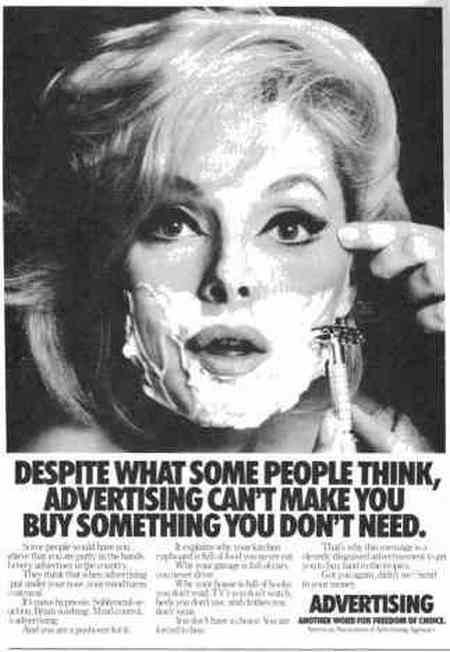
-
Despite what some people think, advertising can't make you
buy something you don't need.
For those who take that at face value, can I interest you in a very large bridge that ends up in Brooklyn?
P.S. Web searches using terms like "weird advertising", or "vintage advertisements" will turn up even more - and perhaps weirder - examples. You might want to block out a whole afternoon.
1 January 2018
Próspero año nuevo.
I'd like to start off the [Christian] New Year by sharing perhaps the most relevant piece of insight I've come across in many months of reading and research. It's the notion that boys learn more about being men by doing everything they can to be "not feminine" than they do from their available male role models.
That's the genius of homophobia, and [still] the reality of our post-modern society. We can only hope, with recent developments in the acceptance of alternative lifestyles in up-tight Amerika/Britain, that this path of socialisation gives way to something more healthy, soon.
In fact, why don't we make it our New Year's resolution as a culture?
[NOTE: The scholar in me insists on giving credit for the insight reported above: Stevi Jackson. Childhood and Sexuality. Oxford: Basil Blackwell, 1982: "Boys seem to acquire masculine characteristics as much by avoiding anything feminine as by imitating men directly; the models most available to them are not men they actually know, but fantasy figures from television screens and comics." (p.87)]
3 December 2017
The bandwagon of sexual harassment (and assorted other indiscretions, all containing the word 'sexual') is rolling like the bank is about to close.
Me? I'm not convinced yet that the iceberg has surfaced completely. I do believe that sexual manipulation (the pun is partially intended) in the workplace and elsewhere - while it will never disappear completely - will now be much more difficult to pull off (sorry), and that's a positive and overdue development.
Sexual harassment is not a 'man' thing, it's a 'position' thing. (And that's my last opportunistic pun, I swear.) In other words, it's the powerful position that makes it happen, not the fact that the person usually occupying the position is a man.
So, why has the recent flurry of accusations - for, so far, that's virtually all that has been forthcoming - failed to convince me that we're seeing the whole picture? Let me put it this way: When men bring claims against women in power, and more men against men, and women against women, the balance of a situation like that will look to me more like reality.
There is no doubt in my mind that sexual favors are required and granted in every combination that the variety of human behavior makes possible. I agree that (some) men are scum. I must also stick to my gut here, and believe that (those) men are not the only ones cleaning their dip-sticks when the parties are over.
1 December 2017
There's a lot of talk these days in Washington (and elsewhere) about "zero tolerance" for various types of misbehaviour.
I firmly don't believe in zero tolerance. Except for hypocrisy.
26 November 2017
In my neverending search for Truth, Justice and - well, you know - I've just encountered a medical book from the century-before-last (XIXth) by H.R. Stout, M.D., in which he notifies America that masturbation - which he also calls "Onanism" - is "a very degrading and destructive habit." He cautions that among the sequelae (things that can happen to you when you "do it") are epilepsy and premature old age. For females, in addition to these horrors, you risk menstrual derangement (huh?) and strange nervous symptoms.
But hey, here's the kicker. Among the homeopathic cures (basically, home remedies) that can be used to treat this malady is . . . wait for it . . . cannabis! He explains further, "Of the remedy selected, take a dose (six globules) morning and evening." (H.R. Stout. Our Family Physician. Peoria IL: Henderson and Smith, 1885, pp.333-334.) Yeah, baby! (He doesn't specify whether you should take the dose before or after the act itself.)
My friends in Peoria, and elsewhere - I'm not making this up! (Click here to read pages 333 and 334 for yourself.)
25 November 2017
The Cronkite School of Journalism and Mass Communication at Arizona State University has rescinded the Walter Cronkite Excellence in Journalism award they gave to journalist Charlie Rose in 2015. They referred to this as a "reversal of history", a phrase which is both refreshingly honest and troubling.
The University of Kansas School of Journalism also has announced they will revoke the White National Citation award they bestowed on Rose earlier this year.
The fact that these actions are as a result of accusations, not (as of this writing) convictions or proof of legal or even moral wrongdoing, are not even the fundamental problem. The question in my mind is this: Are the awards given by these schools recognizing journalism excellence, or the degree to which the journalist conforms to the culture's current definition of appropriate behavior?
I don't condone sexual harrassment in professional settings. I also don't believe that regard for professional excellence should be contingent on peripheral behavior that is not directly related to the profession. And I certainly don't believe that revision of history is justifiable, particularly when it results from hysteria, accusations before proof, and the rush-to-judgment pressure of a social media world.
4 November 2017
"Coming of age" is a common term, almost always used in reference to boys. It used to mean accepting responsibility in the adult world. It has come to mean reaching the all-important goal of "getting girls".
This is a result of a social pressure which Adrienne Rich labeled "Compulsory Heterosexuality". (Ironically, Rich was writing at the time about lesbian issues.)
By the way, this insight of mine came again to my attention after nearly 30 years, as I was going through old files in preparation for a new writing project. I wrote it as a note on a clipping from 26 April 1988, a review of the British film East of Ipswich. Apparently, there's nothing new under the Media.
31 October 2017
We're knee deep in a flood of copy-cat accusations of sexual harrassment and assault against a widening array of powerful men. Sexual harrassment as a condition for employment or advancement is wrong, and should be prevented by the economic interests in control of the perpetrator (management, boards of directors, advertisers and so forth). Yes, it was once accepted and expected in some professions. It is no longer OK. The rules have changed. The piper is waiting to be paid. Sexual assault also is wrong. Assault of any kind has been wrong as long as anyone can remember, and the laws against it can and should be used to deter and punish any such activity. Jails are waiting.
So, the above takes care of a portion of the flood we're knee-deep in. There is, however, a significant number of accusers who are taking up space on the bandwagon. This is happening for one, or both, of two reasons: personal (financial) gain - the American dream - and the growing power of women to gain control of society. Notice I (consciously) used the phrase "control of society", not "equality in society".
I am, and will continue to be a feminist. I signed on, however, as an equality feminist (what I would call a constructive feminist if more people understood the meaning of that term). Some years ago, however, the control feminists (my preferred term here would be defensive feminists) hijacked the movement, because their path was quicker and more beneficial (lucrative). That puts me and other men and women in our "camp" in the position of having to continue the fight for equality. 'Taint fair, Phyllis.
28 October 2017
Astronomer Carl Sagan (1934-1996) wrote the following in his article "The Burden Of Skepticism", in The Skeptical Inquirer, Volume 12 Number 1, Fall 1987:
-
I believe [the dumbing-down of science] is also the fault of the
educational system. We do not teach how to think. This is a very serious
failure that may even, in a world rigged with 60,000 nuclear weapons,
compromise the human future.
I wonder where he ever met Donald Trump way back then!
27 October 2017
Old people (and kids) say the darndest things. While going through some ancient files to find relevant items to digitise for posterity, I ran across a story about a town in Pennsylvania where, at the time of the newspaper article, an underground coal fire had been burning for 30 years. The article, published in the Los Angeles Times on 11 May 1992, describes how the town is decimated, but a few die-hard old-timers wouldn't think of leaving. Like 95-year-old Maude Howey. She - to say the least - didn't mince words:
-
If one of them fellas comes here and tells me I have to move because of the
fire, I know what I'll say. I'll say, 'I was born and raised in this house,
Sonny, and you're so full of crap, your hat don't fit.'
I'd like to think Maudie is still in Centralia, PA, sitting on her porch with a shotgun.
10 October 2017
I'm reaching my limit of tolerance for those who rely on political correctness to leverage their position in society. This includes all minority or discriminated-against groups that I've fought for - gladly - in their struggles for equality. Leveraging with political correctness goes beyond equality. Those who use it are babies, screaming just to get more food, and using social media as their nursery.
I just read a story online. Before another word, let me acknowledge that it may be a planted story, a joke, "fake news", a spoof. I understand that. It doesn't matter, because the incident it describes could easily happen in post-modern Amerika.
The story reports that a probationary fireman in Detroit brought a gift to his new firehouse, a tradition for those joining the force. The gift was a huge watermelon, with a pink bow on it. See where this is going? The racial makeup of the firehouse is predominantly black. The article clearly implies that the choice of gift was meant as a joke. It didn't matter. The man's probationary employment was terminated.
I can't even continue this analysis, as the response, if true, is just too infuriating. I feel like going downtown and spewing racial and sexist slurs (which I neither use nor condone) just to taunt the idiots poised to denounce me on Twitter. BITE ME. There. A little better.
7 October 2017
With all due respect and support, I believe it is time for the feminist movement to do some course-correction. Having taught Women's Studies myself for three years at two universities, (1983-1986) I believe I am qualified to make this suggestion without fear of unfounded sexism accusations. I fully and absolutely support and insist on equality of every kind for women and girls.
The news recently has reported a number of stories that indicate to me feminist ideology has gone beyond the point of equality, into murky areas of political advantage-taking and manipulation. In brief, feminist advocates allege sexism and sexual harrassment with minimal or no question by press nor public, often denying a fair assessment of the other side. I will take three examples to make my point.
1. Carolina Panthers quarterback Cam Newton (28), at a news conference on Wednesday, 4 October 2017, was asked by (female) reporter Jourdan Rodrigue of the Charlotte (NC) Observer about the rather technical football practice of "passing routes". Newton responded, with a sly - some might say shy - smile, that "It's funny to hear a female talk about routes." He thought for a moment, then repeated, "It's funny." (Source: CNN online, and elsewhere)
Jourdan took offense, social media pounced, the NFL quickly sided with the reporter, and Newton fairly grovelled for the next day and a half, apologising as some of his endorsement-deal sponsors dropped him like a career criminal.
Like any other average citizen, I don't know all the details. I depend on what I see and hear in the media to make my judgements. From what I have seen, however, the football player could easily be just a young man, in an all-male sport with all-male mentors and coaches, reacting honestly to being surprised at hearing a female talk about his business in such a technical, knowledgeable way. Surprised is not the same as insulting or, as Newton chose to characterise it in his apology, "disrespectful". In any case, in my opinion, his comment was not even close to shocking and disheartening, as his sponsor Oikos yogurt described it when they severed their relationship with him.
2.Newly-installed U.S. Secretary of Education Betsy DeVos recently rescinded previous government policy, and called for colleges to more fairly "balance the rights of accused students with the need to crack down on serious misconduct" (New York Times, online).
Victims' advocates went apoplectic. I'll speculate on why in just a bit. First, let's look at this position: no tolerance for sexual assault misconduct, and at the same time fair treatment for accused students. In gender terms, that's protection for women and fairness to men. I assume "fairness" in the second part to be similar to the legal, indeed Constitutional, concept of "presumption of innocence" until proven guilty. If proven guilty, then fairness would logically include punishment.
How can anyone argue with this in theory? (If practical application falls short of these parameters, then, of course, people can and should complain.) By expressing their outrage, victims' advocates clearly are saying - without saying it - that the accused (i.e., the men) in these cases, simply by virtue of the fact that someone has accused them, don't deserve to be heard, and any hint of the "rights of the accused" returns women to their previous (unacceptable) subservient and voiceless status. Buzh-wah. Bull-roar. As the British might say, Bollocks!
3.The New York Times reported on 5 October 2017 that Hollywood producer Harvey Weinstein took a leave of absence from his production company after several decades worth of sexual harrassment claims and, apparently, some settlements, came to the forefront when Lisa Bloom, a lawyer previously advising Weinstein, resigned on 30 September. That's the background, and it's both grim and indefensible, if true. True sexual harrassment in the workplace is unacceptable.
Here's the problem: in a statement, Weinstein said "I came of age in the 60s and 70s, when all the rules about behavior and workplaces were different. That was the culture then." Just about everyone scoffed into their lattes, dismissing this as the lamest excuse from Hollywood or anywhere else to try to explain away sexual misconduct. It was a lame excuse for decades of alleged misconduct, but the claim itself was not wrong.
This morning (Sunday, 8 October 2017), on NBC's Meet the Press, Washington Post columnist and respected pundit (well, I respect him) Eugene Robinson echoed what a number of others have said, claiming that he remembers the 1960s, and the kind of behavior engaged in by Weinstein was never OK. Mr Robinson, and others making this claim, are wrong.
That was the culture then. Sexual (mis)conduct in Hollywood and American business in general simply wasn't open for discussion by the general public. Those who didn't know about what went on just didn't know. Those who did know what was shakin' may have talked about it, but didn't question it. The attitude was that it was nobody else's business. No, of course, that doesn't excuse continuation of the behavior into recent decades as society and the rules changed, but in the 1960s and 1970s, the simple fact is that the rules were different. That is feminism's inconvenient truth, and revising history to say it wasn't so is just as unacceptable as the activities themselves.
It's sort of like slavery. Calm down, at least until I make the point. (You might end up having to agree!) In the American South in the 1700s and early 1800s, slavery was acceptable. Gradually social standards changed, equality became the custom and then the law, and slavery was abolished. Claiming that slavery was just as wrong then as it would be now is reasonable. It is wrong, it has always been wrong by the standards we now accept as a people. But to say that it wasn't acceptable then is simply incorrect. It is similar to claims that evolution is wrong, or that the holocaust in Europe in the XXth century never happened. Revisionist history is a devious, destructive technique that some people and groups use to justify their political positions. Revisionist history must be rejected every time it rears its ugly head, regardless of the unpleasant reality it wishes to bury.
In general, some women find themselves in a position now to exploit modern attitudes against sexual misconduct on the part of men and they milk it for all it's worth, with defensive feminists (who are different from constructive feminists) supporting them all the way to the bank using sophisticated social media prosecution tactics. This is not equality, it's unfair advantage - hence my call at the beginning of this rant for some "course-correction". My goal is absolute, complete equality. Unfair advantage for either "side" simply doesn't meet that standard.
23 September 2017
Every television sitcom, especially those featuring and intended for teens, has a few standard plots that the writers use without fail. The bowling show; the sports team winning after a losing season; the school bully; and, of course, the sex talk given by uncomfortable parents.
Around 2000, another common situation was added: a main, white, male, teen character in the show falling for a non-white girlfriend. In chronological order, here are the examples I've seen - and I don't watch everything on television, I assure you:
- Boy Meets World, ongoing, beginning in "Boy Meets Real World" (10 October 1997)
Shawn Hunter (Rider Strong) meets Angela Moore (Trina McGee Davis), beginning a long relationship that lasts the remainder of the show's run (to Season 7, ending in 2000). - Malcolm in the Middle "Lois's Birthday" (12 November 2000)
At first sight, Francis (Christopher Kennedy Masterson) falls for Amaani (Blair Wingo), a young African woman on a tour of wherever Francis's family lives in America (it is never specified in the series). Luckily she speaks English, as Francis, unable to wait for a more suitable venue, makes out with her in the family's front yard. Later in the series, Francis surprises the family by announcing his marriage to a Native American (Eskimo) woman he met in Alaska, Piama Tananahaakna (Emy Coligado) ("Hal's Birthday" [3 March 2002]); she becomes a recurring character for many episodes (and situations). - The Zack Files "Sparkin'" (12 February 2001)
Toward the end of Season 1 (the show ran two Seasons), Zack Greenburg (Robert Clark) hooks up with Sarah (Shadia Simmons), his on-again, off-again girlfriend well into Season 2. Zack's buddy, Cam Dunleavy (Jake Epstein), follows suit, as it were, in "Frog Prince" (3 December 2001), temporarily deserting his love interest, Emily (Barbara Mamabolo), when Zack turns him into a frog. - That '70s show "Hyde Gets the Girl" (9 October 2001)
Steven Hyde (Danny Masterson) gets set up by his friends for a chance to meet the woman of his dreams. That woman turns out to be Melissa (Reagan Gomez-Preston). - Even Stevens "My Best Friend's Girlfriend" (22 March 2002)
Alan Twitty (A.J. Trauth) is enjoying his new relationship with Allison Wong (Tania Gunadi), and best friend Louis Stevens (Shia LaBeouf) feels left out. - Two and a Half Men. Near the end of Season 3, in "Just Once With Aunt Sophie" (8 May 2006), Jake Harper (Angus T. Jones), at age 12, becomes old enough (so the writers believe) to embark on a love-life, and falls pretty hard for classmate Wendy Cho, who invites him to his first boy-girl party. All we know about Wendy is what Jake tells us, and a comment from Charlie (Charlie Sheen) that she's "cute" when he sees her open the door at her party. She never appears onscreen. While it is obvious she is Asian, this is absolutely a non-issue for Jake. His view of her is that she's gorgeous, smart and plays the violin. Wendy breaks up with Jake in "A Pot Smoking Monkey" (9 October 2006), and he is crushed. He explains to Charlie that Wendy decided she has a problem with "mixed relationships". "What," Charlie asks, "Chinese and Caucasian?" "Gifted and remedial" Jake replies.
What's interesting to me about these is not the fact that they happened: since the fact that the relationships were interracial was never the issue, and not even mentioned, to me it's an indication 1) that race relations have changed for the better since the 1950s (with still a ways to go, most people will agree); and 2) that sitcom writers/producers wanted to exploit the new attitudes in America with some minor shock value. Fair enough.
What is interesting to me is that I have never seen the flip-side version of such an interracial matchup, namely the white girl with the black (or other non-white) boy. (Anyone with information to the contrary is encouraged to let me know.)
Again, I don't watch everything on television, but if I noticed the four above, you'd think I'd catch the flip version if it existed. Intriguing.
7 September 2017
What's wrong with media-saturated commercialism? Some say it's nothing more than the current face of inevitable social change, and is a good thing. They tell me to "get real", and stop whining, that every generation complains about the breakdown of their former ways of life. (Cicero: "O TEMPORA, O MORES", Oratio in Catilinam Prima, 63 BCE)
Au contraire. Allow me to elaborate:
Media-saturated commercialism is focused on the immediate. Long-term life and concerns are not important. Immediate gratification (read: profit) is the goal. How many times have you heard, "Hurry - while supplies last - don't delay - take advantage of this offer before it's too late."
We used to have great music. Today, X artist's new album drops Tuesday, Y's drops Thursday, and Z's next Monday. Then X's next album hits the charts in another week or so. (The fact that they all use the same limited formulae and sound the same doesn't seem to bother anyone!)
We used to have great films. Today, the blockbuster succeeds only if it is bigger than last month's blockbuster.(The fact that they all use the same limited formulae and look the same doesn't seem to bother anyone!)
The culture is obsessed with fun. In the past, fun was earned (and consequently appreciated). Today, fun is bought (and consequently more, and more, and more constantly is needed.) The job has to be fun. School has to be fun. And it all has to fit into the classic "three minute segment" programmed into our brains with popular songs and firmly institutionalized by MTV. Creativity? REQUIESCAT IN PACE
Social scientists call this lifestyle puerilism, which means basically, eternal childhood. Its hallmark is instant gratification without any pesky personal responsibility. Entitled children become entitled adults, and there's no reasoning with them about what's acceptable behaviour around other people. Acceptable is what they want at the moment.
Sainthood for Mother Teresa? The public clamored for her to be put on the "fast track". Someone is accused of a crime? The public regards them guilty until proven innocent, and even then guilty seems to stick until the "court of public opinion" decides otherwise.
For those who don't quite get the message, let me close with an example from the XXIst century's dominant religion: Sports. The "love of the game" is dead, buried, and rotting. The motivation today is Money.
If you've read this post this far, you're one of eight (or so). Congratulations, and good luck.
28 August 2017
Big Brother isn't who I thought he would be. Since my earliest awareness of Orwell's 1984 (1949), including dramatizations on television and in the movies, I always thought the unseen tyrants were The Government. It turns out that the entities spying on and controlling us - whose conquest of society, by the way, is virtually complete as I write - are the huge corporations of the world, primarily the media-related businesses known as Google, Microsoft/Apple and Amazon, and the social-media platforms such as Twitter and Facebook.
Every "app" you install on your phone or elsewhere is designed to gather and send back to the source information about your behaviour. EVERY APP; furthermore, ALL of your activity on any of the above-named platforms or with any of the named businesses (and a lot of others) generates permanently-stored information about you and your patterns. The manipulation we can see is advertising (though not nearly enough people recognize it as manipulation). The information collected quietly behind the scenes drives that advertising to the goal of maximum profits.
The notion that this information can also be useful to government entities for some futur(istic) social oppression is a no-brainer. That is the core of what Edward Snowden was/is trying to tell us.
For those of you who still have to live through several more decades of this, and for your children and grandchildren (and beyond?), good friggin' luck.
15 August 2017
People are losing their jobs and fearing for their lives simply because they exercised their right (in America) to free speech. (The Constitution of the United States, First Amendment, guarantees the right of free speech, which the Supreme Court of the United States has limited only in a very few situations where one's free speech comes in conflict with specific rights of other citizens.)
Without naming names and businesses involved, here's an actual case that simply should not have happened: after being "called out" on social media as one of the White supremacist marchers protesting the removal in Charlottesville, Virginia of a statue of Confederate General Robert E. Lee, a man lost his job at a fast-food restaurant.
What does this mean? It means that the majority of the moment can have their way - without due process or dialogue from the other side - by brute force, in this case via Twitter/Facebook/Instagram/&c. This is not only wrong - this is not only dangerous in the long run - this is a case of using the very tactics that one is complaining about the other side using. It is anti-hate protesters, who are against the White supremacist position that certain people (e.g., Muslims, blacks, immigrants - this week) should be excluded from society, using tactics that result in White supremacists being excluded from society simply for expressing their views. White supremacists who burn, lynch or mow down people with their cars are a different story. What I'm worried about here are people who simply hold, and express in public views that are unpopular.
I believe that White supremacists, and all groups and individuals who believe they are naturally better than anyone else, are scum. I also believe that anti-White supremacist activists who Twitter-shame their foes simply for expressing their views are in the same category - scum. I would favor a law, similar to laws against defamation of character, slander and libel, that criminalizes activities like Twitter-shaming when the target has only expressed her or his views. Twitter-shaming places guilt by implication - the notion that just because someone showed his face at a rally that he is also responsible for the nut-job that kills some people by swinging an axe in a crowded street - and that (in my opinion) is criminally unfair.
Lynching is uncivilised and un-American. So is the use of mob psychology via social media to bring about a desired outcome. In the long run, hate that is met with emotion-fueled revenge solves nothing.
Footnote: I just read in the New York Times online about people falsely accused (and Twitter-shamed) of being one of the racists who carried torches at Charlottesville. This is a result of rush-to-judgment lunatics, blinded both by the racist torches and by the awesome power (social media) they are about to misuse. I don't know how I missed this obvious "down-side" when I wrote the above blog. Like any false accusations, once out of the box, it is extremely difficult for the innocent victim of (what I now know is called) "doxxing" to recover, perhaps ever. All the more reason for some kind of legal redress for this injury, as I noted above.
11 August 2017
According to an online report by USA Today, Texas pastor Dr Robert Jeffress, described as "one of President Trump's evangelical advisers", has said that God has given the president "full control" to take out North Korean leader Kim Jong Un. As evidence, Jeffress relies on Romans 13.
Whew.
For awhile there, I thought we might be contemplating nuclear holocaust without being sure that, when we all die and line up at the pearly gates, the Almighty would be glad to see us.
Now I can sleep better.
By the way, Dr Jeffress, leader of the Dallas First Baptist megachurch, also has spoken out against gay, Catholic, Muslim and Mormon people, among others, though so far, he has not authorised the nuclear option for those groups.
10 August 2017
Wal-Mart is under (social media) fire for a back-to-school display that one Twitterer alleges paired guns with a sign that read, "Own the school year like a hero."
Very little surprises me any more. Yes, of course, the photo could have been digitally altered, and Wal-Mart is both denying and investigating the incident.
It doesn't matter. whether real or spoofed, its virality on social media is evidence of the presence of guns in schools and in the popular consciousness. It's like, once the duck is shot, it can't be un-shot. Deal with it, but know this: ignoring it is not an option, and a big firestorm about it is probably not a good option either. Extreme public outrage has the effect of dealing with the symptom, while leaving the cause to rise again in another get-up.
26 July 2017
Last night I had a brilliant idea for the title of a book. But I'd better hurry and write it, if I'm going to have it ready in time:
-
The Presidency of Donald Trump and How it Changed America
for the Better: One Man's Spectacular Failure as the Salvation
of Post-Modern Media-Driven Society
Of course, now there may be no need to write the book. The title probably says it all.
11 July 2017
The 2016 film A Monster Calls begins with a remarkable, and encouraging, voiceover prologue:
-
Conor O'Malley (Lewis MacDougall): How does the story begin?
Monster (Liam Neeson): It begins like so many stories. With a boy, too old to be a kid, too young to be a man.
It's remarkable and encouraging because it is a rare recognition in modern times that adolescence is not childhood. The implication for me - and the film's core message bears this out - is that adolescents have responsibility, and must be allowed control over their lives as they approach the full responsibility of adulthood.
7 June 2017
Edward Snowden's story still has a lot of chapters to be written. You can think what you want about his actions - for exposing the data collection practices of the National Security Agency, you can say he's a patriot or you can say he's a traitor - but don't let either label get in the way of hearing and evaluating his views, his philosophies, his motivation as a human being.
This is worth sharing in detail, so get ready for a bit of a journey.
Around the time of the premiere of Oliver Stone's film Snowden (2016), a panel discussion was held with Stone, the two principal actors in the film - Joseph Gordon-Levitt, who played Snowden, and Shailene Woodley, who played Lindsay Mills, Snowden's girlfriend - and moderator Matt Zoller Seitz all in one theatre, Edward Snowden himself via Internet connection from 'somewhere in Russia', and a number of other audiences in various theatres around the country. A video recording of the event is available on the Snowden Blu-ray as a Bonus program.
During the interview, moderator Seitz asked Snowden to comment on a common feeling some people have, that "If you aren't doing anything wrong, you have nothing to worry about." Seitz asked Snowden, "What would you say to someone who said that?"
"We all have a duty,", Snowden said, "sort of collectively in society . . . to think about when we're being manipulated, when we're being sort of directed to think a certain way, and accept a certain argument reflexively without actually tackling it. The common argument that we have, 'If you have nothing to hide you have nothing to fear,' the origins of that are literally Nazi propaganda. This is not to equate the actions of our current government to the Nazis, of course, but that is literally the origin of that quote. It's from their Minister of Propaganda, Joseph Goebbels. So when we hear modern politicians, when we hear modern people repating that, reflexively, without confronting its origins, without confronting what it really says, I think that's harmful. And if we actually think about it, it doesn't really make sense, because privacy isn't about something to hide. Privacy is about something to protect, and that's 'Who you are', that's 'What you believe in', that's 'Who you want to become'. Privacy is the right to the self. Privacy is what gives you the ability to share with the world who you are on your own terms, for them to understand what you're trying to be, and to protect for yourself the parts of you that you're not sure about, that you're still experimenting with. If we don't have privacy, what we're losing is the ability to make mistakes. We're losing the ability to be ourselves. Privacy is the fountainhead of all other rights. Freedom of Speech doesn't have a lot of meaning if you can't have a quiet space within yourself, within your mind, within the community of your friends, within your home, to decide what it is that you actually want to say. Freedom of Religion doesn't mean that much if you can't figure out what you actually believe, without being influenced by the criticisms and, sort of, outside direction and the peer pressure of others. . . . Privacy is baked into our language, our core concepts of government itself in every way. It's why we call it 'private property'. Without privacy you don't have anything for yourself. So when people say that to me, I say back, 'Arguing that you don't care about privacy because you have nothing to hide is like arguing that you don't care about free speech because you have nothing to say.'"
In an age when social media invades most people's lives to the core, not to mention the fact that the above interview was conducted in the middle of the 2016 Trump-Clinton campaign for the presidency of the United States of America (another story that has many as-yet-unwritten chapters), these ideas couldn't be more salient.
15 May 2017
Boys in capes. And, gradually more and more, girls in capes. The image is used in advertising, especially, to symbolise power and control. Children play with them for the same reason - to rise above everyday circumstances into fantasy and adventure. All good.
Society encourages capes and superhero fantasies as part of the healthy encouragement of imagination and limitless goals.
Then we fail miserably during adolescence to help children transfer those feelings and aspirations into the reality of adulthood, to incorporate soaring in a cape and imagining oneself achieving wondrous things against all odds into their everyday lives as small fish in very big ponds. An adult figuratively running around in a superhero cape and (truly) thinking outside the box doesn't mesh well in a post-modern mega-society. Conformity works better.
10 April 2017
Tristan Harris hit the airwaves today (CBS This Morning) and a few days ago (60 Minutes, with Anderson Cooper interviewing) with an overdue exposé of how the companies in charge of communication media, including online sources of news, use highly sophisticated psychology-based techniques to snag and keep the attention of social-media users and viewers.
Harris was a dot-com entrepreneur, then went to work for Google, and now is campaigning to inform the public about the dangers he perceives. He couldn't be more right, of course, yet his message just may get buried (according to the online stories about his message) because the companies manipulating social-media users probably don't want this message to get out. All the more reason to pay attention, I say.
Harris notes that many people deny the problem, and their own addiction, even the adverse effect on malleable young people. "There's a narrative," he says, "that, 'Oh, they're just doing this like we used to gossip on the phone.' But what this misses is that your telephone in the 1970s didn't have a thousand engineers on the other side of the telephone who are redesigning it to work with other telephones, and then updating the way your telephone worked every day to be more and more persuasive."
The nutshell version is contained in this exchange on 60 Minutes, reported in an article posted on www.cbsnews.com/ on 9 April 2017:
-
Anderson Cooper: Is Silicon Valley programming apps or are they
programming people?
Tristan Harris: Inadvertently, whether they want to or not, they are shaping
the thoughts and feelings and actions of people. They are programming
people. There's always this narrative that technology's neutral, and it's
up to us to choose how we use it. This is just not true.
Cooper:: Technology's not neutral?
Harris: Its not neutral. They want you to use it in particular ways and
for long periods of time. Because thats how they make their money.
He summed it up himself: "The game is 'getting attention at all costs.'" He, and I, believe the costs are staggering and unacceptable.
I couldn't have said it better myself, even though I've said it before (see elsewhere in this journal blog).
Social control is upon us. I heard it directly from my Big Brother.
To Tristan Harris: Thanks, and I hope your message gets heard.
2 April 2017
On his Wikiquote page, it is noted that Sir Thomas Beecham was once asked if he had ever conducted Stockhausen¹. "No," he replied, "but I once trod in some."
(¹Karlheinz Stockhausen [1928-2007], German composer noted for his experimental work in electronic, atonal and aleatoric music.)
18 March 2017
News Item (an actual one): Trump says his claim about British government wiretapping him was something he repeated after he heard legal analyst Judge Andrew Napolitano make the claim on Fox News. (CNN, 17 March 2017)
Interesting. Who knew when The Donald claimed everything is Fake News that he was talking about his own Tweets.
7 February 2017
A video surfaced today that broke my heart. I have supported, even championed the candidacy and work of Hillary Clinton for decades. My trust and support has been betrayed, as the video shows her, with smile beaming, uttering the words, "The future is female."
I can only repeat to her a mantra that I used and utterly believed in thirty years ago, when I taught Women's Studies (Gender Studies) at two universities while finishing my graduate work:
It is not acceptable for one gender - or one race or one class or one anything - to dominate society. Equality is the only acceptable goal.
If Hillary is right, that the future is female, then we're just going to have another gender liberation cycle. In a world where there are so many other challenges to diversity and equality, that would be a monumental waste of energy.
31 January 2017
President Trump's executive order temporarily banning immigrants from Syria and subjecting all visitors from seven predominantly-Muslim countries to possible detention or denial of entry into the United States of America should leave no trace of doubt: the mantra of his inauguration speech, "America First", is code, as are all his slogans and promises. What it really means is "White, Christian America only - all others need not apply".
When a powerful businessman uses code, he rationalises with excuses - Oh, sorry, I mean reasons. We need to put "America first" in blocking admission to the Holier-Than-Thou United States, because terrorists might visit, stay, and endanger our (White, Christian) citizens. (Forget about the fact that no perpetrator of the few, horrible terrorist acts of the last fifteen years has come from any of the countries whose nationals are now blocked or restricted. Also forget about the fact that most of the perpetrators of the attacks of 11 September 2001 were Saudis, yet Saudi Arabia is not on the list. I said forget about it, OK?) We need to put "America first" in trade, because American jobs are lost when we buy goods at cheaper prices from foreign businesses. (Oh, but just one thing before you go away: If we have something to sell in foreign markets, we assume you'll keep buying from us, even if your citizens lose jobs as a result.)
As one brilliant talking-head (pundit) put it a few weeks ago, this is part of "the new abnormal".** Fine. I can endure it, just as long as we bring everyone up to speed - especially young people in school whose trust in the world and social systems must be earned, not assumed - on how to read "code" and how to translate "doublespeak" (George Orwell. 1984. London: Secker & Warburg, 1949).
Speaking of Orwell's 1984, I understand from The New York Times
Editorial page (30 January 2017) that the sales of that book, as well as
other dystopian essays such as Aldous Huxley's Brave New World
(London: The Folio Society, 1937) have increased dramatically since the
United States of America lost its mind and elected Donald Trump, the
people of the United Kingdom went crackers and shoved "Brexit" up
the European Union ("two fingers", mate!) and other
trembling White, Christian minority wealth-holders are following suit.
Good. Moby Dick and Wuthering Heights have been
High School required reading for too long. Make way for the new writers,
Aldous and George, and the fresh, invigorating ideas that just appeared
on the scene only sixty (60) to eighty (80) years ago!
(Note the sarcasm, please!)
_______________________________________
-
**It is not clear to me who first floated the phrase "the new
abnormal", and it is such an obvious and apt description of the
times that it could have been any of hundreds of commentators, so I'll
just leave it where I found it: "pundit".
30 January 2017
As both sides (there are only two???) gear up for their predictable roles in the new United States president's nomination of a Supreme Court justice to replace the late Antonin Scalia, the shooting script begins to read more and more like two Middle School bullies fighting to control the dodge-ball turf at recess. Unfortunately, the spoils to the victor are a bit more valuable than the geeks' lunch money and easy sex with the head cheerleader or the captain of the football team (whichever is their preference).
The Trump administration, even though they have the honour of the opening gambit, are defensive out of the gate (metaphors are my life!), preparing the world to expect The Democrats to oppose whomever is nominated. Kind of like what The Republicans did with President Barack Obama's last nomination, Merrick Garland, except that Democrats' opposition now will have to be for substantive disagreements and/or lack of qualification, while it was crystal clear that Republican opposition to Judge Garland was ossified insistence that Barack Obama wasn't going to get anything through Congress. Nyah! I think.
The Democrats, on the other hand and across the aisle, are trying to look constructive, saying they will consider a nominee who is "faithful to the Constitution" and represents mainstream American jurisprudence. (Too bad nobody in any court or Law School in the world can define that term.)
I think they should all just pull up their pants and go home, and we can just have a re-do of the election. Ahhhh. fantasy. It's all we got left! It's also what got us where we are today. (Where did you say we are?)
20 January 2017
Until today, Donald Trump, as the officially-elected 45th president of the United States of America deserved my grudgingly open mind, waiting, with hope for the unlikely, to see what he would do with his awesome new power.
Trump dashed my hope, and squandered my support, in his inaugural address today by his egregious use of one word: "God". Now, I believe in God at least as much as the average skeptic, as a source of inspiration and spiritual help to those who choose Him as their inspiration and spiritual help. Trump's invocation of God, however, was unacceptable on two counts, one patent and one coded.
The coded message, all too clear if you're listening between the lines, is that Trump's God does not include Allah, nor a non-specific "superior being", nor even "The Force" of Star Wars fame. It is, quite simply, the Christian God that most of Trump's followers believe was responsible for the formation of America itself.
The patent message, unacceptable in any society since the Middle Ages, is that America will succeed (i.e., crush the rest of the world when it is in America's interests) because God is on America's team and, by implication, everyone else is Godless. The fact that - as the tenets of any jihad will tell you - God (in the form of Allah) is rooting for the success of The Righteous over The Infidels is inconvenient at best.
As a firm admirer of the wisdom of the United States Constitution, I am now officially in mourning for the death of "separation of Church and State". Let's hope it might rise again at the 2018 midterm elections (assuming God doesn't cancel them).
17 January 2017
Regarding the 2016 election of Donald Trump as president of the United States of America:
- there is no evidence of any significant vote-tampering by Russians or anyone else on election day.
- It is not a contradiction of the above to say that Russian interference
(via cyber-hacking) significantly affected the outcome of the election in
Trump's favor, even to the point of claiming that without Russian
influences, Hillary Clinton would have won.
In a way, Trump's apologists are getting away with murder when they shut down criticism by the (true) claim that no measurable voter fraud turned the election in their favour. "There are more ways to kill a cat than choking it with cream." --Charles Kingsley. Westward Ho!. Leipzig: Bernhard Tauchnitz, 1855.
14 January 2017
Donald Trump and his spokespuppets - such as his official adviser, Kellyanne Conway - often repeat the mantra that because of the way Trump ran his campaign, he takes office "owing nobody anything".
Wrong-o, Chief.
He owes the voters, and now the American people, plenty (as would anyone elected to this office). Will he deliver on his promises to include all classes of people in his "Make America Great Again" revision of the society? We'll see.
In the meantime, I reserve the right to change the "We'll see" in the paragraph above to, "Yeah, right!" anytime I want.
11 January 2017
To media-watchers: Is there anyone who doesn't think that the leak earlier this week of a 35-page dossier claiming irregularities in Donald Trump's dealings with Russia came from the Trump organisation itself? Come on, a show of hands. I didn't think so.
Think about how convenient it was. It was easily dismissed as "fake news", since the campaign leading up to the election was loaded with such forgery (some certainly planted by Trump's team). Its timing, just hours before Trump's first press conference in many weeks and his first as president-elect, effectively deflected attention away from Trump's business dealings and potential conflicts of interest, which otherwise would have been center stage, and which Trump really, really doesn't want to deal with.
Allow me to propose one further possibility: what if the allegations in the dossier are actually in large part true, and Trump's team calculated that releasing them in such a way that they could be labeled "fake" would pre-empt their release by Trump's critics? Talk about killing seventeen birds with one stone . . .
I have a deep and abiding feeling - and I'm not by any means alone in this - that we are in for a dizzying rollercoaster of calculated misinformation and manufactured "truth", which may just become the new normal as we enter the Reality Show that is the presidency of Donald J. Trump.
A free, vigorous and uncompromising Press is more important now than ever before.
10 January 2017
I'm not an economist - lately I'm not even particularly economical - so it was sort of a surprise recently when I stumbled into some of the ideas of John Kenneth Galbraith (1908-2006), one of president John F. Kennedy's advisors and a prolific (liberal) writer. His view of society is generally described as a belief that the "free market" is not operational at top levels, and that society is controlled by the self-preservation interests of large corporations.
Ya think? Note that he was expressing these ideas over forty years ago. Rather than quote him here (there are so many writings relevant to these ideas and, to be sure, relevant to recent developments in politics, from the Tea Party movement of a decade ago to today's Republican control of the executive and legislative branches of the United States government), I'll just suggest you visit my selection of quotations and search "Galbraith"; or, even better, the Wikiquote page on John Kenneth Galbraith.
One doesn't have to think Trump, Republicans, conservatives or big corporations are wrong to respect, even believe Galbraith's positions. I said I wasn't going to quote him, but I really must include just one:
-
The modern conservative is not even especially modern. He is engaged,
on the contrary, in one of man's oldest, best financed, most applauded,
and, on the whole, least successful exercises in moral philosophy. That is
the search for a superior moral justification for selfishness.
"Wealth and Poverty", speech, National Policy Committee on Pockets of Poverty,
13 December 1963, entered into the Congressional Record, Volume 110, 1964
9 January 2017
Donald Trump is enjoying an extended 15 minutes of fame and popularity, using - OK, manipulating by grabbing it by the testicles - the media in a world with a notoriously short attention span, using techniques suited only for grabbing attention, not long-term quality behaviour.
The fact that he governs by Twitter-feed says it all, but let's look a little deeper into the content, such as it is, for more evidence. Notice that in every single tweet re-criticising his critics - and he responds to every single one, like a spoiled child - before he describes why they are wrong, he introduces an ad hominem disparagement, tapping his audience's emotions before their intellect. This is classic manipulation, in the media or anywhere, used by bullies, preachers and bad politicians to get what they want from their gullible sheep.
Examples: during his campaign for the office of president of the United States of America, in the Fall of 2016, he was miffed about how the New York Times had treated him. Rather than simply describing what they, in his opinion, did wrong, he introduced them as "the failing @nytimes". Last night, when Meryl Streep described him - with video of the incident as backup - as mocking a disabled reporter, Trump Twittered back to deny ("for the 100th time") that he was mocking the reporter, introducing his three-part Tweet with, "Meryl Streep, one of the most overrated actresses in Hollywood . . ."
Ad hominem characterisations are masks for weakness and desperation, or sometimes just for laziness and overconfidence. They have always been a mark of short-term success and fleeting effectiveness. Whether that holds true in the media age, when attention spans are modeled on the 3-1/2 minute MTV video standard and people don't have time to think critically about content and long-term consequences, remains to be seen.
11 November 2016
The American presidential election of 2016 is now history. To say it was an unusual, even bizarre process would be the understatement of the decade.
Contrary to popular opinion, the fact that Donald Trump will be the 45th president of the United States of America is not the top story of the week; instead, the complete dominance of American stupidity must take the cake. Trump was the violinist, playing the public like a square-dance fiddle, but the real winner, the significant game-changer, is the triumph of the Reality Show method of opiating the public. The fact that Trump himself is a master veteran of the Reality Show genre is, of course, no coincidence.
The Reality Show oxymoron has reached its zenith. It consists of a Show that is the opposite of Reality - scripted, performed, and edited for content before consumption by the bloated, overfed and greedy public. It replaces, rather than reflects, Reality; indeed, most of the time it contradicts Reality. The Trump campaign was all of that. It was, by the candidate's own admission, a Show. Among his techniques, which he employed daily and with masterful precision, was describing his opponents (in the primary) and his nemesis (in the general election) in exactly the terms that one would correctly use to describe him. This is the only explanation for his repeated claim that Hillary Clinton was a racist. Once this, and other projections of himself onto his opponents, are "out there", then the same accusations can not be directed back at Trump without appearing to be petty retribution. "You're a racist." "No, you're the racist." "Take that back." "I will not." and so on, ad nauseam. Oh yes, and exaggeration. And hyperbole. And lies. Time after time, non-partisan fact-checkers were asked to evaluate his claims, and found them to be false. (This was also the case for Hillary Clinton, though much less often.)
How could a campaign like this continue, let alone be victorious in the end? Simple: the public now takes Reality Show as Truth. The fact that someone behind the scenes is making lots of money (and/or building up lots of power and influence) only makes it more likely that the Reality Show is the post-modern society's new normal.
Get used to it. Or, you could re-read Huxley's Brave New World or Orwell's 1984.
As for the impending Trump presidency, it is entirely possible that it will be relatively productive, maybe even somewhat positive in many aspects. The use of the Reality Show method of getting elected, however, likely will have consequences that will mystify many, even as they flow directly from Trump's campaign script. While Donald and Melania have tea on the upper floors of the White House, people down on the street will remember the hatred and name-calling of his campaign, and will interpret that as permission to engage in their own acts of bigotry, discrimination, even violence. O TEMPORA O MORES.
28 October 2016
The Simpsons is subversive. Most people think it's just funny. Some of us realise that it's a thorough and accurate indictment of society's misdirection in the post-modern age.
In "Waverly Hills 9-0-2-1-D'oh" (3 May 2009, written by J. Michael Burns), we find Marge downtown, trying samples of ScienceWater until she's about to burst. Desperately in need of relief, but finding a 'customers only' sign at every turn, she happens by Springfield Elementary School. As she hurries in, she rationalises, "Schools have bathrooms, and I'm a woman, so my going in won't cause a panic."
Spot on, Marge. That's about as concise and accurate as you can get in describing how men are virtually excluded from any and all situations involving children.
Of course, society will pay dearly in the long run for its convenient and false assumptions about men. In the meantime, men pay dearly.
22 October 2016
Oh. What? Why the long hiatus? I was travelling in Western Europe visiting cemeteries. So kill me for having an interest in funerary sculpture. (Look it up.)
10 September 2016
Next time you see a television show or movie (especially those made in the "good old days" before 1999 or so), and someone gets a cake from a bakery at a reduced price, before anyone reads the icing, say to yourself, "It's gonna be some kid's bar mitzvah cake." This joke is so predictable you could set your watch by it.
I mention this only to point out (predictably, once again!) the predictability of our routine entertainment fare, particularly that which is offered for our time-killing via television. It's not healthy, but it beats the alternative of shooting up our schools and looting our hardware stores. (Of course, since the abovementioned millennium, we can now depend on "smart-phones" to keep everyone busy, so they don't have to think. Time-killing for the XXIst century.)
An example - just one of many, I assure you - of the bar-mitzvah cake joke mentioned here is in "The Bunkers and Inflation - Part 3", an episode of the classic sitcom All in the Family that aired 28 September 1975. During Archie's strike, Edith has found a job against all odds, and decides to celebrate by buying a $10.00 cake for $1.00. Archie is pleased at the prospect of cake at any price, until he opens the box. "Hold it here. What is this? 'Happy bar mitzvah, Irving.' Who the hell is Irving? . . . How're we gonna eat this? This is a Jewish cake, Edith. They give this to a kid before he gets circumscribed" And the rest is television history.
15 August 2016
With apologies to Stephen Sondheim (West Side Story, 1957), "Somethin's comin', somethin' big" in the race for U.S. president.
I'm not willing to predict this just yet, but Donald Trump lately has been sounding a lot like that old joke I heard in High School: "If you're gonna play like that, I'm gonna pull up my pants and go home." (Example: The Donald's petulant whine on Friday, August 12, 2016 that "The only way we could lose [in Pennsylvania], in my opinion - I really mean this . . . is if cheating goes on.")
It's beginning to look like a possibility (not just a wishful fantasy) that the legitimate nominee of the Republican Party may just go back to Trump Tower and sit (sulk) on his golden throne - hey, you know exactly what I mean! - and they may have a different nominee in November, or none at all.
I rarely thank Republicans for anything, but if this transpires, I will send them a dozen roses. What great theatre!
11 August 2016
When society's goal is marriage, marriage doesn't work. (Corollary: Marriage entered into because it's expected is likely doomed.)
24 July 2016
In his remarks after accepting Hillary Clinton's appointment as her Vice Presidential running mate, former Sen. Tim Kaine enumerated his guiding principles in the campaign and in his career in general: "La fe, la familia y el trabajo." (Yes, folks, he's fluent in Spanish.)
I like Tim Kaine, and this is not a criticism of him so much as a shortcoming of most politicians. Their slogans, like the short litany Kaine offered, give hope to the stupid and leave the thinking people wanting more. These are not unitary concepts. It is entirely possible for Donald Trump and Tim Kaine and almost everyone running for any office to be for Faith, Family and Work, and for each candidate to mean something different by each term. The most obvious example is Faith, but the same holds for all three. A conservative can be for Faith, and mean only (or primarily) Christianity. A liberal can be for Work, and mean that rich bosses should never control a corporation and get big bonuses. A Lesbian can be for Family, and mean that children are just fine raised with two Mommies, with little or no male influence.
I won't say which of the above I would prefer, but the point is that La fe, La familia, y El trabajo each represents a spectrum of possibilities, all of which need to be supported and valued by any candidate that I will end up voting for. Otherwise Fe, Familia y Trabajo are just code words that signal special meaning just to the candidate's supporters, and we are left with the myth that we are living in a simple and predictable society.
17 July 2016
Concerned Mom, or control-freak? You be the judge. (I have my opinion!)
There is a television commercial for Jimmy Dean breakfast products in which a Mom (as usual, no Dad in sight) is seeing her kids off in the morning (presumably to school). The last to leave is a six-footer, obviously a mid-to-late teen, wearing a baseball cap facing backward - a very common practice among youth. Just before he "gets away", his Mom re-hats him so that the cap is now facing forward.
This is a subtle and minor example of a very, very big problem for the youth of today in the Western world, as it involves the core issues of individuality, conformity, self-esteem and pride. Not to mention separation from the stifling control of parents' home, which can not and should not define any young person's trajectory in the larger society where s/he must make his or her own choices.
It would be different if Mom had suggested he put his hat on straight and explained to him why she thought it might be a good idea - but that wouldn't fit in a 30-second commercial where the goal is to sell breakfast products (to Moms). So, as is so often the case, young people are left with the subtle message that Mom's brand of conformity is the right way to go, and Moms are left with the not-so-subtle message that enforcing their world-view on their kids is just fine and dandy.
Poor, pathetic kids. If I had been as poorly prepared as this for charting my own course, I'd sue my parents' generation for child neglect.
13 July 2016
Theresa May is Britain's new Prime Minister, taking office after her last challenger gave up her claim as the better candidate because she was a "mum" [for Americans, that's British for "mom"] with children, and Mrs May is not. Andrea Leadsom had claimed that being a mum gave her "a very real stake in the future of our country, a tangible stake."
Seriously?
To their credit, the British public rejected this position, ranging from high-profile public figures to low-life social media scum, all of which Mrs Leadsom characterised as "enormous pressure - it has been shattering." Mrs Leadsom, of course, followed the expected protocol of our post-modern society and quickly apologised.
Seeing that her "momism" position didn't cut grass is not as encouraging as it might be. The fact that anyone could even conceive of such a position means that a significant segment of society actually supports the notion that moms are somehow better than everyone else.
This position must be resisted, indeed extinguished, if we are ever to achieve equality for women and men. (Wasn't that our goal in the feminist movement? It was - and is - mine!)
11 July 2016
With apologies to AARP Bulletin, July/August 2016, p.46:
-
Girl: Dad, can I have a dollar? I've been good all week.
Dad: A whole dollar, just for being good? Why can't you be good for nothing, like your mother?
Do you see what I did here? Of course this isn't how the old joke was printed in the AARP Bulletin this month. It was a Boy talking to his Mom, and she ends with, "good for nothing, like your father."
The point I make is that my version of the joke doesn't work in today's society. It has to be a boy, and the father who is "good for nothing". It's called male-bashing, and it happens all the time, in advertising and many other venues.
We will continue with a basically unhealthy society until the joke works both ways, including my version offered above.
1 July 2016
A new cliché is now part of the vocabulary of television: cutting to a new scene in which partners are in bed, out of breath, panting after the obvious, no-need-to-spell-it-out orgasm. We can probably thank Chuck Lorre and the gang at Two and a Half Men for this transition device, seen in many episodes particularly in Seasons 9 and later. Many other shows, of course, have jumped on the Lorre-led bandwagon.
There's not really much to say about this - it doesn't bother me in the least, except the fact that it has become so common (I value originality over familiarity any day) - but I will say that as someone who has been watching television since the first Roosevelt administration, you never saw Ricky and Lucy start a scene that way!
26 June 2016
Of the several themes that propel and populate my work, none is more important that what I have called the "spark of adolescence". It is that quality of many developing lives characterised by wonder, expanded awareness of the world, exploration, excitement - nay, thrill - and optimism. It is the very quality that society must extinguish, or at least control, in order to produce the kinds of adults (read: consumers) that it needs to further its dastardly march toward Death.
The obliteration of the spark is particularly reprehensible when applied to boys. For some reason that I don't fully understand, girls - who also experience the spark in their development, of course - seem to hold on to it more easily. It probably has something to do with the fact that girls' role models, at least traditionally and up until the current age of more equality, are more often real people in the family (mothers, grandmothers, aunts) and community (female teachers and mentors encouraged by the society), while boys' role models are more typically plastic action figures or images on movie screens.
If the history of the last 150 years is any indication, there have been several movements centering around helping boys retain the spark of adolescence even as they become adults functioning in a largely impersonal, much-too-large public social structure. In the late XIXth and early XXth century, it was known as "Boyology" and included such durable movements as the YMCA and Scouting.
The XIXth century atmosphere in which boys and young men lived was quite different from today. Then, it was not uncommon for men who cared about helping boys into manhood to devote their lives to such work (as did Father Flanagan, for example, in founding Boys Town), and even to express their feelings about boyhood and optimum development in poetry and works of art.
One such caring, dedicated man was the Church of England clergyman, Rev. E.E. Bradford, D.D. His books of poetry and, occasionally, prose read today like gushy, even "girly" sentimentality, until the reader gets into the spirit of the times and begins to discern his message(s) in the spirit in which they were meant. He was absolutely committed to identifying, describing and, above all, preserving the "spark of adolescence", and his most direct, unmistakable statement of this philosophy has to be his 1920 poem, "The Romance of Youth" (pp.1-7 in The Romance of Youth and Other Poems. London: Kegan Paul, Trench, Trubner & Co., Ltd, n.d. [1920]).
I will extract a few of his themes that are salient today, and illustrate the points with his original lines. You can read the entire poem by clicking either Plain Text or, if you prefer to see how the original pages looked, PDF format. (You may read the entire book of poetry online at: https://archive.org/details/romanceofyouthot00brad.)
Dr Bradford wastes no time, laying it all out in the first lines:
-
"He whom the gods love dearly dies in youth".
So sang the poet in the pagan past
So, in a sort, dies every boy in sooth;
Romantic, ardent, joyous to the last,
He runs to welcome Death, who holds him fast;
And even as we gaze the Boy is gone,
The virile toga round his form is cast
He acknowledges that the passage into adulthood and the risk of the loss of the "spark" is both inevitable and intentional:
-
Yet Childhood's dawn is part of Nature's plan:
The Boy's the treble of her harmony.
He understands her secrets more than Man,
And serves as link with bird and beast and tree.
His heart beats closer to the mystery
Of Universal Being, and his eyes
Perceive a Light that ours no longer see -
A light that lingers in the sunset skies,
Gleams faintly in the stars, and never wholly dies.
He describes in imagery, not historical prose, the boy-spirit that he sees in stories of times past: in Biblical times, Greece, and Rome, though he believes the Romans weren't actually concerned with boys' welfare, but more interested not in friendships of purity,
-
But low intrigues with slaves and pampered pages,
And frolicking with freedom - what a fall
From that pure passion sanctioned by her sages
And handed down by Greece to all succeeding ages!
Bringing the reader into his modern age, he notes that
-
In Britain boys are friendless . . .
Alarmed and riderless: and many a one
For lack of a protector kind and true,
Has died in youth; as David might have done,
Had not his heartless king a kinder-hearted son.
His appreciation of the beauty of The Boy is unmistakable, and unabashed:
-
Behold yon gallant youth with golden hair
That streams behind him like a comet's tail
Dr Bradford clearly believes that young men need contact with the adult world in the form of mentors, a word he actually uses in the poem:
-
O that a friend with virile heart and brain
Had loved him . . .
It is not good the Boy should be alone:
He needs an helpmeet even more than man.
. . .
Could he but steal away and be at rest
With mother Nature and one favourite friend,
Pillow his head on some responsive breast,
Lay bare his heart, and let his Mentor blend
Sweet comfort with wise counsel at the end
He calls to other men to care, to get involved, provided that their motivation is pure:
-
Is there no knight from lower passion freed
To succour him who has no power to call
. . .
Is there no Galahad or Parsifal,
Who finds in heavenly love the highest bliss of all?
Love of the heart alone - Love all romance,
All tenderness, all purity and light,
Will wake the Sleeping Beauty from his trance,
Ennoble him, and glorify his Knight
Finally, he explains how all this attention to The Boy's development will pay off, even as the boy enters adulthood and his expected role (remember, it's basically the XIXth century!) as husband and father:
-
And when the world has seen this vision bright,
All Love will be transfigured, for the boy
So crowned in youth, and early robed in white,
Will look at woman with a purer eye,
And seek from her, in turn, the Love that cannot die.
25 June 2016
Why is it that so many actors on TV look like William Devane? (I choose William Devane as the lookalike name only because he is arguably the most famous of the group.) See what I mean by comparing
- Don Mirault as Ron, the Bar Piano Player, in The Golden Girls ("Journey to the Center of Attention", )
- Chelcie Ross as George Yates in Tales from the Crypt ("Four-Sided Triangle", 29 May 1990)
- even Jon Cryer
playing a second role as the old codger,
Sid, in Two and a Half Men
("Something
My Gynecologist Said", 15 November 2012).
For your convenience, all of the above are available on DVD. (No, I don't get any kickbacks.)
24 June 2016
Disney theme parks in Florida and California, and presumably worldwide, offer a special, personalised experience (extra cost, of course) in which a girl can get a princess makeover. Sparkly dress, magic wand, tiara, the whole "Sleeping Beauty" works.
As far as I know, Disney does not offer a Pirate, or even a Prince Charming, makeover for boys. (And, knowing Disney as we all do, if such an experience were available, it would have been saturation-advertised.)
I wonder, in this post-modern age of enlightenment and superficial acceptance regarding alternative lifestyles, if Disney allows boys who are so inclined to experience the princess makeover? We know from occasional exploitation news reports that gender-bender boys exist, inevitably causing headaches for their schools; and that was before the transgender restroom brouhaha of 2016.
How about it Mickey? Can my nephew be Minnie for a day? Or Jasmine? Or Ariel? Or even Cruella de Vil? He's a nice boy. Doesn't need much makeup.
22 June 2016
An item on the television morning news today (Southern California, U.S.A.) noted that a new ride-hailing service was being launched. It's called See Jane Go, and its Web site features the banner slogan, "hail, yes!", and the promise "Coming Fall 2016".
Oh yeah, it's for women only (men and children may ride along if accompanying a woman), and will feature only women drivers.
Aside from the inevitable and current question of transsexuals being able to qualify, the social acceptance of a service like this (if it is, indeed, accepted, as the idea has been so far) raises some questions for the blighted constructive-feminist in me.
Imagine if someone wanted to create a men-only ride-hailing service - the slogan could be, "Shit, yeah! (man)" - or a blacks-only or gay-only or skinny-people-only service? In my imagination (though never seriously and for-real) I could manufacture reasoning (and catchy slogans) to support any of these. Except that it would contribute to the kind of society I don't want to live in.
19 June 2016
Defensive motivation (as contrasted with Constructive motivation) is a central theme of my analysis of present-day society. (Details of my understanding of this view of motivation can be found among the essays on my exitinterview.biz/ Web page.)
One problem with the approach (and results) of those acting from Defensive motivation is the lack of ingenuity they bring to their tasks. It is easier, for example, for those in business to take over an existing company than it is to build a new one to compete. It is easier to force the "integration" of females into a previously all-male sports team or educational institution than it is to create a new team and/or league or school that serves its participants with quality experiences and takes its place as an addition to the community.
It is a shame that much of the progress made on behalf of people and groups previously disenfranchised has been at the expense of those identified by the ambitious as "privileged" - or, more accurately, identified as "vulnerable" - creating as a result a whole new group of disenfranchised people and generally dumbing-down the standards of high-quality achievement.
18 June 2016
This morning I caught the last hour of the HBO documentary Brand: A Second Coming (2015), a look into the bizarre and frenetic life (so far) of British comedian, actor and author Russell Brand. In a scene from one of his recent stand-up routines, he talks about the Fox News cable channel where, he says, he was invited to appear on Sean Hannity's show, then before the broadcast, was dis-invited, and couldn't even get into the building to speak to Hannity.
As I wasn't recording the show, I'm going to have to paraphrase his comments. He told his audience that in addition to being opinionated, Fox News was also misleading: "I once watched the channel for 12 hours, and there wasn't one story about foxes."
22 May 2016
Traveling to California from Las Vegas (or, indeed, from California toward Las Vegas), a quick eye will notice what may be someone's playful naming of a very minor geographical feature in an otherwise excessively boring stretch of Interstate Highway 15, just south of Baker, California. A tiny sign at the side of the highway tells us that we are passing over Mobi Ditch (a small, mostly dry stream bed).
Ya gotta love it. And if you want to verify it as well as love it, Google Street View ™ shows the sign (and the desolate scenery) at
21 May 2016
On a road trip, in a hotel room, I tuned in (at random, as usual in such situations) to a panel discussion show on the Fox News channel. I would never watch such garbage at home when I have a choice of anything else.
This show involved a discussion of the 2016 (U.S.) presidential race, and one of the panelists was Prof. Alan Dershowitz, who taught at Harvard Law. One of his comments was particularly cogent and timely, and seemed to suggest (not really!) that he might have been reading my journal online. He noted that many politicians, including U.S. president Barack Obama, claim an increasing and healthy diversity in today's society. Looking at the student body at Harvard, he said, you do, indeed, see many colours, genders, sexual orientations . . . but definitely not a diversity of ideas. Society, he clearly implied, is conformist and monochrome. Yeah, boy, that's what I've been saying for months and decades now.
(NOTE that I was "on the road", and did not record his words verbatim, though I stand by my recollection of his main points.)
19 May 2016
Read
NOW, before it's too late (i.e., before the U.S. election in November).
It's a Washington Post article by Robert Kagan, senior fellow at the Brookings Institution and a Post contributing columnist. Just read it, and if you disagree, you can go to Hell in a handbasket along with everyone else.
2 May 2016
While reflecting on Sen. Ted Cruz's (R-Tx) comments that Donald Trump is really a liberal whose positions don't differ that much from those of former Secretary of State Hillary Clinton, I got beyond the obvious surface conclusion that Cruz was just painting politics with a broad brush, and came to an insight as to what might really be going on.
Donald Trump, in his (former?) role as a businessman, was widely known as a friend of both Hillary Clinton and former president Bill Clinton. If I'm not mistaken, he also was a registered Democrat earlier is his career and life. His position on abortion, furthermore, has mostly been pro-choice, which is not the typical Republican position, to say the least.
What if Donald Trump is actually running "interference" in a brilliantly devious scheme to assure Hillary Clinton's election as the next president of the United States of America? Think about it. Trump gets votes from fed-up (and, for the most part, brainless) Republicans by using his trademark brand of offensive, divisive, appeals-to-conservative-bigots doublespeak, taking votes away from the more issue-driven candidates such as Sen. Marco Rubio (R-Fl), Cruz, and Gov. John Kasich (R-Oh). The eventual Republican nominee will thus be weakened and, contrary to most people's original predictions, may actually be Trump himself. The Republican party is in disarray and cannot recover in time for the general election in November, 2016, and Hillary takes the limo back to the White House.
If this ever gets made into a movie script, I want a (large) percentage and screen credit.
30 April 2016
The release of men wrongly accused and imprisoned under the American justice system is often a newsworthy event, especially when the confinement has lasted decades. It is also not that unusual, and typically is reported in such a way that the public seems to feel empathy for the inmate in a way that was (is) conspicuously absent in the public approach to the beginning of that process, namely the arrest and trial. It is as if it takes many years for the collective guilt to surface to the point that it does the government's (society's) scapegoat any good.
Didja ever notice that virtually all such wrongly-imprisoned convicts are black men? By the same token, didja ever notice that the percentage of incarcerated convicts who are black is several quantum leaps above the percentage of blacks in the general population? In my opinion the reason, though it is by no means a good excuse, is that blacks are least able to afford adequate representation to counter both false, easily-made accusations, and a public perception that minorities (whatever that means in this multicultural age) are responsible for what is wrong with communities today.
We truly, deeply, thoroughly live in a sick society.
12 April 2016
In the "Lost Verizon" (5 October 2008) episode of The Simpsons, Marge, for a reason I won't divulge here (no Spoiler Alerts from me, Bucko), changes her mind about letting Bart have a cell phone. She rationalises to Bart that she thinks it's a good idea to be in touch in these days of "stranger dangers" (I've heard that term) and "sinister ministers" (that was a new one on me). Brilliant satire of a society in the midst of hysterical overreaction.
Aside: I truly hope the creators/producers of The Simpsons reconsider their decision not to release Seasons 18 and 19, and any more after Season 21 on DVD/Blu-ray. Streaming video just doesn't cut it for me. Call me XXth century!
8 April 2016
At my stage of life (basically, geriatric), it is fun to repurpose old songs to match current realities. Here is my most recent work (with huge apologies to Simon and Garfunkel, who are about my age):
-
Hello, toilet, my old friend
I've come to visit you again . . .
17 March 2016
Another item offered without further comment. (Maybe I'll start a dedicated page for entries like this!):
-
In my college days, I used to hear a fair amount about the charismatic
religious leader Father Divine (c.1876-1965), perhaps because it was
around that time that he died, aged approximately 90.
His real name is not known, as his early life is shrouded in mystery.
He claimed to be God.
- The name he gave himself was Reverend Major Jealous Divine.
- The FBI listed him as George Baker alias "God".
- In the 1920s, Divine was part of a three-man ministry which included
Samuel Morris, who called himself "Father Jehovia"
[sic]; Divine, who then called himself "The Messenger";
and John A. Hickerson, who called himself "Reverend Bishop Saint
John the Vine".
13 March 2016
The following is offered without any further comment:
-
In the 2008 New Line Cinema film Harold and Kumar Escape from Guantanamo Bay, we have the following credit:
- Echo Valley as Tits Hemingway
12 March 2016
As I was trying to identify a picture of an outdoor sculpture, I ran across a page, originally in German, which I was able to read via Google Translate™, which used the sculpture as an illustration for the blogger's moral panic.
The sculpture is Kirschkernspucker Jungen [Cherry Pit Spitting Boys] by Ewald Wilhelm Hubert Mataré (1887-1965). It is located on the grounds of Hunter House, Aloisiuskolleg, in Bonn, Germany.

Like tens of thousands of public, outdoor sculptures in virtually all parts of the world - OK, probably not so much in Muslim countries - these boys are doing their Kirschkerns-spitting in the nude.
The Web page, which I will not dignify with a link or reference to the author's name, is basically a rant about how an artist who makes images of children in the nude is molesting those children in perpetuity. The author's reasoning, in part, is her assertion that unsavoury men view such works of art - whether sculptures, photographs, or paintings - with lust in their eyes. "It is wrong," she declares, "even if it is not forbidden." [Es ist unrecht, aus wenn es nicht verboten ist.] Disagree. [Nicht zustimmen.] Note that no-one here, the author of the Web page included, is talking about pornography. That, rightly so, would be a different matter.
Coincidentally, and in a completely unrelated situation, this morning I saw a 1980s TV program about the persecution of witches in the XVII century. In those pogroms, now universally condemned, the men in power sought to control the perceived evils of society by scapegoating women, seemingly at random, using empty "logic" and hysterical social disapproval.
Now, four hundred years later, social engineers like the above-mentioned blogger are recreating history. The empty "logic" is the same, the hysterical social disapproval - fueled by the bane of modern existence, social media - is the same. The only difference is that it is now (some) women in power who are seeking to control the perceived evils of society by scapegoating artists with condemnatory brush strokes that are far too broad.
A broader question in this culture-war struggle for social control was raised on another Web site I saw about a year ago (and now cannot find again): "Warum nackt?" ["Why naked?"], the blogger asked, in reference to public sculptures that she found objectionable. Given that the human body exists naked under every person's clothing (and prejudices), the question itself raises suspicions that the blogger was dealing with her own, personal associations of nakedness with sexuality. The simple answer to "Why naked?" may be little more than the fact that the addition of clothing places the subject of the artwork in a time and place, while foregoing the clothing provides a timelessness, a universality for the viewer. There may, in some cases, also be an element of surprise, a technique by the artist to encourage people to pay attention. Neither of these motivations even remotely constitutes abuse of anyone except the critic who cannot go beyond her own hang-ups.
Full disclosure: this is part of my campaign against censorship and revisionist history, and in favor of the MGM motto: Ars Gratia Artis. You want me to give it up? You're going to have to kill me. That's how important it is that humanity survive conservative cycles of repression.
P.S.: People who see sexual innuendo in mere nudity are coming face-to-face with their own (suppressed?) desires asserting (erecting?) themselves. They would do well to clean house before going outside to pursue their crusades.
[ADDED 2018-10-13: An artist speaks to the issue of nakedness in sculpture: In answering the question of why his Greetingman statues are naked (and blue), sculptor Yoo Young-Ho of South Korea is quoted as saying that he is blue because a neutral colour can't be perceived as symbolising a specific skin colour, and he is naked to reflect all men [and] clothing might have symbolised someone's social standing or status. Leave it to an artist to use a nutshell! (story posted 29 October 2012 at www.cnn.com/2012/10/29/world/where-in-the-world-10-29-12/index.html)]
2 February 2016
United States Senator Ted Cruz (R-Texas) won yesterday's Republican primary (via caucusing) by several percentage points over his closest rival, Donald Trump. Cruz claimed victory (in part) with the statement, "To God be the glory."
This clear inference that his victory was "God's will" must not go unpunished by future voters. Anyone who claims to win elections and to preside over fellow citizens by divine right is unfit for office in a multicultural society like the United States of America. Cruz would, by his own statement, represent only those who believe in a Christian God. He might barely tolerate all others. (And he might not!)
How is this different from the Islamic extremist shouting "Allahu Akbar" ["God is (the) greatest"] as he butchers hostages on social media video? It isn't.
24 January 2016
Television commercials reveal a great deal - perhaps everything - about society, its direction, its underlying motivation and its hidden evil. An advertisement currently running in America shows a mid-teenage boy in his bedroom. His mother comes in and reminds him he has friends coming over to visit, and blandly observes, "it stinks in here". She says they will have to "wash" his room - with Febreze™ Air Freshener. They do so, then the friends (all girls) come in, with one commenting, "Hey, it smells nice in here." Karl takes the credit (with Mom smiling knowingly, nay smugly, in the background), "Y'know, I like to keep things fresh. Helps me concentrate."
At first glance, like most commercials, it's cute, and it seems to play on our gentle prejudices regarding teenagers' quirks. And, of course, no Mom (the intended purchaser of the product) wants her house to "stink". Nor am I implying that it should.
What's wrong with this commercial begins with the fact that it encourages the use of a purchased product to mask a problem, rather than exploring how it could be minimised by eliminating the source of the problem, which is, of course, by inference, Karl's lack of personal hygiene. (There are no dead dogs in the corners of the room, nor cigar butts, nor rotting food in evidence.) The next issue, then, becomes the mother's use of shaming and her dependence on Karl's conformity to peer pressure in order to modify his behaviour, to change who he is into who his mother and society (in the form of his girlfriends) want him to be. His capitulation, within the space of 30 seconds, is pathetic. And so, too, will be his whole life when this kind of subjugation continues. His girlfriends are not visiting Karl, they are visiting a younger, red-headed clone of Karl's Mom.
It surely is no accident that, about the same time as this commercial appeared, pop-television talk shows were discussing a recent study (as usual, no source nor credit for the researchers was given) which found that a teenager (read: boy) whose room smells bad will likely be a poor student. (Compare Karl's comment about freshness helping him to concentrate!)
This commercial reveals a society that discourages diversity by making conformity to a preconceived standard almost essential to social acceptance. What processes would be better? Since you asked, I'll tell you: Karl should be allowed to be his smelly self, and to cultivate friends who either don't notice his fragrance or don't care about it. His mother should make sure he does not endanger his own safety, then leave him the hell alone. (If she wants to buy Febreze™ to mask her own odours, that's her business.) If she wants to discuss issues with Karl, on the understanding that he can choose or decline to change his socks after he hears her concerns, that's fine. If he chooses and values friends who object to his hygiene (or lack of same), then let the natural give-and-take of such people be his motivation to change - a change which leaves him with his integrity.
Karl's emasculation in this short 30-second spot is painfully obvious. In the real world, a boy like Karl would have a couple of options: enter adulthood without a full working set (if you get my meaning), or take a semi-automatic weapon to school and shoot up his cafeteria. Make no mistake: the boys who use desperate measures (and typically end their lives in the process) are revolutionaries who can not allow themselves to be compromised, and have had no other options or meaningful role models available to them in their short lives.
[For the moment, the commercial noted above can be viewed at YouTube. Other Febreze™ commercials on the same theme - boys' stinking rooms and Moms pressuring behaviour modification via Febreze™ - can also be seen there.]
27 January 2016
Women's sports, both professional and collegiate (semi-professional) are now part of the social landscape, as well they should be. But why don't comparable sports - take basketball, for example - have men's cheerleading squads supporting the female athletes? You would think the women would insist on having the guys out there with pom-poms just on the basis of equality, if nothing else.
13 January 2016
I watch a lot of television shows and movies from decades gone by, and I'm often reminded about the 1960s and, by implication, my own involvement in changes in society during that time.
I've learned two things from the '60s: specific goals of protest movements and radical action are not always realised or, if realised, they are not always permanent; and protest movements and radical action can, and do, result in unforeseen long-term change, much of it good.
6 January 2016
The main activity of High School (public) in the United States of America is conformity - because it's easier that way for the too-big institution in the way-too-big society. The larger the school the more important is the conformity. Seeing as the same is true for society in general, the High School is merely a microcosm.
The main task, then, for each student is to adopt some meaningful, constructive non-conformity. So for each citizen in the larger society. Most fail miserably, primarily from a lack of an appropriate (for them) role model. Some fail to non-conform at all; others non-conform in extreme, self-destructive ways.
Yeah, human development's a bitch.
13 December 2015
A character in a major motion picture has voiced (better than I did) one of my ideas posted here nearly four years ago. No, it's not plagiarism. Its the society we live in coming to realise, and admit, that we're changing in some very fundamental ways.
The idea is that Sports is replacing religion in Western culture. The motion picture is Concussion, just released for Christmas business. The idea is delivered in the film by Dr Cyril Wecht (played by Albert Brooks).
My original post was considerably broader, including electronic/social media and other current obsessions along with Sports as religion's replacements, but the essential point is the same. The line is delivered in the film to underscore the importance of football in American society, as that is the subject of the film. My tirade from four years ago takes on the society as a whole.
I've added the specific quote to my original post. If you'd like to read it, please plow down below in this blog to the post for 18 January 2012.
11 November 2015
According to television writer/producer Chuck Lorre (Vanity Card #151, first aired at the end of Two and a Half Men, "Love Isn't Blind, It's Retarded", 6 February 2006), an autobiography should be a story of "degradation, despair and, finally, redemption". I guess I'll start now with the degradation, and see how far I get.
2 November 2015
AN OPEN LETTER:
The View
320 West 66 Street
New York NY 10023
Greetings,
My understanding of the basic premise of The View has been betrayed so completely that I doubt I will be able to watch the show again. I have not seen a single airing of the show since mid-Summer, 2015, when you presented the astonishing and extraordinary sit-down between Whoopi Goldberg and ABC Legal Analyst Dan Abrams to discuss issues raised by the Bill Cosby scandal.
The "promise" of The View in its early days was open, frank discussion of social trends and events, no matter whom you might offend. For years you delivered on this promise, providing controversy, humour, insight and viewpoints that many viewers may not have "seen coming". I realise, of course, that the topics and guests were carefully chosen, even scripted in some cases, but reality and candor and genuine fairness usually won the day anyway, even within the confines of Disney oversight.
The Goldberg-Abrams Cosby segment, however, clearly indicated your recent capitulation to social media pressure, political correctness and the "majority rules" mentality that often ends up being counterproductive to social progress. The behind-the-scenes nervous anxiety of your producers and image-makers was so obvious you could cut it with a knife.
This doesn't need an in-depth analysis from me, so I'll just hit the highlights. The basic "message" of the Cosby-bashing segment, and the stated reason for having Dan Abrams involved, was that the public seemed to want Cosby to pay for his "sins", and that nothing could be done, at least immediately, in the courts of law, so the conclusion, stated by Whoopi Goldberg, was that we would have to rely on the "Court of Public Opinion".
How can you, Whoopi, not realise that the "Court of Public Opinion" is nothing but a sugar-coated term for "lynching" and "vigilante justice"? The Court of Public Opinion burned witches in Salem, Massachusetts. The Court of Public Opinion condoned slavery in the South until the Civil War, and racial segregation in many parts of the country thereafter. The Court of Public Opinion tied Matthew Shepard to a fence in Wyoming and left him there to die, and as recently as this Summer continues to provide community support to public "servants" who defy the Supreme Court's decisions on issues such as gay marriage and abortion.
Dan Abrams' complicity in the notion you proposed - that the Court of Public Opinion should trump the Constitutional provision of presumption of innocence until proven guilty - is despicable. For me and, no doubt the other four or five (!) thinking viewers in our country, his credibility and impartiality as a Legal Analyst is down the tubes. (I considered using "down the crapper", but thought that might be a bit crude for the tone I've tried to maintain in this letter.) Men (and maybe a few women) have been convicted and even executed wrongly because of the mentality that prefers a "guilty until proven innocent" approach, a vigilante justice rush to judgment in the Court of Public Opinion.
In closing, let me broaden out this discussion just a bit. The popularity of the Court of Public Opinion is obviously a by-product of the strangle-hold that social media have placed on our everyday lives. In turn, social media pressure is truly an extension of the peer-pressure that has always been a part of our school systems. People are no longer really growing up. They're just becoming drinkers and drug-users with the same childish mechanisms that got them accepted into (or ostracised from) cliques in Junior High. This scenario is perfect for marketing and advertisers, as they can predict, even manipulate, exactly whom they're dealing with and maximise profits. If a few fast-food chains can opiate the masses and make billions, so what if Mom-and-Pop groceries and one-off eateries go out of business? The real loser, of course, is diversity and individual creativity. Yes, Virginia, Orwell was right.
[signed]
29 September 2015
Overheard in an elevator in Honolulu, Hawaii, spoken by an unknown woman:
-
Getting a dog is just like having a baby: after awhile you get over it.
Another item for the "Children as Pets" file.
14 September 2015
I've noticed a number of advertisements recently in which a woman is shown in a restaurant setting offering to share food with a man, then playfully pulling it back just as he is about to take it.
How is this not symbolic of the double standard that allows women to entice and seduce a man sexually, then withdraw consent at the last moment - in effect, a control mechanism? How is this not, if taken to its extreme, a sanitised version of crying rape after the fact, when originally consent was given, but later the woman has second thoughts or needs to deny her role in the encounter?
You say, It's only advertising. Well, my whitewashed friend, advertising is serious business (the play on words is intended). It reflects (and directs) society in ways you haven't dreamed, to an extent about which you have no idea!
8 August 2015
There has been a lot of talk lately about plans by the United States Department of the Treasury to redesign the $10.- bill and replace the image of their first Secretary, Alexander Hamilton, with a woman. Sure. Currency revisions are common in most countries, and God knows U.S. currency has been pretty boring for most of its existence. Recent redesigns have involved only modified portraits of the original men pictured, along with enhancements to deter counterfeiting.
The talk, of course, has been centered around which woman should be so honoured. Current Treasury Secretary Jack Lew said that the bill will feature a woman "who was a champion for our inclusive democracy". In my opinion, there is a clear choice.
Rosa Parks? No. That's a knee-jerk thought that has resulted in the naming of highways, parks, schools and other public places in her honour because of her iconic status, but not her continuing contribution. She was in the right place at the right time to become a symbol for an important transition in civil rights, and she basically rested on that laurel from then on.
Sacajawea? Martha Washington? Sojourner Truth? Susan B. Anthony? Harriet Tubman? Wilma Mankiller? I still don't think so. Mrs Washington was on a $1.- bill in the 1890s, and Sacajawea and Anthony have been featured on coins (that nobody uses in real life), but all of these women's contributions, while noteworthy and in some cases quite courageous and innovative, were relatively narrow in scope.
If women whose excellence is narrowly defined are under consideration, why do we not consider the likes of Josephine Baker, Betty Friedan, Billie Holliday, Katharine Hepburn, Anaïs Nin, Erica Jong, Jean Stapleton, Georgia O'Keefe, Margaret Chase Smith, Wilma Rudolph, or even my grandmother, Ethel M. Jones? (Despite the widespread impression that women have been excluded from history, the list is quite long, indeed.)
My money (pun intended) is on Eleanor Roosevelt. As First Lady for more than 12 years, she could have been the First Housewife, like most of her counterpart presidential spouses. Instead, she worked tirelessly, above and beyond her husband's agenda, supporting minority rights, dignity for the poor and working classes, education, and many other important depression-era issues. Her work and importance was not simply because she was a woman. She operated as a citizen, a person, one who worked not just to elevate and empower one gender, but to bring everyone into equality and provide opportunity for all.
22 July 2015
The "Plot" entry on IMDb for XX, a film in production and due out next year, describes it as
-
An anthology of female-driven horror-movie segments.
What could this possibly mean? When I was a kid (in the last century), we used to hear about "women drivers" all the time . . . No, it must be something else.
3 July 2015
An ad has popped up on commercial television that promises you, and your home, can "smell like the lifestyle you deserve". So says Procter & Gamble about their new Unstopables [sic] fragrances.
Hey, P&G, you'd better think twice. What most people deserve (in my opinion) would require a scooper if left on a public sidewalk.
27 June 2015
As I have been watching a lot of television shows from the 1960s and 1970s lately (God bless the DVD), I'm reminded of the phenomenon known as "token blacks". For those of you not yet through puberty, those were the days when the previously all-white shows and commercials began to add people of colour - in the background, of course - to begin to satisfy the growing criticism that black people were in society, but were not seen on television.
I never noticed it before, but the "token" was always a man, apparently.
21 June 2015
Heart-wrenching tragedy in Charleston, South Carolina. Young man obviously not functional in society kills nine people as they are studying the Bible in their church on a Wednesday evening. The talking heads and so-called pundits explode with appropriate condolences and shock, along with the very predictable avalanche of reasons why it occurred, calls for "dialogue", observations that the way the community comes together is due to the fact that we live in a "great country" (as if nowhere else on earth would people support their bereaved and the memory of their dead), and proposals for solutions "so that this never happens again".
Guns too easily available? No, if someone wants to shoot people he or she (almost always "he") will get a gun despite social safeguards. Racism? Surely that's the cause. The victims all were black, the presumed gunman posted rants and pictures on the Internet making his hatred of blacks (and Jews and Hispanics) quite clear, and according to survivors at the scene shouted his conviction that blacks were taking over the country from whites, and needed to be exterminated. No, racism is not the cause either. Like the guns used in such attacks, racism is just the vehicle in this case that carried the madness into action.
How can intelligent people not see (or fail to admit) the root cause of virtually all acts of inexplicable madness perpetrated (always - ALWAYS) by young men in our society? It is alienation, the feeling of disenfranchisement, the failure of many youth to find a connection to the adult world that works for them. (Also, the dismal failure of the adult world to offer a meaningful connection to many of its young, especially those who don't conform to society's view of what "nice, young boys" should be and do.) Racism, religion, school, popular culture (as symbolised by movies and multiplex movie theatres, for example) are regional variations of what the young man comes to blame for his distress, his angst at feeling like an outcast even at the outset of his life, his inescapable conclusion that things for him are never going to get any better.
Solutions? I can suggest one in a single word: Mentoring. Beyond education, beyond preaching in church, beyond parenting, beyond child protective services and all other traditional social structures, sincere, one-on-one, unstructured, socially intimate and committed, same-sex mentoring.
(Same-sex mentoring does not deny the importance of women in the development of boys and men, rather it recognises that troubled teen males need connections with the adult world that show them by example how they might function successfully as men in society. Women trying to provide this example to boys [in a society like ours where the roles are relatively different] wouldn't make sense to the boy; plus, there is the complication that for many teen males, women are already seen as seductive [they hope], or manipulative [they fear], or both.)
Oh, one more thing: good luck getting men in today's society to take that risk. No-one relishes the idea of being suspected of being fond of teenagers. Meanwhile, underground odds makers in Vegas are taking bets on when and where the next shoot-up is going to happen.
(PostScript: for further support of the idea of Mentoring and specific suggestions on how to get involved and support it, please check out the excellent series on the ongoing crisis surrounding masculinity in general and boys in particular in several issues of Esquire Magazine, including their April, June/July and October 2014 issues.)
18 June 2015
TV shows from the 1960s are fascinating by comparison to today (50 years later, give or take), especially talk shows where the hosts and guests discuss issues of the day. Joan Rivers had a daytime talk show in that era which recently became available on DVD (pirated? maybe; so what!). That Show starring Joan Rivers (aka The Joan Rivers Show) ran for 58 episodes in 1968-69, according to IMDb, usually pairing an expert of some sort with a celebrity.
Last night I watched two of the shows. The first was a discussion of modern kitchens and how to remodel them. The expert was Sally Pepper Adams and the celebrity guest was June Havoc. Lightweight in terms of subject matter, to say the least.
The second show, however, was perhaps one of the most significant of the series, dealing with "modern" education and then-current ideas on how it needed to change. The expert guest was Dr Neil Postman (New York University), whose book Teaching as a Subversive Activity (New York: Delacorte Press, 1969) had just been published. In the book, he advocated a complete re-structuring of how education is delivered to students, in part because he believed culture had changed so fast in the XXth century that old methods failed completely to prepare future generations to deal with it. The celebrity guest was David Susskind, a talk show host himself, an eloquent speaker, and highly opinionated against Postman's ideas. In his first statement on the show he basically ripped Postman a new one - and Joan Rivers agreed with Susskind. Postman never quite recovered during this interview, though he went on to a brilliant career as an observer of media culture and its harmful effects on a public unprepared to defend itself and rise above it.
Postman's scholarship and observations are so rich and varied that they deserve more study and attention than this blog can offer. I recommend that one might start with the Neil Postman Wikipedia page which offers a list of his major books and some online articles. For now, just let me say that Rivers and Susskind both denied that education needed the major overhaul that Postman advocated. Apparently most educators and parents agreed, prefering to continue and perhaps "tweak" the status quo.
Flash forward 50-some years. Education is a joke, in which students are badly/barely prepared for specific jobs, but are almost never taught to think for themselves, to question the world, to experiment with life. It makes sense, of course. The backlash against the freedom, even anarchy, of the 1960s has found that teaching kids to think only makes them less controllable and, perhaps most importantly, less predictable for advertisers and marketers.
Do read Postman, if you can, and then you might even go back to Rousseau, a philosopher of a truly bygone era whose ideas on education are still radical today. If nothing else, consider the title of one speech by Neil Postman, delivered at the National Convention for the Teachers of English in 1969, which may encapsulate his view of the world we've inherited: "Bullshit and the Art of Crap-Detection". Maybe I should have opened with that.
14 June 2015
The loss of diversity is America's most serious challenge in the "smart phone" Twitterverse. It's ironic in the extreme, at a time when pseudo-diversity is the subject of every empty television talk-show and politicians (of all stripes) claim that their approach encourages diversity.
Pseudo-diversity? Isn't widespread (and overnight) acceptance of marriage equality (aka "gay marriage") a step toward diversity? Isn't growing agreement on immigration reform, including a path to citizenship for undocumented immigrants, embracing diversity? Isn't mainstream America's outrage over law enforcement excesses against young men of color an affirmation of diversity? No, not really. These trends are all based on the underlying understanding that in order for them to occur, those who would become the newly-accepted - gays and transgender people, those who seek citizenship, previously disenfranchised people of color - must melt into the pot, must conform to majority rules, must change in some of the very ways that otherwise would make them, and the society they join, diverse.
The method for enforcing this subtle, largely unspoken pressure toward the vanilla center is the new dominance of social media (which, we must never forget, is driven by marketing and advertising, not by some idealistic notion of new democracy). Social media, moreover, is driven by a "majority rules" assumption in practice, if not in design. Theoretically, expression through social media can be the epitome of diversity. Realistically it becomes an enormous schoolyard where everyone piles on the ugly weakling and bullies rule the turf.
We are in an age where the masses that used to mind their own business while they observed, criticised and admired "how the other half lives" now relish what they believe to be democratic participation in that other half. It's mostly an illusion, of course, but occasionally someone's Tweet appears on The Today Show or her selfie becomes news for the obligatory minute and a half (it's not fifteen minutes any more), and that only encourages everyone to Tweet, selfie-snap, and blog with everything from the useless "Love that dress" to the petulant "Can't wait to see . . ." to the death threats against people found Not Guilty in court when the Court of Public Opinion feels otherwise. That Court, for worser or worse, is affecting the votes of politicians, causing suicides, and prescribing to everyone just how to behave on a minute-by-minute basis.
Diversity is not sustainable when day-to-day decisions are made by "majority rule". Conformity in today's enormous, impersonal society is seen as easier, and even as necessary by some. "Public shaming" is the new gossiping, especially in the semi-anonymous world of Twitter and blog responses.
Strategies of success in society are formed in adolescence, a time when acceptance and peer approval are more important than almost anything. Diversity, if it appears at all, also finds its first significant expression in adolescence. Conformity cannot foster diversity. Diversity cannot endure conformity. They are simply mutually exclusive. Only the strongest, most well-prepared adolescents who are different will survive as different adults, if they don't murder their schoolmates in the cafeteria in the process.
Looking to social media, a near-universal essential device for interacting with the world, for acceptance of diversity is futile, a contradiction in terms. It would be different if people were honest and took responsibility for their use of social media, but then, of course, we would already have diversity, wouldn't we?
17 May 2015
Tales of the Second Amendment:
On a road trip, I tune in to whatever is available. Today, it is "The Freedom and Firearms Radio Show", hosted by Tony Whitnack (FM radio station unknown, heard in Central California). After one of the many and lengthy commercial breaks, he plays a Miranda Lambert country song that is, how you say, remarkable. A few lines of the lyric follow:
-
Time to get a gun
That's what I've been thinking
I could afford one
If I did just a little less drinking
Well, there you are. For a YouTube rendtion (with sing-along lyrics), click here.
1 May 2015
Religion is sublimation.
It's just that simple.
12 April 2015
I see more and more evidence each day that women in our post-feminist society are assuming that they have a right to control their men. (The choice of the possessive pronoun in that sentence is intentional.)
There was a silly story today on an often-silly morning news program - namely, ABC-TV's Good Morning America (Weekend) - about a man who had converted his vehicle into a mobile-"man-cave", complete with a full-size pool table, beer spigots and cushy chairs. Pop News reporter Sara Haines, in a not-so-rare editorial comment, noted that regular man-caves were usually "sour-smelling" (I presume she invented that term), smoky, dark denizens, and now we have one roaming the streets. "We don't need more man caves," she asserted, but now we have one moving about in public. The men on the show protested weakly - "Why not?", said reporter Ron Claiborne, rather quietly and without any answer from Haines.
Why would she take the position of denying men a beer-ready retreat? The obvious answer is because women don't have any control in such a place. It would be bad enough if these were her thought-out, rational, personal views. Even worse, I suspect she is merely channeling the current defensive-feminist Zeitgeist which, increasingly, simply assumes that when women are not in control, something is wrong and must be fixed.
Ron Claiborne, and the other men and any available constructive feminists on the program ought to be shouting, not whimpering, their objections to such a discriminatory opinion. How is this different from opinions of the past which held that women shouldn't be allowed to drive, or vote, or chew tobacco? The tables unfortunately are turning full-circle, rather than stopping in the middle at true equality.
20 March 2015
A local "glossy" magazine features a picture of a current celebrity film actress (who shall remain nameless, as she's most likely not to blame), who is described, among other things, as a "hot mom".
Is this not borderline paedophilia? We may assume that "hot" means sexy in glossy magazines, and "mom" means mother of a non-adult child. Describing her with these juxtaposed terms exploits - at a level other than the conscious for those not paying attention - the prurient image of an adult whose interest in a child is more than basic love and affection.
This is not acceptable in Western society. Or is it? The media are confusing me!
13 March 2015
A local television news reporter has reached a new level of absurdity. She was reporting on a genuine tragedy - the knife murder of a fifteen-year-old, allegedly by another teen, when the victim failed to hand over his backpack - when she apparently was overwhelmed by her need to sensationalise the already grim report with a heart-tugging (and inaccurate and inappropriate) description of the murdered teen.
Just before his picture was shown, the reporter nearly melted down as she described "this poor child. Take a look at his young little face."
Are you way ahead of me on this one? The picture showed a virtually full-grown young man, a hint of shadow where a beard might be, indicating he could have been shaving already for a year or more. In other words, a typical male in his mid-teens.
This is more than mere misuse of the language (English). It is grovelling for TV viewer sympathy and, more despicably, it's pushing nearly-full-grown teen men even further into the myth of "adolescent childhood".
This is no way to raise the next generation of adults. This is no way to treat a young man, nor to honour his memory.
My condolences to his family and friends. May he rest in peace.
12 March 2015
Tonight, upon stepping outside just before bedtime to look at the stars (a ritual at my house), a silent, stately aircraft passed through Orion in the Western sky.
Its slowness and quietness impressed me. So few things these days seem to be slow or quiet.
7 March 2015
It's always interesting when a contemporary comment duplicates one from the past. How about one from a 2004 TV show expressing the same sentiment heard in an 1895 stage play?
-
C. Montgomery Burns fails to bribe Lisa Simpson to stop publishing her
homemade newspaper, so he orders her out of his office. She angrily replies
that she can't leave, because her mom isn't picking her up for an hour.
Burns doesn't know what to say. After a nervous pause, he tries small talk,
asking Lisa what she thinks of contemporary popular music. "I think it
distracts people from more important social issues," she tells him.
--The Simpsons, "Fraudcast News", 23 May 2004, written by Don Payne (1964-2013)
"If one plays good music, people don't listen, and if one plays bad music
people don't talk."
--Oscar Wilde (1854-1900)
The Importance of Being Earnest, A Trivial Comedy for Serious People
first performed at St James's Theatre, London, 14 February 1895
Algernon Moncrieff to Lady Augusta Bracknell
Nothing new under the sun? Music hath charms . . .
23 February 2015
More than just an impressive sentiment, Graham Moore's acceptance speech when he won the Best Adapted Screenplay Oscar® at last night's ceremony highlighted an issue which is very close to my priority list, and one of today's most pressing concerns: the struggle between diversity and conformity.
For anyone who missed it, here is the core of his message:
-
Stay weird. Stay different, and then when it's your turn and you are
standing on this stage,
please pass the same message to the next person who comes along.
Those of us who care about healthy human development, as opposed to packaging and raising good consumers in the service of the economy, can do no less than cheer Moore's courage, and thank him for using that opportunity so brilliantly.
I'm well past the target age for the advice as Moore phrased it, but I can promise, anyway, that I am going to "Stay weird."
Thanks Graham.
20 February 2015
Happy New Year (Lunar).
Parents in the XXIst century are raising their kids to be children.
All activities, education, leisure, work, study, reading, learning must be FUN, the louder the better, and the audience always gets to participate. Forget about meditation, contemplation, uncertainty, silence and waiting. Achievement? Measured by how many parties you've gone to in the last week. Satisfaction? Did you "get any" last night. Adulthood? Can you drink yet at sporting events.
Advertising and marketing have built their home, and they're raking in the rewards. Good luck.
25 December 2014
I've reached the point of understanding the loggerheads between two former stars of Two and a Half Men (CBS-TV, 2003-2015) and their management. On the one hand there is a competent adult actor who entered a public meltdown and (among other things) ripped his boss a new one, effectively biting the ass that was paying him; and an extremely intelligent and effective child actor who got religion along with puberty and decided the show was "filth". On the other hand there is an uncommonly successful producer and brilliant writer who wasn't willing to condone insanity and fired them both.
In short, we have two shallow, self-absorbed twerps fighting with a genius. I'm rooting for the genius - even as I continue to enjoy and appreciate the work the two twerps did before they lost it.
Charlie Sheen needs no comment. He simply played the arrogance power card and lost.
Angus T. Jones is another story, the title of which is "Pathetic" which, in its ancient meaning carries the connotation of generating both rejection and sympathy in the "viewer". Religion can be a person's salvation, if I may coin a phrase. It can provide levels of experience, understanding, safety and joy that for many people are not otherwise available. Religion can also be a person's downfall, providing false security and fostering dependence that robs the individual of the individual. The interviews and video statements I've seen in which Jones explains his current rejection of his former job playing the "half man" are heavy on the downfall side, as he transparently parrots the stereotyped views of his cult, without a hint of an original idea or thought-through position. These aren't his words or ideas - they are the uniform of the organisation he's accepted, swallowed, and is now regurgitating. Like so many before him in mindless religious fundamentalism, he sees the show as "filth" presumably because he sees sex as "filth". He is blind to the excellence of the writing, performances and production values that he was surrounded with for ten years. Everyone knows that "filth" and a well-told "dirty joke" are as different as a pile of dirt and a picturesque rolling hill, both made out of the same material.
Without making this too much longer, let me just draw one example to help any readers who may not yet have made up their mind on this issue. Jones had plenty of opportunity to make his break earlier, you know, while he was still being paid a quarter-of-a-million dollars per episode. Take for example the episode in Season 5 ("A Jock Strap in Hell", 20 October 2008) in which Jake's former teacher, Miss Pasternak (Alicia Witt) excoriates Charlie for ruining her life in Season 2 ("A Bag Full of Jawea", 4 October 2004), holding him responsible for her breakdown, loss of teaching credential, and having to become a pole dancer in a strip club. Charlie has a serious talk with Jake about how taking advantage of women is wrong, then tries to make it up to the former teacher by hiring her to tutor Jake. She stays in the house for a few days and, one night, comes into Charlie's room and insists that he pray with her for guidance. (Her religious weirdness was established in the Season 2 episode, so it's not a total surprise.) The next morning she insists that everyone, including the housekeeper, go to church with her, promising the wrath of God if they don't.
No spoilers here. Let me just point out that Angus T. was 15 by this time (born in 1993), and given the intelligence that everyone around him agreed he had, could have (and maybe did) recognise the "filth" by then. The episode's satirical treatment of religion, moreover, could have given him a chance to stand up for his values, even as - great actor that he was - he seemed to enjoy the double-entendres and working with scantily-clad actresses. (His enjoyment of the job, by the way, is evident not only in the episodes, but in the "gag-reels" and interviews available in the DVD packages which show the actors laughing and joking about the mistakes they make while performing the shows. See, for example, the DVD extra on Season 6 Disc 4, "Growing Up Harper" [2009]. In order to be credible today, A.T. Jones really needs to explain how his statements and attitude in those interviews can be so different from his recent rants.) Contracts? Well, as Charlie Sheen showed, bad-mouthing the show and its producer can get you out of anything.
I don't have any patience for twerps v. geniuses. Chuck Lorre is a genius. His "vanity cards" (available online if you don't have freeze-frame technology) would be enough to support this claim, but then there are his other current shows, including The Big Bang Theory (premiered on CBS-TV in 2006) and Mike and Molly (premiered on CBS-TV in 2010), both of which have a depth of humour and insight rarely seen in TV history.
Finally, if all of the above isn't enough, consider this: as producer of . . . Men he was able to fire its extremely popular main star (Charlie Sheen), write his funeral for the beginning of Season 9 and hire the very competent comic actor Ashton Kutcher (Dude, Where's My Car? [2000]) to take his place - and was able to keep the show popular for another four years, adding roughly a hundred more episodes to the syndication package. That's genius.
9 December 2014
The morning news today had a fluffy "pop-news" (yawn) story about how megastar Leonaro diCaprio and Joe Jonas (oldest of The Jonas Brothers Band) left a party with 20 young women to a "more private party" at an undisclosed location. Jonas was described as looking "scared". How cute.
Flash forward to 2054. Accuser after accuser comes forward, claiming that they were molested and/or raped by diCaprio and/or Jonas. (Obviously this is a satirical fabrication, intended only to make a point, and not meant to be truthful nor predictive of any real situation.)
The system, at least today, is set up to allow, nay encourage, once-hopeful, now-obscure women to claim just another bit of their 15 minutes of fame - and possibly financial settlements - by claiming decades-old activities that can not be proven, and certainly can not be disproven. (No need to explain this to Bill Cosby, who is now in the process of being fully demonised.)
Women - and men - are, in fact, violated, and those who are responsible must continue to be held accountable. Women - and men - also claim they have been violated in order to get compensation they don't deserve, and those who are responsible (including their lawyers) for making false claims should suffer severe and lasting penalties, in this life and the next.
Perhaps as time goes on and wisdom increases (anyone holding their breath?) society will be able to strike the correct balance of punishment for true abusers and quick recognition of greedy, opportunistic liars.
2 December 2014
Television and film remakes fascinate me, as they provide an opportunity to see how both the original and the new versions reflect the society/culture in which they are marketed. And they do. XXIst century remakes of superhero stories, for example, always emphasize women more than the originals, and the films are much louder, more frenetic, and more violent than the first ones - not entirely due to innovations in special-effects techniques.
Of special interest to me are remakes of family and relationship stories, which naturally gets me to thinking about remakes that probably couldn't be made in today's market. One such improbability is the quintessentialy 1950s television sitcom Leave it to Beaver (1957-1963). Why would this show not "fly" today? Simple. It's a family with two sons, and no daughters.
Of course, TV producers could remake it with daughters, instead of sons, if it weren't for the title. Think about it.
18 November 2014
If you're tempted to think I had left permanently, joined the Choir Invisible (to quote Monty Python), shuffled off this mortal coil, no such luck. At the end of September, two days after a whirlwind trip to the ER and hospital for what I can only call "stomach anxiety", I embarked on a six-week trip through Western Europe and the UK, looking for surviving evidence of Byzantine influences in mosaics and other artwork in churches. Gotta keep busy, eh?
I also visited two staggeringly huge cemeteries, this time focusing on sculptural art, a common method of commemorating the dead in the XIXth century - provided they were rich.
First, I visited the monumental Camposanto Staglieno in Genova, and provided good eatin' for about a thousand mosquitoes. One cannot imagine, and I could never adequately describe - even with photographs - the overwhelming scale and complexity of this resting place. Each monument is its own museum-piece. You try to take each one on its own, but then you realise that there is another, just as complex and original as the last, and then a thousand more still to see.
A few days later I made it to the smaller, but also complex and compelling, Père Lachaise in Paris. My goal there, in addition to the abovementioned sculpture, was to pay respects to two historical figures that I have admired over the years - Oscar Wilde (1854-1900) and Édith Piaf (1915-1963). If I had had the time, I could have also "visited" Frédéric Chopin (1810-1849), Maria Callas (1923-1977), Gertrude Stein (1874-1946), Marcel Marceau (1923-2007), and even Jim Morrison (1943-1971), as well as a long list of famous figures from French history (Molière [1622-1673], Honoré de Balzac [1799-1850], and so on).
If you've never seen a XIXth century cemetery, a visit to either of these will change you. Just make sure, as I did, that you're not planning to stay, that you have plans for the evening and a hotel room.
NOTE: pictures of the cemeteries, churches and other places visited on the trip here noted can be found on my "vacation pics" Web site, under the link marked "Italy . . . Fall 2014".
9 September 2014
What the hell is wrong with us?
A few weeks ago, I'm listening to creator Graham Linehan's commentary to the DVD of his series The IT Crowd (2007-2010), in which he relates an anecdote about a complaint he received after airing a knock-down fight between a transgender woman and a man (in which the transgender woman kicks butt, I might add). "It [the complaint] was from America, of course", he noted, "where there's a pressure group for every joke."
Today, I happen upon a picture of a charming bronze angel playing a flute, a sculpture by Swedish artist Carl Milles (1875-1955) installed since 1991 in the courtyard of Thomas More Square, London, E1. The blogger who posted the picture comments, "His [Milles'] naked figures often offended delicate American sensibilities - he used to say that he had a 'fig-leaf maker on retainer'."
What the bloody hell is wrong with us (Americans)?
24 August 2014
Seen today on the Website of U.S. Rep. Michael McCaul (R-Texas):
- I value all feedback from residents of the 0th Congressional
District of Texas.
I don't know what this means, either in real or symbolic terms. It just looks sloppy (and, frankly, quintessentially Texan).
UPDATE (2 December 2014): I just noticed that McCaul's website has been revised to read, ". . . 10th Congressional District of Texas." I presume that's correct, though one can never be sure in The Great State of Texas. Bar-b-que and chili they get right. Everything else is iffy, at best.
23 August 2014
Advertising and marketing in the United States of America may have arrived at the point of the other man's nose.
Let me explain.
Freedom of speech has its limits. In 1919, Zechariah Chafee, in his article "Freedom of speech in wartime" (32 Harvard Law Review 932, 957), wrote, "Your right to swing your arms ends just where the other man's nose begins." The quote is often attributed, in various forms, to Supreme Court Justice Oliver Wendell Holmes (1841-1935), whose famous interpretation of this freedom came in the same year, in Schenck v. United States, 249 U.S. 47, 52 (3 March 1919): "The most stringent protection of free speech would not protect a man in falsely shouting fire in a theatre and causing a panic."
Advertising and marketing are (rightly) protected as Free Speech, enjoying the same protection as this blog, my forthcoming book(s) and anything you or I might say on a streetcorner that does not defame someone's character or otherwise break the law. But advertising and marketing are going too far, swinging their arms and connecting with society's nose through the saturation of modern media and the connectivity provided by the Internet. When advertising is both inescapable and capable of shaping society in whatever way pays the highest returns, society can and must exercise its right to limit the damage to its nose, and to maintain the dignity of being human.
In short, when the freedom to advertise modifies or obliterates the freedom to choose (not to mention the freedom to be free of advertising if that's what one wants), then the individual must prevail over the corporations.
20 August 2014
The delivery of news on American television, perhaps everywhere in the Western world, has degenerated or, as we might say in statistics jargon, has regressed toward the National Enquirer. I realise these are real people telling us about atrocities and tragedies and newborn babies and dogs dialing 911 to save their masters, but their personal reactions and opinions at the close of the story, or even interspersed with the details themselves, can get overbearing.
Personal opinions and feelings from what the BBC used to call "news readers" can have a true negative effect: they can undermine credibility and the assumption of impartiality. If a reporter comments on "how awful" a particular murder or kidnapping is, the listener can then assume at some level that the choice of stories to tell or suppress, or the content of the story itself might be coloured - I daresay tainted - by the feelings of those who bring us news. Or is it all just entertainment, after all?
16 August 2014
If I can help just one young person navigate the treacherous maze of modern society and emerge relatively whole and independent, then - it won't be nearly enough.
15 August 2014
Enough, already, with the misuse of the word "iconic", with or without the adverbs "very" or "extremely". The latest performance by this week's pop music sensation is likely not "iconic" in any way; nor is the performer herself; nor is the furniture selection at the local outlet mall. The 1957 Thunderbird is iconic. Statues of Mary and Buddha and Kaali Amman are iconic. Michelangelo's David is iconic.
12 August 2014
A typical argument against non-procreative sex (admittedly not heard these days as much as when I was growing up) is that God intended for it to be used to propagate the (human) species, and that all other participation is therefore immoral.
My feeling is that God should have known better than to make it feel so good.
9 August 2014
I thought last night, in a brief moment outside looking skyward, that any autobiography I would write should probably be titled, The Boy in the Moon.
No, I'm not going to elaborate. Wait for the Kindle edition.
8 August 2014
Dates for entries below between 2 July and today are approximate, as there has been an interruption in the intervening time. Or, rather, two interruptions.
First, because of some unreasonable policies about nudity in art works (museum-displayed paintings, public sculptures and covers of commercially-available rock albums, among other things) that my long-time Web provider instituted, I decided to change providers. I choose not to deal with people who are conservative for no good reason. The transition was not easy, to say the least, despite promises to the contrary. (The fault was both the new provider's lack of up-front information and the old provider's lack of interest in my situation once I cancelled my upcoming payments. The details are not relevant now, nor are they interesting, so no further comment is needed.) Second, a week or so after I began the above-mentioned transition, the computer I built in 2007 lost its internet-connection hardware. Just stopped appearing in the Device Manager, with no explanation, no good-bye. I also choose not to deal with uncooperative hardware, so I began to build a new machine. This process, also, was a bit frustrating, mostly because the mega-store where I bought the components is about 80 miles away, and several key items were defective, requiring four trips in all to get it sorted out. (I know, I know - shop online and have it delivered. Next time, I probably will.)
Long story short: I've been offline for several weeks. Good news for all my readers (both of them): I'm back.
17 July 2014
Scholars (including sociologist Dr Jeffery P. Dennis of Florida Atlantic University) have noted the considerable shifts in how girls and boys have been portrayed in literature and film since the late XIXth century. My own observations have found that, beginning in the late 1980s or early 1990s, portrayals of all-girl or all-boy pairs or groups, especially in films and television, were quite rare. My conclusion was (and is) that the necessary and overdue success of efforts to include women and girls in more aspects of society convinced myopic and formula-driven writers and producers that mixing boys and girls in every story was the safest way to insure viewer satisfaction (and advertising revenue).
Any idiot could predict that such an approach would easily and quickly get silly, but apparently some of those same idiots kept beating the dead formula, and are still doing so today to some extent.
The most absurd example of this boy-girl "requirement" that I've seen to date is in "The Haunted House Game" episode of Goosebumps, produced in Canada and first broadcast in November of 1997. (I'm currently watching the entire series, generally quite clever and well-produced, on DVD.)
In the story, Jonathan Hall (Benjamin Plener) and Nadine Platt (Laura Vandervoort) are out one day playing "girl insults the timid boy", and they see a little girl (Dara Perlmutter) who tells them she lost her cat when it ran into the haunted house she's standing in front of. Jonathan and Nadine get lost in the house, and see a number of terrifying things, including two menacing old men who suddenly turn into a girl and boy (Sarah Osman as Annie and Kiel Campbell as Noah), the same age as our original heroes. Annie and Noah explain that they, too, have been lost in the house for a long time. (Apparently the house only eats boy-girl pairs!) I'm not going to spoil the plot and reveal what happens, but in the tag ending of the show, a third boy-girl pair - Lindsay Murrell and Evan Noble - appear and find the same little girl, still looking for her missing cat.
So, the tally: Formula - 3, Reality - 0.
11 July 2014
It is becoming clear to me that in an era some label as "post-modern", we in Western society are also entering a post-human phase. Technology, in the form of everything from "smart"-phones to the Internet itself, is replacing conversation with texting, in-person contact with selfies shared on InstaGram, and the transmission of culture from the older generation to the younger with Google searches. These things are more than tools - they're implements of mass destruction that leave whimpering consumers shelling out money in their wake, unable to go beyond them, indeed unaware that a world outside of Technology even exists.
One of the most obvious tragedies of the post-human world is the growing inability of people to evaluate the quality, the essence of other human beings. In other words, the once-prized ability to be a "good judge of human nature" will soon no longer be possible.
7 July 2014
There is a strange moment in an otherwise awkward episode of The Golden Girls called "Dorothy's Prized Pupil", which was first broadcast on American network television (NBC) on 14 March 1987. First of all, the plot device of occasional substitute teacher Dorothy Zbornak (Bea Arthur) tutoring an individual student was only used twice in the series, despite Dorothy's repeated expressions in this episode as to how satisfying it is. We are left believing that it is the immigrant adolescent student Mario Sánchez (Mario López) who is bringing out Dorothy's affectionate crush.
Crush? Well, when Blanche Devereaux (Rue McClanahan) comments that Mario is a "very special kid", Dorothy gushes, "Oh, he really is. I'm just crazy about him." When Mario is forced to go back to his (unspecified) country, Dorothy emotionally tells him, "I'm gonna miss you." Mario also is emotional, as he replies, "I'm gonna miss you, too. . . . I'll never forget you." As Mario walks out the door, Dorothy motions for him to come back, and they have an extended hug.
It almost goes without saying that a male actor in the role of Mario's tutor, given the same lines and stage directions used by Dorothy, would have made the audience squirm, at least, and may even have sparked criticism. And that was a quarter of a century ago. Today, a real-life male teacher doing and saying those things would be fired, and maybe even prosecuted. Yes, folks, the teaching profession has changed (even as the quality of general public education is probably as abysmal as it's ever been).
So that describes the awkward episode. Here's the strange moment: When Mario's essay about his feelings as a new immigrant in America wins first prize, the girls have a small party for him. Dorothy, holding his hand, says, "We're so very, very proud of you." Blanche adds, "And Dorothy tells us your friend Barbara Thomas was very proud of you too." The audience laughs nervously. What? Where did this line come from? Mario's friends at school or elsewhere are not mentioned anywhere else in the episode, and do not figure in the story in any way. It seems like the writers are trying to establish Mario's heterosexuality in this way, but if so, why is this necessary? Maybe it's an attempt to divert the audience from any thought that Mario and Dorothy might be romantically attracted to each other, but even this seems absurd at best.
No matter what theory I dream up, I just can't explain it, nor understand it. In a show that consistently, for seven seasons, featured brilliant writing, not to mention performances by the actors, . . . Well, I'm just stumped.
2 July 2014
On an extended drive from a neighbouring city last night, I was listening to the BBC World Service on the radio, and the commentator reporting on the FIFA World Cup activity in Brasil explained to his audience (including me) that the noise in the background was coming from "manufactured World Cup chanting" which, he says, goes on all the time these days.
You mean, all that mindless partying and Dionysian insanity that we see endlessly repeated on news programs and virtually every other television outlet isn't sincere?
Betty, Phil . . . get real. If it has to be "manufactured", then its purpose is obviously to sell something. Marketing. Give the people what [they can be convinced] they want, on demand. Anything less weakens the return on the investment.
1 July 2014
The Supreme Court of the United States of America has, for the first time, decided that family-owned for-profit businesses can have religious preferences that exempt them from certain laws. Specifically, businesses owned by Christians can opt out of the requirement to provide birth control medications and devices under the Affordable Care Act of 2010 (commonly referred to as Obamacare).
In effect, businesses that cannot discriminate based on race and other characteristics of their customers and employees (and rightly so), can now claim their religious beliefs as the basis for denying equality in health care.
Fine. Here's what I want now. I want the same Court to require that all Christian-owned businesses identify themselves publicly and prominently, in the spirit of other "truth in advertising" laws, to make it easier for me to avoid patronizing them - and I will do so, with pleasure.
Any business that discriminates against their customers and/or employees, treating some different from others based on the company's religio-centric views (or should I say prejudices?) does not deserve to generate income from anyone other than those who support those views.
As for reactions to the ruling, the dissent, written by Justice Ruth Bader Ginsburg was described as "blistering" by some news organisations. Louise Melling, the deputy legal director of the American Civil Liberties Union, said it was "deeply troubling. . . . Religious freedom is a fundamental right, but that freedom does not include the right to impose beliefs on others."
Well, apparently it does now.
30 June 2014
News Item: NJ Man Sues Benjamin Moore Over "Racially Offensive" Paint Names
Thank God. Someone is finally standing up to racism in the paint industry. I, for one, stopped using the "Nigga Brown" shade of paint years ago.
Now, for reality. The colours named in the lawsuit are "Clinton Brown" and "Tucker Chocolate". The plaintiff's name, by the way, is Clinton Tucker. The paint names are described in the suit as "extremely racially offensive" and "appallingly racial". Is this for real? Can we allow such frivolity, when more important issues driven by racism go on and on and on?
I'm beginning to think that "political correctness" may just be a right-wing conspiracy to keep us focused on the trivial, while serious issues go unresolved. It's the American Way. No other possible explanation makes any sense.
28 June 2014
Three months ago today (28 March 2014, and also three years ago on 18 January 2012) I expressed my conviction that Sport, along with Pop "Culture", had replaced religion as the media age's "opiate of the masses". I wonder if the following trivial "tease" - the highly annoying technique of television news reporters telling us what's coming up, in an attempt to keep us tuned in until after the commercials - might be a subtle manifestation of the new religion:
-
"Will the soccer gods smile on the American team?"
This, with the common reminder that pop fans "worship" their idols (even though they change more often than chameleons on rainbow wallpaper) might just be the front end of the new narrative. Or maybe we're already well into the next Novus Ordo Seclorum, with pop-concert rituals and sport traditions well established (and making lotsa money for their promoters).
19 June 2014
Chuck Lorre Vanity Cards are da bomb. They appear, for a second or so, at the end of Chuck Lorre television shows (e.g., Mike and Molly, Two and a Half Men, The Big Bang Theory) and contain musings, sometimes ravings, on a wide range of topics.
Many of the cards are quite pointed and accurate critiques of modern society, and the more of them I read, the more I think Chuck Lorre is channeling me (or I him).
Since they are so fleeting when viewed at their broadcast times, I recommend two ways of reading them at your leisure: 1) go to the official Lorre Vanity Card Web Site www.chucklorre.com/ where they can be called up by number, or (2) (in my opinion better, and I'm not getting a kickback) buy DVD sets of Chuck Lorre television programs. They're consistently good, especially the comedy writing.
13 June 2014
The approach to Father's Day 2014 has produced some interesting discussions. On 11 June, the WB television "network" (USA) promoted The Steve Harvey Show (syndicated) with the tagline, "Steve Harvey helps single moms with out-of-control sons."
Today, on ABC-TV's The View, guest-host Terry Crews, a very successful actor who is the father of several children, repeated some of the ideas he has been posting on social media that, according to him, have gotten him into "a lot of trouble". (To his credit he stuck to the ideas, despite their unpopularity.) In a nutshell, he said that fathers give their children unique "gifts" that only they can give. He went on to clarify that he wasn't talking about things, but feelings, behaviours, ideas of self-worth. He also made it clear that he wasn't taking anything away from the importance of moms, and that the "father" didn't have to be a real, in-the-home dad, but might be found anywhere (in society).
Well, the defensive shit hit the emotional fan, I can tell you. As usual, the discussion was not reasoned and thoughtful, typified by Jenny McCarthy's arrogant and oh-so-predictable insistence that her son Evan is a supremely confident boy, and she has been raising him as a single mom.
This type of response, completely typical of discussions on The View and all forms of social and formal media, comes from a defensive motivation, of course. It relies on the most basic of logical flaws, which every student learns in Statistics 101, that correlation does not mean causation. Without the need to dispute whether Evan is supremely confident, which is entirely possible in a single-mother household, one can still quite effectively challenge the underlying implication that his confidence is entirely a result of his mother's mothering. In effect, McCarthy is saying that her single-mothering behaviour is the only influence on her son's life and that anything he is or becomes can be credited to her.
Rubbish. This wouldn't even be true if Jenny and Evan were living on a desert island with no other people anywhere around. Coconuts, sand, weather, every single little thing in any environment on earth influences development.
There is no inherent danger in single-parenting, except the parent's arrogance that she or he is fully capable and sufficient to bring that child into adulthood without any help. And if the child doesn't seek out the help of others anyway, he or she is a fool, and a doomed fool at that.
10 June 2014
As the parade of school (and theatre, and mall, and office-building) shootings continues, with its ever-more familiar ritual community response and saturation media coverage, a dangerous and counter-productive approach to "solving" the problem is gaining traction. It is always introduced with the question, "Why didn't anyone see the warning signs?", a question which, by the way, is asked even in situations where family, neighbors, authorities did see warning signs. This question is increasingly being followed by the naïve suggestion, fueled by defensive (rather than constructive) motivation, that people need to report every suspicious behaviour, package, social-media posting, smell, or imagined problem to the police.
Obviously, the other extreme of completely ignoring questionable things around us is also stupid. The answer, as always, lies somewhere in between.
The problem, unfortunately, is that the public's tendency toward reactionary defesive-motivation response could take us (further) into the Orwellian big-brother state, in which not only surveillance cameras on every tree record every dog's fart, but neighbors and little sisters become spies looking for the big reward of ratting on their friends and siblings.
Short message: civil liberties and privacy are a treasured part of any free society, and without them, the very freedom itself of any society may not be possible to sustain.
Every expression of reactionary problem-solving that hints at the loss of privacy must be followed by some rational individual reminding everyone, "Yes, but we have to be careful not to go too far."
13 May 2014
Actress Emma Roberts commented on James Franco's film Palo Alto, in which she stars, as one that captures that "angsty" time of adolescence (NBC-TV Today Show, 13 May 2014).
Emma Roberts is beautiful and charming, and cannot be faulted for the demise of the English language due to laziness and pop trends. She is only the unwitting reporter, the messenger, the dupe of this dumbing down of our means of communication.
"Angsty"? What's next? (Don't tell me.)
8 May 2014
Hollywood has a long history, perhaps as long as the history of film itself, of exploiting child actors who the world later learns are gay. The exploitation is open, indeed blatant (in retrospect), and fully socially sanctioned, both while it's happening and when viewed later in the context of the actor's sexual orientation.
The exploitation begins when an actor is required to play romantic scenes with actors of the opposite sex. This in itself is not the problem - they are, after all, actors whose craft often requires playing characters that are different from self. The problem is that, in most cases while they are still children or adolescents, they have no opportunity to enjoy (or discover) their true identity, and the public locks the dungeon with their fawning, patronising support for their façade of heterosexuality. Every - and I mean every - interview of child actors on talk shows and publicity tours includes the question, "Do you have a boyfriend (if the actor is a girl)/girlfriend (if he's a boy)."
Troye Sivan set the record straight (the pun is definitely intended) in 2009, when he was just fourteen. X-Men: Wolverine was about to open, in which Troye plays the Wolverine/James Howlett as a boy, the character played by Hugh Jackman as an adult.
(A bit more background perhaps is needed before the story continues. In 2013, Troye, at age 18, posted a YouTube video - his YouTube channel is legendary, by the way - in which he announced to his fans and viewers that he is gay. In the video, he tells us that he had informed his family exactly three years earlier, in 2010, just a year after the Wolverine interview noted below. The 2013 video is called Coming Out.)
In a 2009 interview with Simon Bailey on Perth, Australia's A Current Affair Channel Nine as the film was about to open, Bailey asks the inevitable at 4:25 into the interview: "So Troye, tell me, is there a girlfriend on the scene?"
Troye's response is brilliant (OK, so it was planned and is a bit obvious in its execution, but planned by Troye, certainly not the interviewer): "Simon, put your manners back in."
That's the most elegant way of saying, "It's none of your fucking business" that I've ever heard. Long-lasting congratulations to Troye Sivan.
3 May 2014
Good Morning America (Weekend) today reported that Donald Sterling is being described by many as "the most hated man in America". Could this hyper-over-reaction get any more absurd?
So, Americans now hate Donald Sterling for his privately expressed racism more than murderers? Child molesters? Bankers? Even lawyers?
America is stoopid. And, with the recent addition of social media, dangerous.
2 May 2014
The Los Angeles Times reported yesterday that basketball legend Kareem Abdul-Jabbar has criticised both sides in the Donald Sterling private racism controversy in a Time Magazine op-ed piece. Along with a stinging, and well-deserved, criticism of Sterling for the content of his recent conversation with his girlfriend as well as a long history of alleged discrimination in his real-estate practices and so forth, Abdul-Jabbar also criticises many on the other side, who he says are guilty of "extreme finger-wagging" and for bringing out "the torches and the rope". Furthermore, he says whoever taped and leaked the conversation should also feel our wrath.
Wow, and I thought my critique (see two entries below) was good. Abdul-Jabbar is to be commended for reminding us of the big picture. Thanks.
29 April 2014
NBA Commissioner Adam Silver yesterday banned Los Angeles Clippers owner Donald Sterling from any dealings with the NBA and levied a fine of US$2.5 million. The ban was "effective immediately", and is for life. (See 27 April 2014 entry below for original story and reaction.)
What's good about this is that the NBA, operating under its regulations and with every right to do so, censured one of its members for a type of unsportsmanlike conduct that has no place in XXIst-century professional sports. (The ugly memories of former times when such conduct was accepted are now even more clearly sealed in the past, simply unacceptable in the present, and even less likely to resurface in the future.)
What's bad about this is that Commissioner Silver's actions against Sterling's private expressions of his own personal biases may have been excessive when compared with other sanctions imposed on other sports figures in recent years, in basketball and other sports. A lifetime ban for comments that have no apparent direct connection to decisions about the team or the sport (Donald Sterling), compared with a year's suspension, later reduced to 162 games, for involvement with performance-enhancing drugs while playing baseball (Alex Rodriguez) is only one of many possible comparisons.
What makes the difference? The enormity of public reaction makes it impossible for the Commissioner 1) to take time to put the incident in perspective and 2) to do anthing else. Further evidence of the effect of this rush to judgment and lynch-mob mentality was offered in a conversation today on Today (NBC-TV) in which Matt Lauer asked respected sportswriter Bob Costas about the inevitable vote among the other NBA owners as to whether Sterling should be forced to sell the Clippers, which he has owned since 1981. Costas and Lauer agreed - I would say, also, that they "admitted" - that public pressure would assure that the vote among owners would be unanimous. Their reasoning was that no-one would want to be identified as being on Sterling's side.
When the public, who are not privy to details other than those fed to them by the media and are certainly not fair and impartial even on a sunny day, can have this kind of influence, there are many other groups, organisations and individuals - maybe you? - who should be very, very worried.
28 April 2014
I'm sitting outdoors at a "modern" coffee-shop (no, not Starbuck's, never Starbuck's!). Two young women, probably early-20s, sit down nearby, out of sight behind a pillar, but not, by any means, out of earshot, as they're talking loudly. Well, one of them is. Here's what I hear:
"I mean, like, we're having, like, an adult conversation, and, like, she [apparently the woman's mother] treats me like I'm a child. She goes, 'You stay out too late', and, like, 'Who did you go out with last Thursday . . .' I mean, like, I'm not even living at her house any more. I'm like, 'Who do you think you are?'"
Adult conversation, like, indeed.
I decided to spend the next five minutes (on the clock) counting. (After all, I have no life.) At the end of five minutes, I had counted the word "like" 186 times, and the word "fuckin'" seventeen.
Yeah, real grown-up. She may even be, like, a High School graduate, Ohmigod. I wish her, like, good luck in the world of fast-food employment.
27 April 2014
How about this for a headline:
-
Donald Sterling Bullied After Racist Comments
Absurd? No, not really. Calm down. Think about it. He's being treated like a criminal for private comments he probably made to his girlfriend about his personal preferences, without any indication that his attitudes affect his public business dealings in any way. (Note that he owns a private business with no official ties to government nor government funding. Also, I am aware that in his non-basketball businesses he has had discrimination complaints lodged. I'm talking only about the current situation.) What else would you call the way he is being treated? Are his attitudes wrong? In my opinion, yes. He's also pretty damn ugly. But personal racism and ugliness are not illegal, and in my opinion should not be considered automatic disqualification to run a private business. On the other hand, those who support his business as fans or sponsors have similar rights to express their opinions and, if they choose, withdraw their support of his enterprise.
Background: Near the end of last week an audio tape surfaced allegedly containing comments made by Sterling, owner of the Los Angeles Clippers basketball team (a member organisation of the National Basketball Association, or NBA), in which he asked his girlfriend not to show up at Clippers games with African-American (black) men. (I will comment on these statements as if he actually made them, though I realise at this point the authenticity of Sterling's voice has not been established. This saves the virtually pointless repetition of the adverb "allegedly".)
The swiftness and the depth of the reaction is nothing short of stunning. Everyone is talking about it, virtually always with disgust, advertisers are dropping like flies, and the public are demanding 24/7 coverage, as usual. This is nothing short of the villagers storming the castle with torches demanding that Frankenstein's Monster be destroyed. (Of course, in that case, the Monster actually had killed some villagers. Here, we have a jerk requesting that his girlfriend not associate publicly with black men.) People are calling for investigations, swift and decisive action, player boycotts, fan boycotts, resignation, denial of ownership privileges for Sterling . . .
Wait, just a minute. I despise racism just as much as the next guy, maybe more. I have actually refused to associate with members of my own family who have openly expressed racist views. I have supported full equality for over 40 years. Some of my best friends are white.
I believe racism is immoral. But racism is not illegal, as long as it doesn't directly result in denial of civil rights, and in my view legislating morality is almost always a bad idea. Sterling's comments, as far as I could tell, were private, directed to his girlfriend, and bespoke his social preferences, not his employment practices nor decisions about business dealings with his players.
Just as people are entitled to be outraged on learning of these despicable statements and are free to boycott, call for resignations, figuratively demand Sterling's head on a stick, Sterling should also be entitled to hold any position or attitude he wants (as long as he is willing to endure the consequences).
If the implication, which pervades the world's reactions, that Sterling has no right to be racist "in this day and age", is allowed to go unchallenged, then America cannot call itself a "free" society. Sterling, like any idiot, has the right to be a jerk. There are "types" of people who make me uncomfortable, and with whom I will not associate. Race does not play a part in my exclusions, which might make it a bit easier for others to agree that I have every right to choose people to associate with and people to exclude from my personal life. If others could tell me I cannot live this way, we would be in very dangerous territory, indeed.
Racism cannot be bullied away. In America's disgraceful past, that's how racists controlled the world. It is not acceptable now for anti-racists to take the same approach. It is up to those of us who deplore any systemic discrimination to provide information and alternatives to those who continue to believe that such prejudice is viable. Racism will die only when the last racist chooses to denounce it.
How criticism is expressed and justified is as important as the content of the criticism. The assumption, clearly implied in this instance, is that Sterling's racism is tantamount to criminal activity and must be punished. This is a dangerous attitude, and if allowed to become a part of the process, can then be applied to any number of other activities that everyone knows are unacceptable (note the sarcasm).
Sterling will suffer enough appropriate consequences if people just express their outrage loud enough for his financial underwriters to hear. It is not necessary to rely on the (false) argument that he has no right to his attitudes.
25 April 2014
GQ Magazine recently published pictures of actress Julia Louis-Dreyfus apparently getting intimate with a partner wearing a clown costume.
ABC-TV's Good Morning America, always the arbiter of good taste on behalf of their viewing public, showed one of the pictures with the caption, "Empowering or Demeaning for Women?"
The dilemma (?) echoed a discussion a few days earlier on ABC-TV's The View regarding Miriam Weeks, a Duke University women's studies and sociology major who is financing her education by working in adult films as porn star Belle Knox. Her story was featured in Rolling Stone, the online version of the article dated 23 April 2014, in which she claimed appearing in porn films was "empowering" for her as a woman.
Some women on The View's panel objected to her use of the word "empowering", claiming she was "hijacking" a term that should only be used when describing behaviour that is a good example for young girls, role-model behaviour. Yadda yadda. Apparently, The View adds to their resumé of expertise the authoritative meaning and connotation of English words and phrases.
It's just so clearly obvious to me that those who believe sex (outside of committed monogamy) is OK tend to view Weeks's participation in porn and Julia Louis-Dreyfus's clownish publicity stunts as "empowering", and those who think non-monogamous sex is bad tend to see it as "demeaning".
It's really that simple.
4 April 2014
The new normal in political correctness: famous and/or influential people can say whatever they like, as long as they apologise immediately thereafter.
Let me try to understand this: does this mean that such people are just stupid and impulsive and unable to control their outbursts, or that they've discovered a clever way to vent their true feelings and still keep those lucrative product endorsements and suck-up fans that support the lifestyles to which they've become accustomed?
How disgustingly American!
[ADDED 1 May 2014:
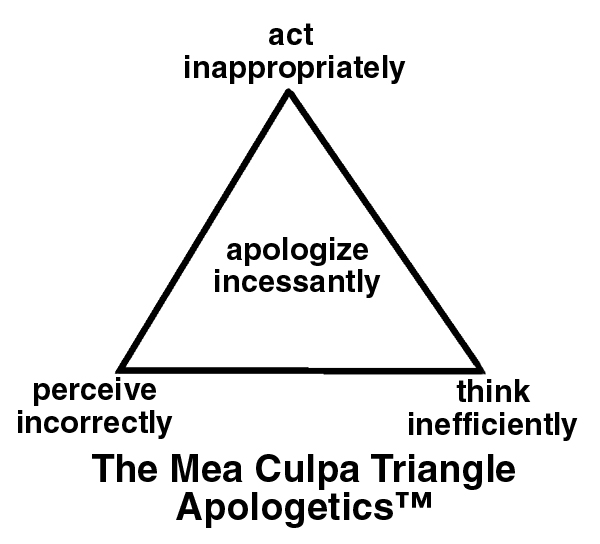
This graphic illustrates the idea of serial apologiæ in an admirably clever way. It appeared (in "Vanity Card" #369, a one-second flash screen, customary at the end of a Chuck Lorre production) concluding the "The Speckerman Recurrence" episode of The Big Bang Theory, which aired 8 December 2011. (The entire text can be seen in the Chuck Lorre Productions Official Vanity Card Archives (you just knew there would be such a Website!) at www.chucklorre.com/index-2hm.php?p=369.)]
Added 28 May 2014:
Nietzsche said: "Do not be cowardly towards your actions! Do not abandon
them after the event! Remorse is indecent.
--Twilight of the Idols or, How to Philosophize With a Hammer.
Leipzig: C.G. Naumann, 1888, "Maxims and Arrows", 10; English
translation by Duncan Large. Oxford: Oxford University Press, 1998
30 March 2014
Racism. Don't you see? Society is using it to regulate society.
The only way to end racism is not to fight it - unless it is accompanied by violence, taking or destruction of property, or denial of other rights such as employment or education, in which case you then fight violence, theft or destruction, and civil rights, not racism.
Imagine this scenario:
-
They say: "You're nothing but a fat, lazy Mexican."
You respond: "And? . . ." ["¿Y? . . ."]
It's easy. Rednecks and Hillbillies in the United States have this down to a science, even "working" the stereotypes to their own economic advantage and creating a rich vein of humour. Who's laughing then? (Everyone on both sides!)
Racist slurs and taunts, like all forms of stupidity, crawl off and die when ignored. This means that those being slurred and taunted ignore the racism, as well as those who are offended on their behalf, such as the so-called "bleeding-heart liberals" who, for example, feel "Indians" shouldn't be stereotyped. Of course they shouldn't. Get over it. Let it go. It will die of its own lack of oxygen.
Unfortunately, the media become the spoilers here, exploiting every racist crumb and putting uninvolved observers in the position of having to respond, or be branded as "racist-enablers" - the exact reverse of the "nigger-lovers" accusation during the institutional-racism era in the United States of America.
Yes, it's a complicated issue.
And? . . .
28 March 2014
Update on Marxism:
Sport and "Pop Culture" are the new "opiate of the masses".
As with religion in the "good old days", only those who rise above the opiated masses - not necessarily reject Sport and Pop Culture, but develop their interests further - will do anything meaningful in or for society.
Beyoncé and David Beckham are the archbishops, and Oprah is the Pope.
NOTE: This notion has appeared before here in my humble blog. See below, 18 January 2012.
[ADDED 2014.06.19: I've just discovered a Chuck Lorre Vanity Card that makes a very similar point. It's No.224, first aired at the end of "It's Always Nazi Week", an episode of Two and a Half Men, which aired on 3 November 2008. In Lorre's words, "Some people say there's no god. I disagree. I think there're actually four gods: The god of money, the god of medicine, the god of war and the god of technology. Like it or not, these are the gods that rock our world."]
15 March 2014
Kids often complain that they shouldn't have to learn Algebra (or any "un-fun" subject) because they'll never have to use it in their adult life.
Whenever a student, or a curriculum designer, or anyone in between considers future practical utility in deciding whether a subject should be taught or learned, the result stops being education and becomes training.
8 March 2014
The debate about whether or not to exclude screaming infants and toddlers from public places continues unresolved, while the numbers and volume of these noisy intruders shows no sign of decreasing.
The debate, really, is about whose rights should prevail over the other: should adults and well-behaved children have the right to relatively quiet enjoyment of public places, or should wailing babies and shrieking (read: attention-seeking) toddlers control the situation? (My use of the words "wailing" and "shrieking", while accurate, probably make my position on the question rather obvious.)
Until now, I haven't encountered a substantial argument for either side, just a lot of complaining about noise on the one side, and whining about "baby-haters" on the other. ("Whining" - there I go again, loading the terms. At least I admit it!) I'm going to try and remedy that lack of substantial argument here.
The historical reasons: In primitive societies, babies and toddlers were (and are) seen in most gatherings, whether inside a family home or elsewhere in the village. In these settings, the people worked in the same places that they lived. There wasn't a great difference between the private sphere and the public sphere of their lives. The significant difference, brought on by the enlargement of societies and particularly by the Industrial Revolution which, in effect, created cities as distinct from villages, was that new types of public space were created, with new rules and expectations. Work places were designed for productivity, and new types of venues were invented for entertainment and special occasions. As the noise of everyday life increased, new expectations for peace and quiet in certain public settings began to develop, especially in places where people were now paying for the privilege of admission or participation or getting paid to do their work. In offices, restaurants, theatres and public transortation, anyone who was noisy or otherwise disruptive - children, infants, or adults - was restricted or removed, often by official rules and laws.
The sociological/psychological reasons: One of the major goals of child development - contrary to the popular delusion that childhood should be a time of complete freedom - is preparation for adulthood, and for a functional and productive participation in society. Obviously, newborns spend most of their time, and rightly so, in their homes. Bringing an infant or toddler out of the home, and into society instantly becomes a learning experience in which the child begins to form ideas about how the world works, and what her or his participation in it will be like. Simply stated, a child whose attention-getting tantrums are allowed, or even encouraged by giving them the attention they are demanding, does not learn that certain behaviours affect other people, disrupt public order, and, if continued in later stages of development, might be punished or result in the disapproval of other people, thus limiting their own social success. If they are infants who cannot be blamed, or toddlers who cannot be controlled, they are not yet ready for experiences in the wider society, since they cannot (or will not) learn adaptive behaviours while acting out.
The "human rights" perspective: Much of the defense of noisy babies and toddlers comes from women who incorrectly feel their children's right to act out is an extension of their own rights as women. Said differently, many women believe an attempt to silence (or exclude) their noisy children in public places is a restriction on their own freedoms. This is absurd on its face. If this were the case, then these women should be able to scream in public, too, and virtually everyone agrees that this would not be tolerated. Be that as it may, the "rights" issue can be boiled down to this, if I may use a specific example to stand for public spaces in general: should 150 people in a "nice" restaurant have the right to a peaceful dining experience - which they've paid for, along with their food and service - or should five or ten people whose children are out of control have the right to dominate and degrade, perhaps ruin, the experience for all the rest? The noisy-children people are in the minority. Any argument for minority rights in this situation is going to have to dig pretty deep for their reasoning. Look at it this way: if adults in a restaurant, theatre, church, or other public venue start screaming or acting in an unruly fashion, they will be required to leave, as they would be infringing on others who have a right to an orderly atmosphere. Why should children be different? My perspective: I am a grown person who cannot enjoy public situations in which noise dominates what, in my opinion, should be relatively quiet places (see above for examples). I will not attend public concerts if my objective for being there is to hear the music; I will not enter or, if already inside, will not stay in restaurants where children are misbehaving; I will not patronize or, if already checked in, will not stay in hotels where noise is not controlled; and so on. If pay-for-quiet guarantees were available, I would take advantage of them, but they are not, and while most restaurants (another specific example meant to stand for many situations) have a policy against throwing food and even shirtless and shoeless patrons, very, very few have policies against excessive noise. This leaves me, in a so-called "free country", with limited options as to how to spend my time.
I am open to suggestions. I don't for a minute believe legislation is the answer. It has to be a grass-roots groundswell of public opinion that encourages society's "entitled" parents and children to see beyond themselves and blend in comfortably with the rest of society, for the common good.
Since this is the case, should I begin now to hold my breath until it happens?
19 February 2014
Today on the Good Morning America "crawl" (the text strip at the bottom of the screen that gives you the news that their other mindless programming - and advertisements - crowd out of their schedule) had the following item:
- South Carolina Mother Arrested For Not Returning Movie She Rented in 2005
OK. I see how this might (marginally) qualify as interesting news on a national broadcast.
But how in God's green name is the fact that she's a mother relevant to the alleged crime and arrest?
Would GMA (ABC News) run an item like the following?
-
Vegetarian Gets a Parking Ticket on His Golf Cart in Wal-Mart Parking Lot
Of course not. Point made. Case closed. . . . Until Tomorrow, Same Time, Same Station.
16 February 2014
Those who promote Creation Science as a serious discipline may gradually come to realise that the mainstream of society will forever remain unconvinced. Despair not! They can always find work teaching the art of rationalisation to advertising executives and anyone else in need of a facile explanation - for their skill at this technique is only a few [crucial] centimetres short of masterful.
8 February 2014
While working on my online quotations database (velutluna.info/quotations/accurate_quotes.html) I ran across a book called The Great Chain of Life (Boston: Houghton Mifflin, 1956), by Joseph Wood Krutch.
Ya think it's a pseudonym? According to en.wikipedia.org/wiki/Joseph_Wood_Krutch apparently it's not.
He must have had parents, then, with a slightly perverse sense of humour.
30 January 2014
Something's up. In one day, indeed all before noon, I heard or saw three (3) advertisements for services that wouldn't exist if a sizable chunk of our population weren't both scared and vulnerable for exploitation.
Defensive motivation - people afraid of losing something - is alive and sick in American society, and Defensiveness, thy name is Christian. This is not a Christianity that Jesus would ever recognise, and wise people have been pointing this out for centuries:
-
S'il y a un Dieu, l'athéisme doit lui sembler une moindre
injure que la religion.
If there is a God, atheism must strike Him as less of an insult than religion.
--Edmond de Goncourt [Edmond Louis Antoine Huot de Goncourt](1822-1896)
Journal entry, 24 January 1868, in Robert Baldick, Editor/Translator.
Pages from the Goncourt Journal. London: Oxford University Press, 1962, p.135
Here's what I heard and saw earlier today:
- radio commercial advertising "Biblical health insurance" (their words) - an alternative to Obamacare for those who want coverage that doesn't charge them for "things you don't want to pay for"; the obvious inference is abortion and contraception, of course
- billboard advertisements (I saw at least three in a 20-mile drive) offering auditions for Actors, Models and Talent for Christ. Their Website, http://www.amtcworld.com/ promises that they are "Making Good Bolder".
- poster at a large Coin/Collectible show announcing a meeting of the "Christian Coin Dealers Association"
I can only interpret this separatist agenda as a defensive attempt to perpetuate an America that probably never existed anyway, one in which every family was The Cleavers (as portrayed in Leave it To Beaver from 1957 to 1963 on television); in which Country Clubs had the unquestioned right to exclude anyone they deemed undesirable; and in which the Daughters of the American Revolution kept alive the dream that "the South will rise again".
19 January 2014
Russian president Vladimir Putin was interviewed by George Stephanopoulos and others (a portion of the interview shown on This Week With George Stephanopoulos, ABC [United States], 19 January 2014) regarding Russia's new law forbidding "homosexual propaganda". Putin's predictable rationale was that the people of the Soviet Union wanted to protect their impressionable children. (I believe we've heard that argument a few times before, perhaps most forcefully in the "Save the Children" campaign of the 1970s, led by Anita Bryant. The misuse of children to achieve the goals of adults when those goals otherwise are not feasible is hardly a new manipulation.)
A statement by Putin that was, to me, a bit surprising (unless you remember that he's just another lying politician) was that Russian society does not treat lesbian or gay people any different from any others under the law, that all Russian people are absolutely equal, and that lesbian or gay people may be or do as they please with each other, without interference from the State.
Here's my question: if it is OK to be gay or lesbian in Russian society, why is it not OK for children to hear about it?
Meanwhile, the Internet is full of images of Russian homosexuals being beaten in the streets by other Russians who feel newly justified in their actions by the law against "homosexual propaganda".
11 December 2013
Free newspapers (with tons of advertising, of course) are common in London, with content that is as useless as the paper it's printed on. Today's issue (Metro, 11 December 2013, p.25) reports a real heart-tugging interview with poor, little, pitiable Justin Bieber on the American syndicated radio show On Air With Ryan Seacrest.
Before continuing, make sure your hip-length Wellies are handy, as it gets pretty deep.
The Biebs told Seacrest (who must have been struggling to keep from wetting himself) that he - Bieber - is the victim of a bullying campaign as he "tries to defend his pop brat ways".
The British are not very sympathetic to his infantile antics (and Bully for Them!). They seem to regard them as publicity stunts. (Fancy that!) The article described him as "the scrawny singer . . . whimpering", as he said, " People don't get to see me living as a 19-year-old boy. I'm still finding myself. . . . Of course I make mistakes growing up. . . . People forget I'm a human being." Boo frigging Hoo.
As examples of his "finding himself" as a "human being", the article noted that in recent weeks he was seen spitting on fans, urinating in nightclub kitchens and visiting brothels. They go on to note that just the week before, he "shot himself in the foot again" when he was accused of calling a size 14 female fan a "beached whale".
That's it, Justie, always stick to the script your handlers have written for you, and you'll keep rakin' in the dough. Until you start putting on weight and the teenyboppers (and your handlers) go scrambling for the next tight young sensation who has no talent to get in the way.
On the other hand, the same page of this tabloid had a short article about Jennifer Lawrence and hear fears that "her popularity is waning". All sarcasm aside, let me say that this, however unintentionally, reveals a deep and important issue in today's society. It would be profoundly human and natural for a talented and articulate actress like Lawrence to be concerned that her ability as a performer might be less than the standard she would like to maintain, but to be "nervous" and "anxious" because she is "always aware of how quickly people can hate you" is tragic. This illustrates the dementia of current society: popularity matters, talent and ability don't.
29 November 2013
On my way to the airport for a flight to London Heathrow, I was driving behind a van that sported a sign in the back window:
-
WIFE AND DOG MISSING
--------------------
REWARD FOR DOG
Underneath was an added banner:
-
DOG FOUND - CASE CLOSED
Two days later, in a free throwaway "news"paper in a London Underground train, there was a picture of a wife's way of giving her husband an important message.
It seems a few years back, she had her local pub put up a sign on their outdoor bulletin board that read:
- MARRY ME PAUL?
She returned to the pub in recent weeks to post a new message:
- PAUL . . . I AM DIVORCING YOU - BTW I AM KEEPING THE DOG
Everyone likes dogs, it seems. Bloody tough, however, on wives and husbands.
13 November 2013
On a recent road trip to some of the National Parks of the Western United States, I found a most unusual product for sale in one of the backcountry gift shops - candy cigarettes! I haven't seen these anywhere since the 1950s, and frankly I was astonished that a store, let alone a manufacturer (Made in China for a Seattle, Washington distributor) would ignore the enormous political-correctness pressure and go ahead and sell these mock cancer-sticks. I have no problem with this, despite the fact that I would encourage kids to avoid smoking for health reasons; to me, freedom of choice is more important than suppression of a kid's options. To put it another way, I feel it's better to encourage healthy behaviour through education, not through suppression of products and images.
What astonished me the most is the package design, featuring a delighted man holding a lighted cigarette (real) in his smiling teeth, and an eager pre-teen boy looking up in admiration, with the slogan, "Just Like Dad!" placed between them. To top this, the display box that contained the individual packs in the store had the same pictures, with a text-balloon coming from the boy that said, "Hey dad - can I bum a smoke?" Absolutely in-your-face defiant!

(A picture of the display box can be seen at www.democraticunderground.com/10023405635 along with a report out of Australia about a store facing a $100,000-plus fine for selling the orange-flavoured death-sticks. [If you visit that site for a look, don't miss the fascinating discussion blog, with pictures, below the story.] Apparently, a mother complained when she saw the merchandise on a shopping trip with her 13-year-old daughter. Why was I not surprised to know it was a mom who complained? I imagine if the package showed a mom and daughter [instead of a father and son], and the logo "Just Like Mom!" on the pack, the complaining mom might have gone ballistic, with dire consequences to the store and its workers. In my opinion mommy needs to get a life. She might even thank the store for giving her an opportunity to talk to her daughter about not smoking. In case the abovementioned link to the display box image is defunct, I've provided a local copy here.)

In defense of the manufacturer/distributor, the package does request that you "Please recycle", though it does not contain any reference to the Surgeon General of the United States and health warnings.** That, I suppose, is proof that it doesn't have real smokes inside, though the sugar content alone would prompt some bleeding hearts to seek to ban the product as it could contribute to obesity.
Now, I suppose I have to assure readers that I deplore obesity that results from laziness and could be avoided by eating right. I do encourage parents and children to eat responsibly - if they choose to do so (not just because the society makes bad choices unavailable). Don't you see? It's so much better, and individuals are stronger, if they choose the behaviour that's healthy, rather than having health shoved down their throats.
Just keep your grubby protests away from my bubble-gum cigars!
**(The display box does have a label, once the top row of cig-packs has been bought and removed, that seems to say, "SURGEON GENERALS AGREE: Candy cigarettes are safer and more healthy than real cigarettes." Well, there you are! Butts covered!)
19 October 2013

I feel no comment is needed for this sign, seen in Los Angeles (Sunset Boulevard at Parkman) yesterday.
8 October 2013
In My Humble Opinion (IMHO):
The most beautiful and competent woman who ever appeared in television or films:
-
Connie Booth (Constance Booth, born 1944), as Polly, in
Fawlty Towers (1975-1979).
(She also co-wrote the series with her then-husband,
John Cleese
[John Marwood Cleese, born 1939].)
Other nominations, however inadequate, are welcome.
7 October 2013
Ever notice in television commercials how certain things always must happen in certain types of ads?
- In pizza advertisements, you must always see stringy cheese stretching as one piece is pulled away from the others.
- In dog food commercials, the dog always licks the owner (or at least the one providing the food) at the end, while the human beams a smile and hugs the satisfied animal.
- In most fast food commercials, the viewer follows the bouncing food. Hamburgers, salads, even drinks fall or are poured from above, just out of camera range, and bounce or splash into perfect readiness for eating. When does this ever happen in real life?
Why bring this up? It's my continuing campaign to keep my readers (all three of you!) aware, and watching with critical eyes what television forces down our throats.
In the same vein as the obligatory clichés in commercials noted above - ever notice that whenever a cooking segment is hyped ("stay tuned for . . ."), if the chef involved is shown on camera, she or he is always fooling with the food? Cutting, patting, seasoning, as if it's verboten to show a chef just standing around, waiting to go on the air.
They're manipulatin' you, Bucko.
12 September 2013
Dr Phil (Phillip Calvin McGraw, Ph.D.) is a media psychologist. Already I've admitted my bias, as media psychologists are even lower than "pop psychologists" on the helping professions food chain. Today, appearing on The View (ABC) to promote the premiere of his new season - of course, why else bother to appear on a show that isn't his own? - he highlighted one of the issues that he will be "tackling" - I would probably say "exploiting" - as his annual verbal slug-fest gets underway again: rape.
His guests, he says, are "both the accuser and the accused" in a case of alleged rape that happened at a party attended by four male High School students and one female classmate. They were all underage, alcohol was served, sex was had. Now the young men are accused of raping the girl, and if convicted, face not only the attendant penalties, but lifetime registration as sex offenders. (Reminder: they are minors, yet their penalties and lifetime registration are adult consequences.)
If one or all of the young men raped the girl, they should be held accountable. But, to say the least, questions remain. The case has not yet been tried in court. This makes Dr Phil's statement on today's show all the more astounding, beyond the basic logical flaws which I will try to focus on.
Dr Phil: Sexual consent cannot be given when one is drunk . . . in an impaired state.
OK, here we go with the corollaries and analysis:
- Is all sex that occurs under the influence of alcohol to be considered rape?
- If everyone goes to the party fully aware that sex is on the table (so to figuratively speak), does the intervention of alcohol make any difference? If so, why?
- Putting the alcohol aside, is sexual intercourse such a one-way activity that once the female consents, it's "all systems go"?
- If everyone is under the influence of alcohol and sex (without force or coercion) occurs, why not charge the female with rape as well?
- Should "taking advantage of someone who is drunk" rise to the level of criminal rape? Isn't "intent" one of the elements of the crime of rape? If the alleged rapist was drunk, doesn't the "impaired state" nullify that intent, just as it (in Dr Phil's mind) nullifies the consent of the alleged "victim"?
And on, and on goes the fractured logic. Look at me. Trying to analyse, on the basis of logic, something that was said by Dr Phil.
This "picture" is so full of post-feminist manipulation, not to mention male-bashing and exploitation of sexual activity by the legal system, that it would take a book or 2-hour documentary to examine the issues. Michael Moore . . . interested? Could be your next blockbuster. If you don't do it, Bill O'Reilly might, and you know where that would leave us.
9 September 2013
I wonder what the hype-infused news organizations will call a "manhunt" when the cops are searching for a woman.
My bias is for news readers (as they were once called in England when there was only one BBC) to use value-neutral terms in their reporting.
- "Wildfire"? How is that different from "forest fire" or "grass fire"?
- "Rushed to the hospital"? Why would anyone in medical distress "stroll casually" to the hospital?
- "Brutal stabbing"? How 'bout a "gentle stabbing" story once in awhile.
- "Breaking news"? Yeah, right.
Hype gets ratings. Hype is manufactured. Down with hype. Hype doesn't build character or credibility. Hype, frankly, teaches kids to lie.
7 September 2013
Pushy 'eagle dad' trains 5-year-old son for solo flight
He Yide (Duoduo) has flown a plane solo (with his dad He Liesheng in the back seat), has attempted an ascent of Mt Fujiyama (again with his dad at his side), and is sometimes required by dad to walk in zero-degree Beijing weather wearing only shorts. The Chinese press has dubbed the older He as an "eagle dad" for being so demanding.
Just another news item about "extreme parenting"? Maybe.
But our oh-so-compassionate mavens at NBC's Today Show set some records of their own for unrestrained bad-mouthing, using words such as "horrible", and even raising the possibility, in so many words, that He's parenting style may border on "child abuse".
Who do they think they are, spouting vile value-judgments - as if everyone "obviously" would agree with them - when there was no allegation that the boy was ever in any danger, and, except for his crying while walking half-naked in the snow (I've done as much myself!), he seemed to be enjoying his exploits and seemed obviously fond of his father during an interview.
Today, on the weekend edition of ABC's Good Morning America, we had a different side of the coin: another 5-year-old (American in this case), playing Beethoven (badly) on the piano. (Don't get me wrong - Beethoven played badly by a 5-year-old is perfectly acceptable and praiseworthy, especially as compared with the so-called "music" coming out of so many kids and young adults today.)
How do these two 5-year-olds compare? They are both achievers. Do we really think that the toddler pianist doesn't have "pushy" adults behind him, even if he, like the Chinese pilot, appears to be enjoying himself as he performs?
The bottom line is that both kids are doing something constructive that could serve them well as they develop and grow into adults. There is no known danger to either child. And the media-saturated hosts, particularly in the case of He Yide, have no bloody business laying on their biased criticism, which really amounts to criminal defamation of character, in my opinion, without the caveat that what they're saying is their personal view only.
DOWN WITH THE NANNY STATE.
3 September 2013
I just finished reading three books that have changed the way I think. These books are by college professors (scholars), so they will not be widely read or talked about, but if they were, our society would be forever different - and, in my (humble) opinion, better.
- R. Danielle Egan & Gail Hawkes. Theorizing the Sexual Child in
Modernity. New York: Palgrave Macmillan, 2010; a
recent history of ideas
regarding child rearing, sex education and parenting
- J. Jack Halberstam. Gaga Feminism: Sex, Gender and the End of
Normal. Boston: Beacon Press, 2012; an analysis of current pop
culture and speculation about where it might be headed.
- Kathryn Bond Stockton. The Queer Child, or Growing Sideways in the Twentieth Century. Durham NC: Duke University Press, 2009; an interesting "pseudo-psychological study" - using a survey of literature (novels and films) since "real" research with actual children is currently impossible - of what goes on in the very different, isolated world of childhood in a culture that insists that "growing up" be delayed long past physical maturity (NOTE: "Queer Child" carries the antique, traditional meaning of "different", including but not by any means limited to those who might become gay in adulthood)
All three, in one way or another, discuss the reality that is brewing and getting more restless underneath the media-constructed images that we all see, and that are rearing and instructing our culture's children.
A full discussion of these authors and their brilliant ideas needs a different forum (and possibly a scholar more up-to-date and connected than I). For now, let me just list the two main "take-aways" for me:
- Childhood is over at puberty.
Delaying the preparation for adulthood past that point - i.e.,
continuing to regard people in their mid-teens and later as
"children" - is nothing short of immoral.
- Social programs, expert advice, educational programs and propaganda regarding childhood that have been widely adopted in the last 200 years has been in the service of controlling and shaping various ideas of an "ideal" society, not for the mental, physical or socio-psychological health of individual children.
Take my word for it, these points are solidly documented in the books listed above. As these are notions I've suspected for decades, seeing them now laid out and backed up with scholarship and meticulous analysis filled me with admiration and anger, at the same time.
Perhaps I should try to put a positive spin on this: I'm convinced that, sometime in the next 100 years, this type of groundbreaking scholarship will percolate into the society at large, and the experience of adolescent growth and socialization will be a lot more sensible and healthy than it is today.
Will that be soon enough for you?
Footnotes: R. Danielle Egan is Professor of Gender Studies at Saint Lawrence University in Canton, New York; Gail Hawkes is Associate Professor in the School of Behavioural, Cognitive and Social Sciences at the University of New England in Armidale, New South Wales, Australia; J. Jack Halberstam is Professor of English and Director of The Center for Feminist Research at the University of Southern California in Los Angeles, California; Kathryn Bond Stockton is Distinguished Professor of English at the University of Utah in Salt Lake City, Utah.
21 August 2013
It's funny how real life often follows art. Well, sort of.
Recently I stumbled upon a brilliant article by the late film critic, Roger Ebert, in which he mentions an interview he gave to NBC for a show hosted by Tom Brokaw (article dated 7 November 2003, retrieved from www.rogerebert.com/reviews/elephant-2003). The interviewer, he says, threw him a loaded question regarding gun violence such as that seen at Columbine High School in 1999: "Wouldn't you say that killings like this are influenced by violent movies?"
"No," answered Ebert, "I wouldn't say that. . . . Events like this, if they are influenced by anything, are influenced by news programs like your own. When an unbalanced kid walks into a school and starts shooting, it becomes a major media event. Cable news drops ordinary programming and goes around the clock with it. The story is assigned a logo and a theme song. . . . The message is clear to other disturbed kids around the country: If I shoot up my school, I can be famous. The TV will talk about nothing else but me. Experts will try to figure out what I was thinking. The kids and teachers at school will see they shouldn't have messed with me. I'll go out in a blaze of glory."
Back to yesterday [20 August 2013]: Michael Brandon Hill was arrested at Ronald E. McNair Discovery Learning Academy near Atlanta, Georgia, having entered the school with considerable firepower (guns and ammo) in his possession, which he (fortunately) did not use on any people before he surrendered. According to reports quoting school employee Antoinette Tuff, he told her to "call the news and also the police to let everyone know he was here."
This is not a scenario from a violent movie nor a gun-laden video game. To me, it is clear evidence that Ebert was right.
The (inevitable) media analysis that followed featured a number of talking heads, asking the (inevitable) questions: How much was this individual influenced by violent movies and video games?
And the beat goes on . . .
18 August 2013
The era of the "token Negro" is not over.
In the 1960s, when I was still teething (well, figuratively), members of my family used to exclaim, "N double-A C P" every time a black person was seen on television - which wasn't that often. This was a clear reference to the pressure being exerted by the National Association for the Advancement of Colored People for television shows and commercials to include people of color, the objective (of course) to make television more representative of the ethnic makeup of our country. Blacks used in such a way, on television as well as in business and society in general, came to be known as "token Negroes".
Is the era of "tokenism" over? Think about it, in reference to today: how often do you see a law enforcement officer portrayed by a black (usually a man)? My guess is that the percentage is far greater than the number of blacks in the actual law-enforcement workforce. This is an obvious effort - left over from decades past - to place people of color in socially valued roles, instead of portraying them as criminals and vagrants. Of course, there's nothing wrong with a person of color playing a law enforcement officer, but when more than half of such roles are filled by blacks (perhaps an exaggeration, perhaps not!), then some manipulation is going on.
A more obvious example is the poker game. It is almost a cliché that in every foursome playing cards, one of the players - and only one - will be black. OK, so "the guys" are liberal enough to invite a black acquaintance to play with them. The point has been made. For decades!
A notable exception, to the great credit of the show's creators, is the "Poker" episodes (6 January 2002 and 21 April 2002) of Malcolm in the Middle, in which Hal (Bryan Cranston) is the only caucasian in the group of six, all of the other five being black. Even better, the show's writers didn't sink to the "easy obvious" level of everyone patting themselves on the back about being so "hip". Instead, they went at least one better, and played on the presumed audience knee-jerks in masterful fashion.
Hal is trounced in the poker game, and comes home depressed, finally confessing to his wife that he feels the group took advantage of him because he was "different". This theme builds to the point that he finally confronts Abe Kenarban (Gary Anthony Williams), the father of Malcolm's (Frankie Muniz) best friend Stevie (Craig Lamar Traylor) and the host of the poker night. "Obviously I'm different" Hal exclaims: "I mean, I walked through that door and stuck out like a sore thumb." Abe is incredulous, and demands Hal explain what he means by that. Hal unloads, "You and your poker buddies all ganged up on me because I'm not a professional. . . . You and your doctor friend, and your lawyer friend, and your dentist friend, you decided it was OK to skin a guy just because he's a working stiff." Abe is furious: "Listen, you idiot, we didn't 'ganged up' on you, you just stink at poker."
It was a delicious moment, and the Malcolm series had many more, continually flying in the face of convention: whites yelling at blacks when they were acting like jerks, Malcolm's older brother Francis (Christopher Kennedy Masterson) lusting after a beautiful African student visitor (Blair Wingo as Amaani) and nobody commenting (or apparently caring) that she was black, and, as Malcolm's and Stevie's families were close friends, missing many, many opportunities to self-congratulate over their progressive attitudes toward race relations.
It was, in retrospect, a vision of how America should be, and hopefully will be, once we get over "race" as an issue. We will get over it, right?
[added 2013.10.24: A major film has been released that helps me make my point: Last Vegas is the story of four older friends (you know, my age!) who take a trip together to America's gambling capital. You guessed it: three white guys (Michael Douglas, Robert De Niro and Kevin Kline) and (dare I say it?) their token, Morgan Freeman. Would it have killed them to have Freeman and Bill Cosby and De Niro and Kline? Or any combination other than the stereotype?
added 2013.11.11: a recently-released sequel reminded me that yet another film uses the abovementioned cliché - Grown Ups (2010) and Grown Ups 2 (2013) have childhood friends Lenny Feder (Adam Sandler), Eric Lamonsoff (Kevin James), Kurt McKenzie (Chris Rock) and Marcus Higgins (David Spade) reuniting a couple of decades later for various silly-fun activities. Chris Rock is - dare I say it again? - the group's token.]
17 August 2013
Reports on television (or elsewhere) about lesbian or gay people who have "come out" often tag their stories with slogans like, "living a lie", or "his/her secret life/double life". This slant invites comparisons with criminals using false names or informants living under "witness protection".
In today's society, but only very, very recently, such clandestine behaviour may seem unnecessary, as these previously-verboten lifestyles are gaining widespread acceptance.
Those who would question a gay or lesbian person's motives for living "under cover" may be tempted to think such people lacked courage. Nay, it is society to blame for marginalising these people and condoning the crushing consequences of spilling these secrets during the whole of the XXth century. What a waste.
"Now it can be told."
16 August 2013
The recent publicity regarding the (apparently) excellent new film The Butler, directed by Lee Daniels and starring Forrest Whitaker (among others), highlights a crucial issue for modern society: keeping history alive and accurate.
It seems the general tendency of a fast-moving society is to forget or sanitize history, recent and ancient. Some want this to happen because they're lazy or too busy to pay attention. Others want this to happen for their own selfish or manipulative reasons.
The devious practice of manipulation or sanitization often is referred to as "revisionist history". It doesn't matter whether this is done passively or actively, through neglect or intentionally, "revisionist history" is wrong, dangerous and unacceptable.
The Butler reminds (or teaches) new generations that major injustices existed in our society that needed to be addressed by difficult and risky social action to move toward the goal of racial equality that many of us feel is necessary and right. Any distortion of the truths of the past, from minor instances of faulty memory to outright suppression of facts, makes further progress on those and other issues more difficult and less permanent.
The history of many social issues, in addition to racial equality, is at risk of the contamination of "revisionist history". Today's young people, for example, often have no idea of the difficulties and dangers associated with bringing women, disabled people, lesbians and gays, or non-Christian religions into the mainstream of American society.
Any attempt to revise history, or neglect its preservation, without solid, verifiable scholarship must be resisted with all the resources available to honest, impartial citizens. It is in their (our) best interests to do no less.
15 August 2013
Today some (hack?) psychologist on TV was commenting on a recent study that found High School-age kids (virtually all the comments by the hack were about boys) are conducting their "romantic" liaisons via texting. Some surprise, eh?
Wait, it gets serious.
The psychologist, maybe quoting the study, maybe injecting her own bias, noted that the content of the alleged texts was getting more racy, more explicit, something she seemed to view as a social problem. With a tepid, not to mention insincere, apology, she then launched into her advice to parents, that it is OK to "snoop" (her word) on their children's texting and eMails.
This psychologist will not be getting my kids' business. In my personal and professional opinion, it is not OK to intrude on a young person's eMail or text messages, especially if the young person is an adolescent who should be learning the sanctity of privacy in a society where there is less and less of this precious freedom. If parents cannot comfort themselves in trusting their teens, then they should deny them electronic access altogether, a priori, like some parents deny kids the "right" to eat meat or to sleep-in on Saturdays or Sundays instead of going to Temple or Church.
In former times, teen privacy was symbolized by The Diary, which was opened and read by others only in extraordinary circumstances, at least if we can believe most old movies. The only difference now, albeit a significant difference, is that texting and eMails are "forever", existing in cyberspace for hackers (and hack psychologists) to read and use against their authors at any future time. The solution here is early education (something the "protected children" in our society almost never get) about responsibility and consequences and - dare I say it? - common sense.
Let me just be clear in repetition (and pardon my shouting): IT IS NEVER OK TO SNOOP ON TEEN CHILDREN WITHOUT AN ACTUAL, LEGALLY-OBTAINED SEARCH WARRANT. How would you feel if your "parent", the government, did that to you?
25 July 2013
Sometimes you buy a set of DVDs just for a bit of fun in the privacy of your own home, and you stumble upon brilliance. Such is the case with the 2002 TV series Believe Nothing, starring Rik Mayall.
Rarely have I encountered such relevant satire as, for example, the episode, "Prepare to Meteor Maker" (Season 1 Episode 2, written by Maurice Gran and Laurence Marks) in which an evil megalomaniac (a parody of Virgin's Sir Richard Branson) plots to take over the world by convincing everyone that a meteor will strike and destroy the planet, thus allowing him to buy every important company at a fraction of its value.
This situation leads to the following conversation, as the two protagonists are about to board their hot-air balloon, thus escaping the holocaust. Cnut's list of things currently considered important by the culture is a scathing indictment of just how superficial and mindless current society has become. (And, in my humble opinion, it has gotten much, much more so since 2002!)
-
Dr Hannah Awkward (Emily Bruni): You don't seem very despondent
about the impending end of civilisation.
Professor Adonis Cnut (Rik Mayall): Well, it depends what you mean by "civilisation". Of course, I'll mourn the explosive vaporisation of the Parthenon, the Taj Mahal, Kylie Minogue's gluteus maximus, but will we really miss, for example, Celebrity Chefs [he pronounces this rather like "Slybarity Chefs"] . . .
HA: No.
AC: text messaging . . .
HA: Hardly.
AC: Big Brother, New Labour, Alcopops, the National Lottery Draw Live, the word 'designer' used as an adjective . . .
HA: Certainly not!
AC: alternative medicine, cars with "Baby on Board" signs, ready meals . . .
HA: I quite like "Che Guevara's Traditional Boil-in-the-Bag Vegetarian Fajitas".
AC: Yeah [Cnut ignores her], body piercing, people who say 'wicked' when they mean 'quite nice', gas companies that sell electricity, electricity companies that sell gas! No, no. Far better is [for] you and I to start with a clean slate, Hannah.
29 June 2013
It looks like we've added a new basic category of human being to our biology. Moms. As distinct and different from women, or any other class. With the recent classification of "children" replacing the former gender-based categories - you know, those two groupings for which school restrooms are labelled - that gives us four, but not the traditional four. Where we once had men, women, girls and boys, we now have (in order of apparent importance), moms, children, women and men.
To wit: This morning, on ABC News, the following "tease" (short description of upcoming reports, once the obligatory advertising is aired) was heard:
-
Mom fired because she was just too good looking.
The fact is that the story itself, in all its implications both spoken and implied, had nothing to do with the fact that this woman happened to have children. It was, is, and always will be a story about a boss who fired his employee for a reason she thought was unfair - he said she was so alluring that he was afraid his own marriage was in danger - and how the Iowa Supreme Court, after initially rejecting the case, was now reconsidering her appeal of the original lower-court verdict in favor of the employer.
Speaking of the Court, the reporter made another irrelevant reference when she noted, with some contempt if I heard right, that the court was made up of "7 white men". The all-male court is relevant, since they originally sided with the (male) employer, but the complete absence of any racial or ethnic content in the story - both employer and employee are white - makes the ethnic composition of the Court a non-issue.
What we have here is knee-jerk reporting if these gaffes were unintentional, and manipulative news writing if they were intentional. Either way, it's unacceptable. And probably inevitable.
28 June 2013
See if you can guess how many months ago this was written:
-
Society . . . has gone to the dogs; a lot of damned nobodies talking
about nothing.
Ready? Here's the reference for your amusement, and perhaps amazement. It was first heard on 3 January 1895 at the Haymarket Theatre, London, in Oscar Wilde's play An Ideal Husband, Act I, spoken by Lord Caversham.
How about this, from the same play, spoken by Lord Goring in Act II:
-
Mrs Chevely is one of those very modern women of our time who find a new
scandal as becoming as a new bonnet. and air them both every afternoon
in the Park at 5.30. I am sure she adores scandals, and that the sorrow
of her life at present is that she can't manage to have enough of them.
Somehow it rings true today in the intellectual wasteland called America. It's like Wilde was writing just yesterday about tomorrow's round of television talk shows.
25 June 2013
Interlude.
23 June 2013
As a developmental psychologist, I have written many things about issues involving children, whose future in my view is quite troubled and bleak. My comments, for the most part, have been descriptive, not philosophical. In other words, I've tended to report what's happening (as I see it), but not why.
Why has society become so obsessed with children and so overly protective of them at the social level, as well as at the family and personal level? Celebrity births - the pending royal baby in Britain currently being the most available example - are not merely congratulated, but accorded levels of recognition previously reserved for Nobel prizes. Children are manipulated in advertising sometimes to the point of abuse. Primary and Secondary schools are venues for adults debating excellence and achievement, and desolate dungeons for children who should be learning how to think and act as free citizens.
The answer is as complex as any modern issue, and can be summed up simply as follows: Children are programmable; furthermore, the longer they remain programmable, the better for those who would mold society in their image of what should be, rather than let society proceed on its own creative path.
Now you know.
21 June 2013
Paula Deen cooks up a mess of vitriol. She admits under oath in a deposition related to a discrimination complaint that she has used the word "nigger", and her employer (The Food Network on Cable) and various sponsors and affiliated charities drop her like a Southern baked potato.
This is not a free speech issue, as employers and sponsors are free to disassociate themselves from anyone they consider bad for business; still, it seems they might be acting unfairly toward her. On the other hand, her main business is her restaurant in Savannah, Georgia, which apparently is doing better than ever, so she is really only losing the "extra millions" that she was able to squeeze out of her once-adoring public.
On the other other hand, saying the N-word (see above) is not, in and of itself, racist, and there is so far little or no evidence of further Deen racism available to the public. In the absence of such evidence, negative public reaction either from offended blacks or politically-correct whites is overkill.
The only thing that seems certain in all of this is that she can cry like a baby on cue. While doing so, on the Today show on Friday, 21 June 2013, she uttered the soon-to-be-famous phrase, "I is what I is".
No, folks, I'm not making this up.
18 June 2013
I note with a great sense of loss and sadness the passing of my best friend. I think the most fitting tribute would be the quotation from the Brihadaaranyaka Upanishad that ended almost every eMail and letter my friend sent me:
-
May peace and peace and peace be everywhere.
Perhaps I will say more about this new hole in my life, perhaps not. For now, great soul, AVE ATQVE VALE.
13 June 2013
What's up with the music - usually with a pounding, boom-box beat - that so-called "news" programs play during segments in which they're giving information to viewers?
This "technique", no doubt a result of some marketing research that probably shows viewers' heartbeat and respiration respond more to pounding music than just ordinary talking, is used for everything from roving "person on the street" interviews to features listing travel tips and good deals on toys for the holidays.
Today, on ABC-TV's "Good Morning America", there was a pounding rhythm - no music, just a drumbeat - throughout a segment in which an Italian chef was describing how to cook a Fathers Day meal.
For me, a music track under a segment that's trying to give information to viewers is just distracting. For some time now, it has made me reach for the remote and begin channel-surfing.
There must be at least three or four viewers out there who feel the same way. Sisters and brothers . . . "Just Say No" (two, three, four).
11 June 2013
1 To the choirmaster: with stringed instruments. A Maskil of David.
Give ear to my prayer, O God; and hide not thyself from my supplication!
2 Attend to me, and answer me; I am overcome by my trouble. I am distraught
3 by the noise of the enemy, because of the oppression of the wicked. For
they bring trouble upon me, and in anger they cherish enmity against me.
4 My heart is in anguish within me, the terrors of death have fallen upon me.
5 Fear and trembling come upon me, and horror overwhelms me.
6 And I say, "O that I had wings like a dove! I would fly away and be at rest;
7 yea, I would wander afar, I would lodge in the wilderness, [Selah]
8 I would haste to find me a shelter from the raging wind and tempest."
9 Destroy their plans, O Lord, confuse their tongues; for I see violence
and strife in the city.
10 Day and night they go around it on its walls; and mischief and trouble
are within it,
11 ruin is in its midst; oppression and fraud do not depart from its
market place.
12 It is not an enemy who taunts me--then I could bear it; it is not an
adversary who deals insolently with me--then I could hide from him.
13 But it is you, my equal, my companion, my familiar friend.
14 We used to hold sweet converse together; within God's house we
walked in fellowship.
15 Let death come upon them; let them go down to Sheol alive; let them go
away in terror into their graves.
16 But I call upon God; and the Lord will save me.
17 Evening and morning and at noon I utter my complaint and moan, and
he will hear my voice.
18 He will deliver my soul in safety from the battle that I wage, for many
are arrayed against me.
19 God will give ear, and humble them, he who is enthroned from of old;
because they keep no law, and do not fear God. [Selah]
20 My companion stretched out his hand against his friends, he violated
his covenant.
21 His speech was smoother than butter, yet war was in his heart; his
words were softer than oil, yet they were drawn swords.
22 Cast your burden on the Lord, and he will sustain you; he will never
permit the righteous to be moved.
23 But thou, O God, wilt cast them down into the lowest pit; men of
blood and treachery shall not live out half their days.
But I will trust in thee.
--Psalm 55, Revised Standard Version (1952)
7 June 2013
So, it takes The Guardian, a British newspaper, to inform the world that - wait for the surprise!!! - the United States government is collecting hundreds of millions of data points representing the telephone calls of Verizon customers, and mining those data for information in the War on Terror. The justification, of course, is rooted in the Patriot Act of 2001, a highly questionable set of laws pushed by the Bush Administration in the wake of the attacks of 11 September 2001. The successful passage of the Patriot Act manipulated the nation's paranoia at the time to minimise any possible objections. The astounding thing, at least to my mind, is that the Obama Administration has continued the restrictions that emasculate the United States Constitution's Bill of Rights (specifically the First and Fourth Amendments), and have even gone so far as to defend and justify them in language that would make George W. proud as a prize hog at the Texas State Fair.
"Nobody's listening to your phone calls . . . that's not what this program is about", said Obama. Fine, but that's not what the protests and complaints against the program are about, either. They're about invasion and abrogation of privacy without due process of the law - in other words, without good reason. Nobody's listening to our phone calls, yet. Tomorrow is another slippery slope, Barack. Just how stupid do we look?
For brevity, let me tear apart just one of these straw-man (straw-person?) rationalizations. According to the New York Daily News, "The program has been credited with stopping a 2009 bomb plot to blow up subway trains in New York." The logical leap required to justify the billion-data-point collection by noting one, or two, or ten successful disaster preventions is equivalent to claiming that shutting down the Interstate Highway system would result in fewer fatal automobile collisions. Of course it would.
What's missing here is a credible proposal that government do some hard work, instead of taking the relatively easy way out, when that easy method is based on the government ignoring those pesky privacy rights. The easy way out is just to collect the telephone numbers, duration, source and destination of all the telephone calls made by Americans, which apparently is what is now happening. The hard way might be to devise a rational method, limited in scope to situations where probable cause can be demonstrated, of keeping tabs on potential terrorists. If the CIA and FBI can't come up with such a method, then we should fire them and get someone in who can.
2 June 2013
Coco's Restaurant chain is running a television advertisement which depicts a thief who is ultimately caught by a cop. The thief is white, the cop is black.
This follows advertising protocol, which is also reflected in virtually all media - television shows, movies, magazines, &c.: ALL thieves are white (caucasian), and a large majority of police officers, sheriff's deputies and security guards are black.
I mention it only because in real life, many thieves are non-caucasian, and many law enforcement officers, perhaps even a majority, are white.
The three of us who are still thinking for ourselves should ask why advertisers do this sort of thing (besides the obvious reason of tricking us out of yet another chunk of our hard-earned cash).
30 May 2013
SheZow. An Australian cartoon has been running for several months, in which a 12-year-old boy named Guy turns into a girl superhero upon uttering the magic words, "You go girl!" It is said that the target audience is 3 to 12-year-olds.
I don't know quite what to make of this, though it is clear there is a lot of internet buzz about it, everything from " oozing with progression and adorableness" (I quotes 'em as I sees 'em, folks!), to " Why do we need to confuse kids? I know a little girl who pretends she's a dog . . . maybe I should start feeding her dog food . . ."
I guess the best I can do is ask, Why do we need this? Cross-gender behaviour, in my opinion, is good for both girls and boys who are so inclined, but the boy becoming a girl seems at best unnecessary.
Consider the flip side - girls into boys. Popular culture has been loaded with images of females acting like stereotypical males for decades. Girls becoming boys, though, seems pointless and, to most feminists, would be unacceptable, no?
This one leaves me stumped. Unless . . . it's an attempt to get publicity and, thereby, money for the production company. OK, now it makes sense.
24 May 2013
Headline: Boy Scouts vote to allow gay members
O.K. Some will hurl epithets, some will say, "'Bout time". The vote reportedly was 61% in favor of overturning the 1991 ban, which at the time was based on the Scouts interpretation of the phrase "morally straight" in the Scout oath. (Is it just me, or is the pun inescapable? I mean, surely their original objection was based on their view of morality, not any modern connotation for the word "straight", right?)
With every mention of this historic vote, it is also made clear that the Boy Scouts of America will continue to reject (openly) gay men as Scout leaders.
Given their revised interpretation of "morally straight", I wonder if the Scouts could share in detail their rationale for allowing gay members, and excluding gay leaders?
23 May 2013
It seems every Spring - I mean, of course, every "Prom Season" - we hear of some High School kid who invites a celebrity to be his date. (Occasionally, it's a girl who tries to outclass her peers in this way, but usually it's a male teen. More hormones, I guess.) This time around, 17-year-old Milken High School (California) senior Jake Davidson tried to score Kate Upton, and when she declined, 21-year-old model Nina Agdal stepped up to the limo.
If we can assume that a Prom date is, at least in fantasy, a pseudo-sexual event (oh, grow up!), it seems strange to this cynic of fair play that parents and child watchdogs aren't claiming child exploitation. (The age of consent in California is 18.)
To illustrate this point, consider the absurd (one of my favourite techniques for calling attention to hypocrisy). Many High Schools for some time now have been allowing same-sex couples at their Proms. What if some geeky High School kid (male) convinced a good-looking gay man (well-known or not) to be his date, or an athletic High School athlete (female) somehow arranged to be escorted by a non-ambiguous (i.e., openly) Lesbian rock musician?
Something tells me the officials in charge would be waiting at the door, and the news coverage would not be nearly as "cutesy" and "winky-winky" as was the case for young Davidson this season.
Why mention this? Because laws that assume High School kids are innocent, defenseless children are not only absurd, but counterproductive for teens' healthy development. By High School, young people should be prepared to face adulthood, more than protetcted from experiencing it.
22 May 2013
I have a challenge for America's moms: whenever you characterize yourself out loud or in print - for example, as one who chauffeurs kids to sports, or is delighted with the offspring's achievements, or works for a living - describe yourself as a "Soccer parent" or "proud parent" or "working parent", without dropping the "M"-word.
I dare you.
I mean, why should we know your gender? Is a mom better than a dad? Dare!
17 May 2013
About a year ago (11 May 2012) in this "column", I wrote about "attachment parenting", on the occasion of a Time Magazine cover photo (21 May 2012) and the publication of Dr Mayim Bialik's book on the topic. Perhaps due to the "natural" cycle of sensation-seeking media stories, the topic is in the news again.
This time around, what has struck me most directly between the eyes is the apparent fact, or at least my overwhelming impression, that in all stories about attachment parenting the younger "participant" (yeah, like he has a choice!) is a boy. It's as if either 1) a mother-son interaction is more attention-getting for the media sharks, or 2) moms don't bother to attachment-parent with girls. Or, possibly, 3) attachment-parenting with girls is age-old, and therein not newsworthy.
A few examples, and then I'll put this baby down for a nap:
- Dr Mayim Bialik - two sons (Miles Roosevelt and Frederick Heschel)
- Jamie Lynne Grumet - son (Aram), both shown on the Time Magazine cover noted above
- Danica McKellar - son (Draco)
Of course, there are examples of moms extended-breastfeeding daughters, and other examples of attachment parenting between mothers and their girls. The Time Magazine article behind the cover noted above contains some. Also, The Stir, apparently a Mommy Web Site (my admittedly sarcastic term), has a list of ten celebrity moms who "practice attachment parenting": Angelina Jolie (many children, boys and girls); Pamela Anderson (two sons); Salma Hayek (daughter); Beyoncé (daughter); Maggie Gyllenhaal (two daughters); Gisele Bundchen (daughter and son); Kourtney Kardashian (son and daughter); Claire Danes (son); Gwen Stefani (son); Hilary Duff (son). But the majority - to me, as I read and watch TV in my cave, it seems like the vast majority - of those the media focus on, especially if the story involves breastfeeding, are moms and boys.
It may (or may not) also be significant that two of the three examples in the bullet list of moms featured in media stories are actresses (indeed, both were child stars), and that both have separated and/or divorced from their husbands. As a scholar, I hasten to note that this is a million miles away from a representative sample. It is not research. It is pop culture, and through my filter to boot.
What does this mean?
Dunno. Just the messenger.
15 May 2013
Today's "Today" show (NBC) ran a feature story on the " millennial generation", (aka "Generation Me") which they noted, among other things, are highly connected to electronic gadgets and, probably because of being told continually as children they were "special", tend to act "entitled" often seeming to be lazy. (In an unrelated story also today on "Today", the show asks, "Would you let your kid potty train at a restaurant?". Unrelated to the "millennials", perhaps, but maybe a harbinger of the next crop of young adults?) Similar features about recent generations of Americans have aired in recent months.
On the other hand, in a Time magazine article, Chelsea Clinton seeks to dispel " Four Myths About Millennials", saying that such descriptions don't describe the millennials she has come in contact with.
As a Boomer looking back, I'm noticing more and more how dissimilar recent cohorts of human beings are from my generation and those before. I try to avoid labeling the change as "bad" or "good", because it just "is". Coincidentally (?), I've been reading some things lately that were written and said in my youth, or at least in my mid-adulthood, which seem to caution us about just what is happening now.
Without going into detail and hopefully without injecting my own bias, I encourage those who care about more than just the most recent marketing of the iPhone to read the following:
-
Bruno Bettelheim. The Uses of Enchantment: The Meaning and Importance
of Fairy Tales. New York: Alfred A. Knopf, 1976
Joseph Campbell and Bill Moyers. The Power of Myth.
New York: Doubleday, 1988
(See also the video recording, available on DVD,
of the six PBS specials, also called The Power of Myth, Acorn Media,
1988/2013, and other versions)
Bettelheim, a psychiatrist, repeatedly mentions the importance of "inner-directedness" being the operative principle in child and adolescent development, a process in which the developing person finds solutions to life problems, rather than being given solutions by adults. Fairy tales, in their original forms (or as close to original as possible), provide opportunity for the hearers to imagine themselves in the story and learn from the situations and outcomes without the effects of contemporary (adult) revisions and filters that are inevitable in modern (often "sanitized") versions, especially in films where everything is explicitly spelled out, and imagination is minimised. Bettelheim criticises even illustrated books of Fairy Tales which, he feels, impose too much direction and literalism on the child's imagination.
Campbell, in his interviews with Moyers and throughout his career, notes that our society has lost the effectiveness of the world's great stories (or, as he puts it, the one great human story, with its virtually endless variations and inflections), partly because many have come to insist that the stories are literally true (theists), or could not have happened (atheists). He feels that society is in need of finding new myths (new variations on the one great human story in metaphoric form), and for the time being, is living without these quite useful links to the natural world from which we all come, and, essentially, in which we all live.
My motivation for suggesting the above reading is not so that someone, someday, will admit that "I told you so", or even that they will feel that Bettelheim or Campbell "told us so". The ideal outcome from this, and similar, reading "assignments" would be a lively discussion about how and why these authors' notes on modern society are wrong or right.
The fact, as I noted above, that today's society "is" does not mean that it cannot benefit from the opinion of past wisdom as to what "could be".
4 May 2013
Flipping around the cable-channel "dial" today, I came upon the following capsule description for the "Smile of a Child Network":
- The biblical adventures of Bob the Tomato and other veggie friends.
I wouldn't be surprised if tomorrow's teenagers rise up in the middle of the night and kill us all, just out of revenge for feeding them such garbage (apologies to the Tomato community) when they were kids.
I mean, this kind of thing makes you nostalgic for shows like Sponge Bob Square Pants, and [gulp] Barney.
16 March 2013
I was looking in the ads in a local free newspaper for a tree trimming service, and I found one that looked OK. (I mean, how much can you tell from a 2" x 2" ad?) Then I noticed in somewhat small print near the bottom, "Christian Owners". In my world-view, this is code for, "We don't like serving just anybody - Christians preferred". In other words, we're Amerikuns, we don't like A-Rab terrorists, and we don't like Messican (Mexican) immigrunts (to name a few).
I assume they wouldn't like me, either. No sale.
I figured this was an unusual case, especially for someone whose business is cutting trees and clearing dead branches from my yard, so I went online to look further. What I found there was astouding: an arborist whose business name actually is: "Tree Climber in Christ". The comapny's motto is, "When you Need to Get to the Top". (In the words of the brilliant Anna Russell, "I'm not making this up!")
Jesus, I wasn't expecting a sort of American Inquisition! (With apologies to Monty Python's Flying Circus.) I think I prefer another company, at least by name, found in the same internet search: Gorilla Tree Service. At least you know where you stand . . .
10 March 2013
It has been gradually dawning on me that the current wave of revisionist history and disregard of the past in favour of new and appropriate rights for women, gays and Lesbians, minority groups might have unintended consequences. The rapid pace of change in our age of blitz-media communications may be trashing some quite important customs, habits and values without most people noticing their absence and loss. One day society may need some of those aspects of the past. Will it be too late?
As of now, this is just a vague feeling I have when viewing, reading or otherwise "revisiting" books, television programs and movies, music or other well-developed products of the past. Perhaps, for now, for anyone who thinks this worry of mine might have some merit, similar activities might be the best way to see what I mean. Take a look at movies or TV shows from, say, before 1970. The book I was reading when this notion occurred to me, in a form that could be written down as I am doing here, was The World of Children, a book of photography and commentary by Philippe Arias and others, published in London in 1966 by Paul Hamlyn Ltd. The scholarly and other descriptions and opinions about childhood and children (and adolescence and adolescents) expressed there seemed oddly different from what might be written in such a book today.
I wonder if we in "Western" societies have already lost much of what was then considered valuable or appropriate for people entering the world and learning about it and enjoying it.
9 March 2013
An attempted murder charge after a fraternity party at a Los Angeles university was reported on a weekend television news program this morning. Students, apparently not involved in the incident, were interviewed for their reactions:
-
Daniela Abrams:
I mean, that's really scary, 'cause, like, the attacks that we've heard
[sic] are mostly, like, like rob, like, like up-close assault like
that, especially when it's another student, is really scary.
Aerial Epstein-Norris: There was just like, five, like police officers, they didn't, they weren't, like, just, like, officers, they looked like more investigators, and that's all I saw, and I was like, I wonder what's happening. That's, like, really scary, really freaky, I would not expect something like that to happen.
Like, what? How embarrassing for these poor women. How embarrassing, like, for their university, and for that matter, like, their, like, High Schools. Let's be honest. How, like, embarrassing, like, for our whole, like, culture.
8 March 2013
Ads have proliferated in recent months for so-called "Christian higher education". We need to question the motivation behind setting up, maintaining and advocating institutions that have a specific religious affiliation, and expect to be accredited by the same standards as the great state colleges and universities, and private institutions such as Stanford, Princeton, Harvard, Yale, and the like.
What is their position on cultural diversity? On "creation science"? Or, for that matter, on the First Amendment to the United States Constitution and other, presumably secular, political matters?
Why is a college or university with a trumpeted "Christian atmosphere" necessary in the first place? There may well be good answers to these questions. We need to ask.
7 March 2013
While searching the Web for a source for a quote about Religion by Jon Stewart, I was led to the online videos of Stewart's interview (The Daily Show, 6 April 2011) with former Arkansas governor and Southern Baptist minister Mike Huckabee. In their discussion (Part 3 of the "Extended Interview" posted at the Daily Show site) of the United States Constitution and its relationship, as it were, to what Huckabee refers to as "Holy Scripture", the former governor said:
-
The genius of [the United States Constitution] is that it can be
amended. The Scriptures, any religious document, whether it's the Koran or,
for that matter, the New Testament, is not a scripture that is written so
that every culture can come and revise it, and revisit it, and then change
it to make it so it fits the culture. Culture is to fit Holy Scripture, not
the other way around.
Huckabee's statement, unfortunately for his argument, only applies to cultures that are completely dedicated to, and controlled by, a single religion. America, indeed most countries in the world today, are multi-cultural and encourage people of many religious persuasions to spend money in their economies. The American Revolution itself was an unequivocal rejection of the idea that "Culture is to fit Holy Scripture." It was, to finish Huckabee's quote, the affirmation of "the other way around".
4 March 2013
It seems like every time a library or child development organisation or community group wants to show a drawing or photograph of a young person alone with a book and thereby encourage reading, the young reader is more than likely male. I wonder why that is?
1 March 2013
A subject for the "Hot Topics" segment at the top of today's installment of ABC-TV's "The View" was a research study - as usual, the source was not specified - which supposedly found that mothers of boys die sooner than mothers of girls. This led quickly to discussion of what it's like to be the mother of a boy, during which one of the panelists claimed, purportedly on behalf of all mothers of boys, that "We are emotionally breast-feeding our boys long after they stop the actual practice. I am", she continued, "breast-feeding my sons [who are well past actual breast-feeding age] right now."
I don't have an issue with this statement, because I believe it is probably true for many mothers, and not necessarily a bad thing in itself. I would point out, however, that, while I certainly don't regard the panelist who made the claim or mothers who share her view as paedophiles, this is another clear indication that paedophile-like feelings are present in the general population, albeit in a subtle and (I believe) usually harmless way (i.e., not overtly sexual). It may also explain why women in particular are so irrational and extreme in their demonization of paedophiles: Jealousy.
27 February 2013
William Osborne is an American composer, living in Germany for the last two decades, who has focused his energies during most of that time to integrating women into the great orchestras of central Europe. In a radio interview which I heard while driving (hence I do not have access to the actual words spoken, except by memory), he was asked about his campaign to force the Vienna Philharmonic (Wiener Philharmoniker, also referred to as the VPO) to admit more women to its ranks. He pointed out that the first woman to enter the official roster of the group was harpist Anna Lelkes, and that happened in 1997. The orchestra gave its first concert (as the Philharmonic Academy) in 1842. Osborne added that since the entry of the first woman, the VPO's hiring of women has lagged far behind the percentages of most of the other major orchestras of Europe and North America. Perhaps predictably, he made a subtle connection between sexism and racism by mentioning that, in the years before World War II, some 40% of the orchestra's personnel were members of the Nazi Party, and that the only current exceptions to the otherwise all-Caucasian group are three "half-Asian" musicians who have Western surnames.
Osborne explained in this interview that resistance to racial and gender integration of the Vienna Philharmonic is due to a feeling that a change in the all-male, all-white makeup of the group would compromise the unique quality of the music-making. He used the word "camaraderie" to describe what defenders of the orchestra's traditions feel would be lost by integration. (Osborne has been quoted using strikingly different words in other contexts such as his Web blogs and in newspaper articles. For example, osborne-conant.org/Taking-on.htm quotes his essay "Art is Just An Excuse" in which he claims the "exclusionary policy was part of an intolerable racist heritage".)
VPO flautist Dieter Flury explained the orchestra's position (at the time) in a 1996 interview on West German State Radio: "From the beginning, we have spoken of the special Viennese qualities, of the way music is made here. [It] is not only a technical ability, but also something that has a lot to do with the soul. . . . if you think the world should operate according to quotas . . . if you establish superficial egalitarianism, you lose something very significant. . . . Something produced by a superficial understanding of human rights would not live up to the same standards."
It is possible that both Osborne (and those who support integration of the VPO) and Flury (and those who believe integration will change the essence of the orchestra) are right. A political reality of the post-feminist world of the XXIst century is that public opinion is on the side of women taking part in previously-all-male institutions and activities. Said differently, this means that, for today, it is the right thing to do. A result of the exercise of that political power is that the same institutions and activities will change fundamentally. Said differently, this means that the integrated institutions will no longer exist and function - in the case of the VPO, will no longer "sound" and "feel" - the way they did in the past.
The summary of all this, in my opinion, is that uniqueness, specialness, individual flavour are becoming a thing of the past while homogeneous social structures are being encouraged - some would say forced - to become heterogeneous. Ironically, while attempting to increase diversity, this represents the loss of diversity, in the sense that the VPO will be just like the NYPO, or the BSO, or any other top-quality orchestra in the world, in the same way that cities, churches, educational institutions and any number of other social entities are emasculated. (The pun is most certainly intended.)
In postscript, let me once again express my feminist notion of what should be happening instead: women should form their own all-female institutions, taking the time, in some cases decades or centuries, to develop the quality and standards that men developed in the all-male groupings, instead of taking the easy (or at least easier) way of "muscling in" to highly-developed well-functioning organisations, typically changing them forever. Such an approach would increase diversity in unimaginable ways. (Perhaps that's why it doesn't happen that way!)
It is right to question exclusive groups and propose good reasons why old policies should be changed. It is wrong categorically to assume that all-male institutions - or, for that matter, all-female or all-anything groups - must be integrated on the basis of arbitrary concepts of "fairness".
10 February 2013
11-year-old boy riding on his father's (or uncle's or other adult friend's) shoulders, feeling 10 feet tall (that's the idea), and powerful = Pure enjoyment.
This image, indeed this activity, is common and timeless. It is shown in a recent magazine ad for Chase Sapphire Preferred credit card.
The reason I notice this, and include it here, is that it struck me that this is one activity/image that is difficult to imagine being "shared" with women. In other words, it seems unlikely that a mid-childhood boy - or girl, for that matter - would find himself or herself riding on the shoulders of a woman for recreational purposes, unlike other traditional man-boy activities in advertisements and movies/tv in which recently we have seen women, such as playing catch in the front yard, or washing the car. Fishing may be another such activity unlikely to involve adult women.
Is this important? If so, why?
I think it is important. As social roles for females and males merge and flow and blur, it is still important, as long as males and females are different in significant social ways, for boys to include men in their role modeling behavior, since they one day will be men (and role models?) themselves. Of course, it is also important for girls to include women in their role modeling, but in current society, there is little danger of losing that tradition.
3 February 2013
Why is the divorce rate in America/Britain so high? Because people get brokered into marriage for the wrong reasons.
The only meaningful and durable relationship is one in which each person without compromise lives her or his own life, and in this context, they happen honestly to like being with each other.
2 February 2013
Nothing that is (or has been) posted on the Internet will ever be lost. Expired, censored or "404 missing" pages can be retrieved from archive.org/, with its Wayback Machine, and other resources.
The problem is that, several years back, the Internet surpassed the last opportunity for organising it, making any sense out of it, cataloging it. Hence, while it's all out there, future searchers will not be able to find anything but pop music.
1 February 2013
Music World Mourns the Death of Phrasing
Beyoncé-Gate peaked yesterday. The superstar "singer" (she is really not so much a singer as a performer, but I quibble) started her appearance at the Super Bowl XLVII Half-Time Show Press Conference by delivering an a cappella rendition of The Star-Spangled Banner to prove she could sing it. Silly. There never was any doubt that she could sing it. She did go on, to her credit, to admit her Inauguration Day performance was lip-synched. Unfortunately, her excuses of lack of rehearsal time and bad weather were weak. If the rehearsal time was not adequate or the weather might affect a live performance, she should not have agreed to take the "gig".
All this, of course, is side show, which is what Beyoncé is good at. The real issue for me was the lack of musicianship - leave alone basic singing - in her performance, on January 21 and yesterday. Phrasing, a crucial aspect of "real" vocal music, was and is totally lacking in her performances. Granted, phrasing is not necessary in much of pop music today, and she is, after all, a very beautiful woman.
But the song in question here was the United States National Anthem. The way Beyoncé delivered it, it was not music. Anyone who thinks otherwise need only revisit the recorded performances of the piece by real singers, such as Marian Anderson, or Marilyn Horne. As for lesser-known "real" singers, one might visit the YouTube videos of Lievens Castillo or Brenda Randall performing the difficult piece. (I bet they weren't paid as much as Beyoncé, either. Yes, I quibble.)
31 January 2013
Bruce Weber's remarkable 1987 film Broken Noses is a biography of boxer Andy Minsker, and his work with aspiring boxers among the boys and young men of his home town. One segment of the film is an interview with Minsker, and his mother and stepfather (his mother's current husband). The mother whines a bit, as she resuscitates an old complaint that when Andy won one of his titles, he failed to thank her. She repeats several times her primary reason for expecting he should thank her, namely that "I carried you for nine months . . ."
This is nothing short of pathetic. It wouldn't even deserve to be mentioned, except that this expectation (gratitude) for this biological function (giving birth) is a central feature of many mothers' psychology in America and, presumably in other developed countries of the world.
There are many actions taken by many mothers that do deserve gratitude, that do rightly earn the devotion of their children, but the mere act of giving birth does not even begin to qualify in and of itself.
In the first place, it is almost always either a selfish act on the part of the mother - something she feels pressured to do and is well-rewarded by the society for accomplishing - or it's a mistake. In the second place, being born into a crazy, competitive, dangerous world for the wrong reasons is no favour to the incoming child. Once the society's fawning support for new mothers wears off - which it certainly does by the child's adolescence, if not much sooner - the child with a mother whose only "claim to fame" is the fact that she endured the pregnancy is, to say the least, missing a great deal of what should be a part of development and socialization.
Mothers (and fathers) who are not prepared to continue their obligations to their child(ren) once the pregnancy is history should seriously consider remaining childless as a service to the unborn.
29 January 2013
Human life cannot be reduced to four minutes of programming between commercial breaks and still remain "human life". We must reclaim the ability to live for significant amounts of time without advertising, to find and enjoy large chunks of existence without the intrusion of materialism and marketing.
23 January 2013
There is a war a-brewin', and when it gets going, I'm going to be front and center with my keyboard sharpened. My growing annoyance over the years has been spoilin' for this fight.
The war will be between so-called "entitled parents" and the rest of the world (i.e., the great majority). I came across this term while reading about an interview on the Today Show (Tuesday, 22 January 2013) with Philip Galanes, a New York Times columnist and author of books on modern (or, rather, post-modern) etiquette. Galanes was talking about the vitriolic reaction he had gotten from "entitled parents" when he suggested that a mom with a crying baby might modify her (the mom's) behavior by removing the screaming brat from the place where the screaming was bothering other people. "Why are you anti-baby?" the idiots shot back.
I was pretty sure I knew what the term "entitled parents" meant, but I went online to find out how the blogosphere was using it, and maybe where it originated.
They are, of course, parents (in honesty, almost always moms) who feel they are entitled to special treatment because they have kids. I think they see it as sort of a temporary royalty, since they feel they have been anointed by society for following the rules: you must procreate. OK, I've procreated, now I get the perks.
I suppose I first noticed this in the 1970s, when "Baby on Board" signs began appearing in the back windows of cars. It seemed immediately absurd that I, as a driver, should be extra careful around this mom's car just because her baby was riding along. The equally absurd implication was that if there was no baby in the car, I could be as reckless as I wanted.
A first-lieutenant in the above-mentioned (about-to-boil-over) war is likely going to be a blogger called The Bitchy Waiter. He explains that while it seems to entitled parents that he hates babies, it is really the parents he hates, as they are the ones "who let their spawn become the center of the world." His message to them is clear and direct: "Get over yourself. They're kids. No big deal. You aren't the first person to bring a life into the world. Little Johnny and Suzie are the center of your world, not ours."
Oh, yeah.
Postscript: Morning news programs today are reporting a study by Safe Kids Worldwide and American Baby magazine which found that 78 percent of mothers with children under 2 years old talk on the phone while driving (illegal in many states) with their babies, and 26 percent admitted to texting or checking eMails with their babies on board. (Anyone familiar with this kind of research will recognize that since these are self-reports, the percentages represent those who admitted the behavior, so the actual incidence is probably higher.) Of those mothers who drove an average of 150 miles per week, ten percent had been in a crash with their babies in the car. This figure, according to the researchers, is three times higher than the general population, and approaches the crash rate of teen drivers. The invulnerability illusion of these young moms stands out in these results like a sore thumb - or a broken arm - or a dead baby.
18 January 2013
The chance pairing (in my personal DVD viewing) of two very different films led me last night to realise something perhaps profound about life and how we in Western society live it:
Americans, and those in societies like America, tend in overwhelming majority to feel they're "really living" when they're successful doing what they're told is desirable, and it is no accident that this life closely parallels the marketing and advertising that saturates their every waking minute. The minority who avoid this narrow path, however difficult their lives may be to sustain and validate, can be viewed either as potential wreckage or as creative pioneers. Personally, I tend to favor the latter description even as I fall short of living up to it myself.
The two films that led me to this observation were Mr Bean's Holday (2007) and Bruce Weber's journal-like Chop Suey (2001). Weber's film seems to start out as a light documentary of the photography sessions with athletic and handsome young men that led to the book, The Chop Suey Club (Santa Fe NM: Arena Editions, 1999). Before long, we see that Weber seems to be introducing his main Chop Suey Club member, Peter Johnson, to some of the many significant people Weber has met along the way through film clips and interviews with (and about) such diverse characters as fashion magazine editor Diana Vreeland (1903-1989); Brazilian boxer Rickson Gracie (born 1958); British explorer Sir Wilfred Thesiger (1910-2003) and, most importantly, lounge singer Frances Faye (1912-1991).
The cumulative effect of Weber's Memory Lane is that the viewer comes to realise that a significant underground of people exists even in affluent, conformist societies who simply go their own way, sometimes rising to fame above the mediocrity, sometimes not. Vreeland's unlikely passon for surfers; Sir Wilfred's consuming admiration for the desert and its Bedouins; and Frances Faye's triumph as a singer whose fan club included the likes of Sinatra, Judy Garland and Mel Tormé, despite her inability to get bookings in Las Vegas's "big rooms" because of her openly unconventional lifestyle; are examples of the non-traditional lives that Weber seems always to have sought out and documented with his camera.
How did Mr Bean's Holiday fit into this pattern? Obvious and simple. The juxtaposition of the non-glamourous Mr Bean (Rowan Atkinson), and the glitz and unreality of the Cannes Film Festival, punctuated with the theme song of the film, the nostalgic and quintessentially-French "La Mer" (Albert Lasry & Charles Trenét, sung by Charles Trenét [1913-2001]). (Anyone who is not [yet] familiar with the uncompromising individuality of Mr Bean would do well to get the TV series on DVD, and become immersed.)
17 January 2013
Texas Governor Rick Perry has responded to President Obama's gun control initiatives by proposing the solution that prayer is more effective than gun-control laws, according to cbsatlanta.com/ and many other news outlets. Finally, a reasonable solution. So, get with it, Rick, down on your knees. Let's see some prayin', let's get some results.
Oh, wait a minute. I've been praying for years that morons like Gov. Perry will one day see the light: that regulation of weapons like Ak-47s, which did not exist at the time the Second Amendment was written, does not even come close to threatening our individual liberty. Whose prayers is God going to answer?
If you want to talk about laws infringing our basic rights, how about the George W. Bush/Dick Cheney Patriot Act? Or proposals to regulate the Internet? Or the exceptions to the First Amendment that lawmakers and the Supreme Court have been willing to allow in recent years?
Let us pray . . .
15 January 2013
News reporting in television, internet and print media continues to rely on clichés for reasons that we need to question (since news tends to shape our perception of the world outside our immediate environment).
What is the difference between being "shot" and being "gunned down"? It's the same kind of question (which I've mentioned before) when we hear that someone was "brutally murdered". To make that phrase valid, there must be "gentle murders", and such presumably more-enjoyable experiences should be reported equally.
Gentle murders absurd? Yes, of course. Just like the manipulative and gratuitous use of shock-value terms. We've got to remain aware of how we're being jerked around.
7 January 2013
I wrote on 29 July 2012 (see below) about a JIF peanut butter commercial with a positive father-daughter relationship, where at the end of the commercial JIF's registered trademark "Choosy moms choose JIF" appeared onscreen, seemingly out of context (as there were no moms in sight in the commercial.
I wonder if JIF's ad agency read my blog, because now there is a spot on the air showing a boy playing a video game, while his dad (presumably) is making him a peanut butter sandwich, before they start playing the video game together.
At the end of this new spot, the same trademark appears onscreen, with the surprising twist that the voiceover announcer closes the commercial with, "Choosy moms - and dads - choose JIF."
I take this as progress, and I'm impressed. On behalf of America's dads, Thanks, J.M. Smucker Co.
5 January 2013
Comments by Webloggers, especially when anonymous, have become notorious, and are increasing in their notoriety by the hour. Today, I found the following comment posted on yelp.com in apparent support of Los Molinos Elementary School, located in Hacienda Heights, California (East of Los Angeles):
-
Five stars for the Home of the "Wildcats" because
"Moms, look how I came out!"
For the cookie cutters out there, you're kids will feel safe and
will recieve a well-education.
I can only hope, on behalf of English teachers (and all educators) everywhere that this is some kind of intentional parody. (?) If not (God help us), here's some advice to begin with: "'i' before 'e', except after 'c' . . .", and so forth.
3 January 2013
There is something perverse about hyping non-conformity in a world where conformity is fast becoming the only game in town. Two advertisements currently on American television serve as examples:
- A boy is riding through town in the back seat of a car,
looking out at a world where every
white car in every driveway of every house looks the same, and the
man and woman, also white, (husband and wife? How did I know?) standing next
to the cars in the driveways of the houses also look the same. The boy's
car arrives at his school, where he approaches the front door, then turns
and looks with satisfaction at his mom (of course), waving goodbye to him from
their dark-colored Audi. The closing tagline is, oddly enough, a quote
attributed (actually onscreen) to Oscar Wilde, "Be yourself. Everyone
else is already taken."
- The current Disney on Ice spectacular is called,
"Dare to Dream"
Be very suspicious of invitations to individuality when someone is trying to sell you something. It's only disguised conformity . . . and you have to pay for it.
[added beginning 14 November 2016]: This might be a good place to start collecting pseudo-revolutionary slogans like those above.
-
It's good to be different. --Hunt's Tomato Sauce, 11/2016
Go Rogue. --Nissan Rogue, with tie-in to Rogue One: A Star Wars Story, 11/2016
16 December 2012
A weekend of grief and disbelief has followed the seemingly senseless killings last Friday at Sandy Hook Elementary School in Newtown Connecticut. An inevitable atrocity has re-ignited the equally inevitable and familiar responses: more gun regulation, school lockdown security, monitoring of people's personal communication and expression, even if it means an invasion of privacy.
The response of many, especially politicians, was expressed in the words of president Obama, as meaningless as they were necessary, required by a public both outraged and confused by what took place: "We have to take steps to make sure something like this never happens again."
If the entire history of humankind is any guide - and it can be! - atrocities involving human against human are just as impossible to prevent as earthquakes or lightning strikes. False hope of eradicating horrific behavior serves to make it more likely.
What we need are ideas that address causes more than measures that prevent effects. More gun regulation? In my view, yes. It won't solve the problem, however, as possession of firearms, even assault weapons, isn't the cause of mass murder in schools, shopping malls and military bases. Heightened security in schools and other places where numbers of people gather? Yes, if such measures can balance our right to free movement around our world with our need to be safe. Still, we wouldn't be addressing the causes of incidents such as school shootings. Closer monitoring of internet postings, eMail and other personal communications? It is difficult to imagine doing this while also respecting the right to privacy that is a cornerstone of any free society. Even if privacy rights were infringed, it still wouldn't address the causes of violent, anti-social behavior.
The Sunday talking-heads shows danced around what I believe is the central issue, while focusing on the abovementioned prevention issues, and others. To me, the cause fairly jumps off the screen, or page, as otherwise intelligent and thoughtful people mention in passing that the shooters are always young males. I would say it with different emphasis: The shooters are always . . . always . . . ALWAYS young males. This truth screams at us, and we as a society scream back, Take away the guns. Put armed guards in nursery schools. Lock up everyone who appears mentally ill. Execute every murderer until we're sure we've put down the last one.
How, then, do we respond? What, given the above analysis of what not to do, should we do? I've written about this in detail elsewhere, and will (no doubt) again, so I'm going to make this go-round as simple as possible:
-
Reverse our society's trend of excluding or discouraging
men from all aspects of the lives of children and teens,
while continuing to value positively the important contribution
of women to children's development.
Allow, encourage and reward men who get involved in group or
individual situations as mentors to boys and adolescent men.
Prepare youngsters to respond to, and even seek out male
bonding outside the family (if necessary), and reserve any
restrictions and possible punishment only for those situations
where there is physical harm or obvious force is used.
This would include one-on-one friendships between boys and men
who are not related.
To begin to see the value of this, imagine if the Columbine teens, or the Aurora (Colorado) Movie-Theatre shooter or the Sandy Hook Elementary School (Newtown, Connecticut) gunboy had a trusted man-friend that they could have confided in, not about the potential massacres, perhaps, but just about their own alienation and feelings of being socially outcast - common themes running through the post-mortems of all these deranged kids. Imagine.
To meet society's requirement that explicit sexual activity be forbidden, let it be stopped by the simple separation of those who are inclined to cross this line, without law enforcement or public humiliation for all involved in public court proceedings. Any who refuse to honor such separation then could be prosecuted as are stalkers and trespassers.
Quite a bit of healthy mentoring would survive the parameters outlined here, and would give many otherwise troubled boys and young men an alternative means of finding attention, not to mention the fact that these youngsters might have someone close enough to them to notice any signs of serious trouble that might indicate a need for "professional help".
Consider this incontrovertible fact: until about 30 years ago (give or take a decade), hero-worship of role-model men was a common feature of boys' lives that was fully supported and valued by the society, a developmental atmosphere that is starkly different from today in Western cultures. In the last 30 years (give or take a decade), unlike previous generations, we have been shocked by least two or three mass murders per year, always . . . ALWAYS . . . perpetrated by young men who felt alienated, and wanted in their own twisted way for someone to notice them.
I would think that anyone could "do the math" on that one.
8 December 2012
This entry really should be dated a few weeks ago, but, with great regret, I can't recall when I heard this gem of wisdom nor who said it. This may be the single most important expression of the meaning of life that I've ever heard, not to mention the most economical and direct:
-
The key to a successful life is to be relevant.
The more I think about this, the more it seems that everything we do, and feel, and want, and need is explained in these ten words. It's not that the idea is new, for people have consciously and unconsciously been living this way, or failing to, all along. It's just that, at least for me, it has never been so well expressed, clear, obvious and . . . well, relevant!
I can easily imagine that a book could be written about the nuances and applications of the key words "successful" and "relevant", what the statement means and what it does not mean. (It might be like what happened with "Love thy neighbor as thyself", which over time became the New Testament and then the worldwide Christian religion. Now that I think about it, the smart thing to do would be to make sure something like that "doesn't" happen with this precious phrase.)
I can tell that I will be returning to this idea over and over, as long as keep thinking (and writing). For now, I'll just leave it as it is, with this plea to the world: If anyone knows the original source of this idea - who may have been the first to share this wisdom with the world - please let me know. I cannot (and will not) take credit for it myself.
27 November 2012
The use of social media and portable electronic devices has progressed beyond convenience and is now on the threshold of being the basic organizing principle of post-modern society. To put it simply, those who are controlled by their connections will inhabit their own wasteland, while those who learn to limit their dependence and maintain their basic animal humanity will become the new elite. (Of course, that doesn't mean that they will automatically enjoy or benefit from being in the elite, as the crushing pressure of worldwide commercialism will marginalize those who don't conform like never before.)
In former times, money and power, often made possible by educational opportunities available to those born into money and power, defined the elite of society. Indeed, the tiny elite were able to define and develop the society that we now myopically seem to believe was universal. No, most of the music, art, literature, architecture and all other refined aspects of life that we study about and enjoy today - if they've survived destruction by modern idiots - were developed and left to us by a tiny upper crust of the world's people. It is likely, I suppose, that true creativity, true excellence always will be a rarity, and maybe that's as it should be, as long as they aren't lost completely under the weight of the mindless majority.
Today and in the future, those who become truly creative and excellent will be those who learn, through self-discipline and moderation, to rise above the mediocrity that inevitably results from tweeting to an audience who couldn't care less what you're having for dinner, or what your adorable kids just said, or texting your useless (and predictable) opinion about the latest pop-star scandal, or how great it is that so-and-so celebrity got married or pregnant.
Now, here's the problem. How will young people with the rare ability to become creative and self-disciplined get the message? Who will be their examples, their mentors, and how will these true, complete humans of the future even know that they need to be different, to (re-)claim their lives, to invent themselves rather than be invented by Apple, Microsoft, Google, Twitter and Facebook?
Moralizing? No. Laws or other external regulation? Certainly not. The only forces that can penetrate the unprecedented media saturation that assaults us minute by minute are . . . unfortunately . . . logic and rationality. True thinking, reasoning, self-examination. I say "unfortunately", because these processes, these qualities, are hopelessly old-fashioned, and may be nearly extinct since the materialistic backlash to the 1960s that has characterized the last generation or two.
The solution is as simple as it is unlikely: develop and live by standards that are not externally imposed, and require that everyone in your life - including family - respect your individuality, or piss off.
You have to be ruthless to be elite. (Good luck.)
18 November 2012
Justin Bieber won the Artist of the Year award at last night's American Music Awards in Los Angeles. Congratulations to him. (Of course he won for being the best commodity in the Music Business, but the award, which he also won in 2010, assures at least a few more years of lucrative income.)
The low point of his appearance was when he petulantly scoffed, "I want to say this is for all the haters who thought I was just here for one or two years." OK, maybe he does have haters, but I'm not a Bieber-hater, and I am among those who still, despite awards and contracts, think his days are numbered. Because he's not an artist, in the true sense of the word. I mean, compare Bieber with Tony Bennett, for example, and you'll see what I mean.
In addition to this low point, there were several other moments that were at least bizarre, if not embarrasingly revealing.
First of all, Justin's date was his mother. (The breakup with Selena obviously sent him back into the fœtal position. I believe the current term for this on the street is "whipped". He may be fiscally sound, but he's a psychological basket case. At one point he looked at his Mom, and said, ".I wanted to thank you for always believing in me." Translation: "Thanks, Mom, for making me so cute, and letting me live out your dreams.")
While onstage, he got a kiss from Jenny McCarthy. "Wow. I feel violated right now," he said, laughing. Violated by a kiss from a show-biz colleague? Too many years as an under-age sex object for the world, I guess, as he still seems to feel like he's a potential victim in the Child Abuse Industry.
For her part, McCarthy said backstage that she did "grab his butt. I couldn't help it. He was just so delicious. So little. I wanted to tear his head off and eat it", offering further evidence that he's still regarded as a childish morsel, not to mention McCarthy's frightening mayhem imagery.
Once again, let's compare this foolery with other performers whose performances could be classified as artistic. Aled Jones (Welsh boy soprano) debuted in the mid-1980s much younger than Bieber did, and enjoys a strong career today. Lenny Kravitz joined a professional choir when he was about 12, and has become both wildly successful and solidly socially relevant. Harry Connick Jr was eleven when he released his CD called "Eleven" (originally called "Pure Dixieland"). He's unquestionably an artist in musical terms, as well as in other areas such as acting.
Others may have started careers as young adults, and have had astounding careers also counted in decades, combining musical skill with message. Bono (and the group U2), Dylan, Joan Armatrading, Sting, Springsteen, Carly Simon. And then there was Michael Jackson, fondly remembered as a pre-teen sensation, and relevant to his dying day and beyond. These are artists. Bieber and his lot are latter-day circus folk.
The difference boils down to style versus substance. Bieber has style. Artists have both.
In fairness, there well may be a true artist lurking inside Justin Bieber. We can speculate and hope that he will add some substance to his style as his career progresss. This is much less likely for him as long as he is the chess-piece of an enormous marketing effort, but it could happen and I trust we will see movement in that direction soon. Until then, the "artist" designation, in the true and classic sense of the word, will have to wait.
14 November 2012
The public reaction to the accusation of inappropriate sexual activity on the part of voice actor/puppeteer Kevin Clash, who for 27 years has brought to life the character of Elmo on Sesame Street, has revealed some positive and, to me, encouraging new attitudes in our culture. As of today the accuser, now 23 years old, has recanted his original claim that his consensual relationship with Clash began when he was 16 years old, and he now supports Clash's contention that the relationship began when the young man was 18.
There are several significant threads to this story. This was an age-different homosexual relationship which, except for the now-refuted claim that the younger man was under age, was freely admitted with both parties acknowledging that it was consensual. It wasn't that long ago that even these facts would have ruined Clash's career and even brought criminal charges. Also, Clash's profession was clearly and closely related to children, the Sacred Cows of modern society. In very recent memory, any whisper of homosexuality would have disqualified him from this sacred duty without a second mention.
There is also a troubling aspect, at least for me, when I see and hear the reactions of people who, now that the young man has recanted his story, talk about the affair with a palpable sense of relief. The fact that the younger partner had (barely) passed his 18th birthday makes it OK, when the original claim that he was (gasp) only 16 would have brought out the most virulent revenge-motivated hatred from the same people who now (rightly) praise and revere Clash for his long career of bringing joy to children.
Am I the only one who sees the absurdity of this? Am I the only one who feels there is so little difference between the average 16-year-old and the average 18-year-old in terms of his (or her) sexuality, that the vigilante-reaction associated with 16-year-old sex (with over-18s) seems a bit over-the-top? What about the inconvenient truth that in some states, not to mention some other countries, sex between "adults" and 16-year-olds isn't even illegal?
But, let's focus on the positive: anti-gay attitudes, per se, are obviously fading into history, and that's a good thing.
13 November 2012
I just read a movie description on amazon.com/ regarding a coming-of-age film (doesn't matter which one, doesn't matter where I read it), that described the move into college-age (i.e., the move out of the parental home) as one for which "the future is scarily wide open".
This kind of knee-jerk description of late adolescence is pretty much a figment of the adult imagination. Whether adulthood is "scary" or "heart-poundingly exhilarating" has mostly to do with whether a kid was protected from the adult world (scary) or prepared for it (exhilarating).
12 November 2012
Commercial television currently is hyping Playing For Keeps, due in theatres in early December. In one of the clips, Lewis (Noah Lomax) and his dad George Dryer (Gerard Butler) are sitting in a booth in a coffee shop, and George asks Lewis, "Do you have a girlfriend?" "No", says Lewis. "Well, I need to fix you up, then" George quips. Lewis is about 10 years old.
There is a line missing here. In fairness, George should have followed up his first question with another: "Do you want a girlfriend?"
Assuming that a pre-teen boy (or girl) 1) wants a heterosexual romantic relationship, and 2) would benefit from one, is just wrong. It's an incorrect media-driven assumption, and there are absolutely no precedents in history or in literature produced before the last quarter of the XXth century. Hollywood is playing fast and loose with human development here.
Straight people (roughly 90% of the population) suffer from such assumptions because they are pressured to manufacture feelings and behaviors that they are not ready for. Gay and Lesbian people (roughly 10% of the population) suffer from these pressures because their natural development process is blocked as society forces them earlier and earlier to "declare" heterosexuality. The result of this is at least an adolescence of self-doubt, private and public denial of a truth about themselves, and the all-too-often worst-case scenario: suicide.
All because a macho, unthinking and in all likelihood ignorant dad didn't ask his son what he wanted.
07 November 2012
It is approaching the point where institutions and programs specifically designed to bring women into the mainstream of Western society should be disbanded and re-purposed.
The League of Women Voters was an essential and effective organisation after women were given the right to vote ("suffrage"), in some countries as early as the late XIXth century, and in the United States of America upon the adoption of the 19th amendment to the Constitution in 1920. In the XXIst century, with roughly half of all voters being women and with women gaining elected office in virtually every state and at every level of government in the United States and Western Europe, an organisation like the League, whose name implies special consideration for women, is an anachronism. Its resources and energies need to be directed to more relevant needs, perhaps rebranding itself as The League of Disenfranchised Voters, or the Society Against Voting Irregularities.
The California Museum for History, Women and the Arts in Sacramento, California, needs to be re-named as, for example, the California Museum for History and the Arts. A focus on women's history is entirely appropriate, especially since the struggle for equality is so recent. The name of the institution, however, should not imply that women need special consideration. Among other things, that implication is condescending, leaving the impression that the building and organisation was built by men who must have decided to do women a "favor" by giving them a Museum.
Various women's hospitals and medical groups also need to be "ingtegrated", and their names changed to reflect this. At one time, women's medical issues were undervalued and sometimes ignored. Then, the presence of special medical groups was both necessary and welcome. This has changed. It is impossible to imagine today a hospital that caters primarily to men and their medical problems, to the exclusion or detriment of women.
Equality for women in Western culture is one of the great achievements of the XXth century and there is absolutely no danger of those achievements slipping away. Any further focus on women as a special class of people will allow those who favor superiority for women to realize their unacceptable goals.
Here's a simple test you can do, which I developed from my profound interest in equality. Whenever you see the name of an institution or public service that contains the word "woman" or "women", substitute the masculine alternative and see if you still support it.
Would you give any weight to the endorsements of an organisation named The League of Men Voters? Would you contribute money to an institution calling itself The Museum for History, Men and the Arts? Would you allow to exist in your community a Men's Hospital or Clinic for Men's Medical Issues?
Well, you shouldn't.
04 November 2012
Excessive patriotism (aka "flag-waving") can usually be regarded as a form of racism. The same is true when someone makes a big, public deal out of her or his religion. With Christians, in particular, the motivation (or, if you prefer, the excuse they use) are the words of Jesus:
-
EUNTES IN MUNDUM UNIVERSUM PRAEDICATE EVANGELIUM OMNI CREATURAE
(Go ye into all the world, and preach the gospel to every creature.)
(Mark XVI:15, Vulgate and KJV)
As usual, many take these Biblical exhortations literally when they were meant figuratively, metaphorically, symbolically. No-one in their right mind could interpret this to mean that would-be missionaires should go around preaching the Gospel to snails or mosquito larvae. (Though St Francis of Assisi [1182-1226] was known for preaching to animals; and there are many stories and paintings depicting St Anthony of Padua [1195-1231] preaching to the fishes. I encourage you to do a Web search. It's wild - and the pun is intended.)
Patriotism and public displays of religious obsession are forms of racism because their basic purpose is to say to the world, "I'm better than you, because my country is better than yours, and my religion is the only right and true faith. If you don't unquestioningly support my country and share my religious views, then you don't deserve to exist." For most people who don't need to defend their nation or their religion in this way, private feelings of patriotism and religious devotion are more than satisfying enough.
The disguised racism of excessive patriotism and religious zeal is just as real when Americans hide behind these false fronts as it is when they're invoked by Muslim extremists or radicals of any other nation or faith.
01 November 2012
By now most of us are used to recorded telephone menus when we call businesses or service organisations. By now all of us have heard the following on many (most?) such menus:
- "Please listen, as our menu items have changed."
- "We are currently experiencing a very high call volume."
Oh yes, I almost forgot:
- "Your call is very important to us."
28 October 2012
Watching news coverage of the mechanical, predictable movements of the two U.S. presidential candidates as the November 6 election approaches provides several types of opportunities. One, of course, is to see if either candidate is going to say or do something of substance. (Not likely in such a controlled process.)
We also get a chance to see images, to get impressions. For weeks now I have noticed in virtually every speech, in states and cities all over the nation, when you see Mitt Romney or Paul Ryan on a stage, everyone behind the speaker - probably VIP seating on a stage or platform - is white. When you see Barack Obama or Joe Biden speaking, the audience behind them on the stage is, well, more colorful, more varied, more diverse.
It is inconceivable to me that the Republican party can survive, in some areas of America flourish, without being more inclusive. It is also surprising that Republican organizers don't realise that they're projecting an all-white image, and strategically place a couple of African-American or Latino or even Asian "ringers" behind their candidates. (I'm not recommending such image-manipulation, just saying that I'm surprised they don't do it.)
24 October 2012
Justin Bieber and the rest of the young male singers and groups have as their fans - teenage girls.
Taylor Swift and the rest of the young female singers have as their fans - teenage girls.
You want a real revolution in music? Find and promote singers - female or male - who appeal to boys, and whom young females couldn't care less about.
Of course that won't happen, because the result would be inevitably, explicitly (and inappropriately?) erotic, or wildly absurd in a way the music business (as presently operating) wouldn't be able to control and manipulate.
23 October 2012
Call me stupid (you wouldn't be the first), but I don't think I like a society where every crime is solved, every lawbreaker caught. And I'm not saying this just in case I ever do something wrong myself.
Besides the obvious desire to avoid convicting innocent people - especially if the death penalty is involved - I have this semi-secret, deeply submerged, yet real, admiration for people clever enough to get away with stuff. I guess I realize at some level that a society as large as ours (America, Britain, any Western society) with complete and perfect suppression of crime would have to be a police state.
-
Laws are only words words written on paper, words that change on society's
whim and are interpreted differently daily by politicians, lawyers, judges,
and policemen. Anyone who believes that all laws should always be
obeyed would have made a fine slave catcher. Anyone who believes that
all laws are applied equally, despite race, religion, or economic status,
is a fool.
John J. Miller [John Joseph Miller](born 1970)
And Hope to Die (in Jokertown Shuffle Wild Cards IX), 1991
The more laws and order are made prominent,
the more thieves and robbers there will be.
Lao Tzu [Laozi](Zhou Dynasty, circa Fifth century BCE)
The Law, in its majestic equality, forbids the rich, as well as the poor,
to sleep under the bridges, to beg in the streets, and to steal bread.
Anatole France [Jacques Anatole François Thibault](1844-1924)
The function of the lawyer is to preserve a sceptical relativism
in a society hell-bent for absolutes. The worse the society, the
more law there will be. In Hell, there will be nothing but law,
and due process will be meticulously observed.
Grant Gilmore (1910-1982)
Professor of Law at Yale, and elsewhere
The Ages of American Law.
New Haven: Yale University Press, 1977, pp.110-111
Oh, one more thing: if anyone ever steals my car, I want the bastard fried.
22 October 2012
The third U.S. presidential debate is this evening. My impression is that this has become a contest between a soulless community activist (Obama) and a soulless bank manager (Romney).
Oh, what I wouldn't give for a viable third party candidate - with soul.
20 October 2012
I saw the saddest thing today (not the first time, nor the last): A boy, about 14, skateboarding while checking his cell phone.
Here we have one of the iconic images of freedom - a boy at the threshold of adulthood, sweeping carefree and gracefully along the sidewalks of his town - completely and totally negated by his attachment to his electronic device, the already-ubiquitous symbol of human dependence and servitude. He might as well have a mechanical heart, or an oxygen supply on wheels that follows him everywhere.
How bloody sad.
17 October 2012
If I had a nephew just turning 10 years old (relax - I don't), I can imagine he might ask me, "Why is it that I can't drive a car until I'm 16, I can't legally have sex (in this state) nor vote until I'm 18, and I can't get into movies rated NC17 (No Children [under] 17), but I have to pay the full adult admission of $87 when I go to Disneyland?"
I suppose I would have to tell him that 1) society isn't consistent or dependable, 2) children (and teens) are exploited and manipulated with no voice to question or complain, and 3) when it comes to a question of fairness vs making money, making money trumps everything.
Of course, there is the argument that Disneyland is actually designed (intended) for the 10-18 age group more than any other, and that people of that age benefit the most from what's offered, and therefore should pay top price. Fine. Then why don't adults, who by this logic are just going along for the ride (the pun is intended) pay less for their admission?
I refer back to 3) above: making money trumps everything.
11 October 2012
The most dangerous threat to the world of the future has arisen from within our society. It is what I call the "MTV attention-span", and consists of an ever-shortening time period in which people are willing to pay attention to things they see and hear. Currently, I would estimate it's about 3-1/2 minutes. Or less.
This constant need to stimulate, to re-grab people's attention has devastating implications for everything from education to spirituality, even to sanity itself.
The trend probably originated with advertising-driven media programming, and now that those influences are in their second or third generation, it is a standard feature of parenting and general child-rearing. (I call it the "MTV attention-span" only because MTV is such a clear example of the short-segment dissemination of information.) Every segment of society seems to be concerned not with quality nor depth, but keeping people's attention. It's especially true in homes and schools. If a child claims boredom, the parent or teacher attending to the brat nearly always believes it is their duty to relieve that boredom and offer some alternative stimulation.
Imagine what this means with regard to reading a book, or for that matter, writing a book, or a play, or making a sculpture or going to an art museum to look at a sculpture!. With video-game apps for the smart phone, why bother? Imagine the incalculable loss when someone brought up this way will have no chance to learn to appreciate a Beethoven symphony, or even a piece of Jazz or Rock music that lasts longer than 3 or 4 minutes. Imagine a world without people who take time to contemplate, to meditate, who don't even know how, or to whom the notion of extended thinking never even comes up as an option. With that as a starting-point, the list of society's losses as a result begins to stretch into infinity.
4 October 2012
I wonder if anyone can tell me the difference between the adjectives "crisp" and "crispy" . . . All I know is that, far and away, "crispy" is used more in advertising fast food.
29 August 2012
The most heinous evil of mass communication made possible by internet-era technology is that it unintentionally (?) grabs hold of the natural human tendency to think that everything one hears about or sees is happening everywhere, all the time, right outside the door.
It is coming to the point where everyone should study and understand statistics first, before being allowed to watch television.
23 August 2012
There is nothing more pathetic in God's forsaken world than a [male] teenager going to an amusement park like Six Flags, Sea World or Disneyland, with his mother as his only companion.
29 July 2012
Since positive father images are rare on American television, it was encouraging to see a JIF peanut butter advert today where a father and daughter were building a treehouse together. (Never mind that building a treehouse has always been a traditionally father-son activity. Nothing says it has to be that way.)
So, the father tells his daughter it's time to build the roof. She has an inspiration, runs into the house, and makes her dad a peanut-butter sandwich. "You made this for me?" he says, deeply touched. "Well, you're making this treehouse for me", she replies. A really, truly nice moment.
The commercial ends with the voiceover reminding us, "Really choosy moms choose JIF."
What? There wasn't a Mom-sighting or any reference to one in the entire 30-second commercial until that last moment. Are we really so obsessed with mothers as family care-givers that we can't have even one father-child "story" without mentioning her?
25 July 2012
It is difficult to live your life out of step with society. It is tiring. It is exhausting, sometimes, to find your own way without following the role models the society offers, without getting the rewards - the hugs, if you will - the same society provides to those who conform, who internalize every trend, every image, every stereotype.
I believe much of the depression that supposedly can be cured by the expensive drugs advertised incessantly (mostly) on weekend television is caused simply by being conditioned to require society's constant approval and then having to live without it.
I believe the extreme cases of this depression, this pressure from being different in a manipulative, controlling, media-saturated world, is at least part of what is behind the violence of young men who spray bullets into crowded movie theatres or school cafeterias.
22 July 2012
In the wake of the mass shooting in Aurora, Colorado on 20 July 2012, we have seen former Los Angeles Police Chief William Bratton, among others, calling for citizens to support and participate in a new campaign which advises us, "See Something, Say Something".
This suggestion is both helpful and potentially harmful. In our society, characterized as it is by otherwise worthless people being able to vent their biases and share their impulsive thoughts with the world through (often anonymous) social media, suggesting that the unbalanced or those driven by ulterior motives should be among our crime-fighters invites trouble.
To say that the power to report to authorities what we don't like about our fellow citizens might lead to abuses and mistakes would be an understatement, at least. Extortion, revenge, defamation-for-the-fun-if-it, and scores of other possibilities arise when today's public is encouraged to "See Something, Say Something" to law enforcement many of whom are already looking to advance their own careers and influence.
11 July 2012
Proctor and Gamble (aka P&G) currently are running a television commercial portraying mothers fawning over and taking care of young kids who will later become athletes. They close with the words, "Behind every athlete is a loving mom", and the on-screen logo, "P&G - Proud Sponsors of Moms".
This is a blatant exploitation of society's current obsession with Momism - "The hardest job in the world" (also mentioned in the commercial) - and, by the way, is unbalanced, unfair, and incorrect.
I don't follow sports too closely, but I do know that every time I've heard about Tiger Woods' childhood, or Venus and Serena Williams' family, it was the fathers who got kudos for their support and encouragement of these top athletes.
The main message here is not that giving moms credit for what they do should be stopped or minimized - but that advertisers who go so far as to imply or suggest that moms are the only important parents should be boycotted, or at least ignored and ridiculed.
2 July 2012
The most pathetic thing about the "This is Me!" generation is their vain assumption that those who see their posts, or pictures, or videos on the Internet is going to give a rat's ass.
It is one thing to show your vacation snaps to Gran or your neighbor and expect them to be interested, but the whole world? My God, doesn't anyone need talent or ability or charisma any more?
Granted, there are some brilliant blogs, photos and videos out there produced and posted by teens and younger Internet users - but I can guarantee they aren't likely to be preceded by the vacuous introduction, "This is Me!"
24 June 2012
A current television advertisement tells us we can get "Hand-Grown Avocados from California".
What can this possibly mean? I mean, what is the alternative? Synthetic avocados? Avocado light? Don't the avocadoes just appear on the trees and ripen? How does the "hand" figure into the growing process?
Advertisers have us by the ears (or worse!), and they're jerking us around like paper sacks, and we may have gone past the point of no return to sanity, simplicity and truth.
12 June 2012
There has always been an interest, in fiction, films, television and the popular culture in general, in contacting 'departed spirits' via Ouija boards, seances, psychics and the like.
Why is it no-one is ever interested in contacting those who have not yet arrived, the as-yet unborn? If nothing else, we could at least warn them . . .
11 May 2012
Currently there is a broad-based, if superficial, discussion in American media about what's being called "attachment parenting". This is largely due to a provocative Time Magazine story and cover (21 May 2012) showing a twentysomething mother breastfeeding her nearly 4-year-old son, and Dr Mayim Bialik's book Beyond the Sling: A Real-Life Guide to Raising Confident, Loving Children the Attachment Parenting Way (New York: Touchstone, 2012).
Three things occur to me that don't seem to be part of the national discussion:
-
1. The term "attachment parenting" is a misnomer.
In truth, this is "attachment mothering".
If you don't see what I mean, just try out the term
"attachment fathering" for an exercise in absurdity.
2. Children - particularly boys - whose breastfeeding days go beyond when they learn to walk are probably in for lifetime problems. This is not necessarily because of the prolonged breastfeeding, but all the associated parenting behaviors that go along with the "attachment" approach. You think the attachment drive ends when the breast goes home to the bra? Think again. Also, I'm willing to bet that the percentage of boys who are allowed by their mothers to keep sucking is higher - much higher - than the percentage of girls.
3. Attachment mothers typically claim that extended breastfeeding is based on the needs of the child, and that the child will decide when it's time to stop. This rationalization needs to be exposed and truth told. It is the mother's needs (and desires) that are being satisfied when breastfeeding extends into toddler-hood and beyond. It is, in fact and by definition, a form of pedophilia. The fact that women derive erotic pleasure from breastfeeding is well known and widely documented.
Over a hundred years ago, Oscar Wilde wrote:
-
"A mother's love is very
touching, of course, but it is often curiously selfish. I mean, there is a
good deal of selfishness in it."
("A Woman of No Importance", 1893, Act III, Lord Illingworth to Gerald Arbuthnot)
More recently, Edward, Duke of Windsor (for a short time Edward VIII) said,
-
"The thing that impresses me most about America is the way parents
obey their children."
(Look Magazine, 5 March 1957)
Probably true then, certainly true today.
By the way, there is a very unusual (the word I'd use is "strange") book by Guru Rasa von Werder (pseudonym of Kellie Everts), called Breastfeeding is Lovemaking Between Mother and Child. Morrisville NC: Lulu Enterprises/lulu.com, 2007. This is not a book (nor an idea) to be read, this is a book (and idea) to be ridiculed.
6 May 2012
Advertisements and commentaries that use the term "Career Politician" are referring to someone from the other political party.
1 May 2012
In a somewhat confusing rant today on ABC's morning show "The View", panelist Elisabeth Hasselbeck seemed to be saying that pre-game preparation was not so important for professional athletes as most people think. To make a comparison, she said (and I paraphrase, since I don't have the video at hand), "It's not like a surgeon who is about to operate on someone's heart, especially a kid's - they need to be sure they get enough rest the night before to be ready . . ."
The use of the phrase, "especially a kid's" is a much-overused technique of adding an irrelevant emotional "kick" to one's point, and it's used almost automatically by many people on television, in politics, and many other venues. It's reprehensible manipulation.
When you think about it - and 99% of people who hear this technique don't - the clear implication emerges that (to extend Hasselbeck's example) the survival of a child during heart surgery is more important than the survival of an adult. I don't want to get anywhere near a doctor who shares that opinion.
It's reminiscent of the "Baby on Board" window-placards and bumper-stickers of a decade or so ago. The slogan could only mean that for automobiles not displaying the sticker, any sort of reckless driving around them is OK.
I pray that one day idiots will somehow come into awareness of just how stupid they are.
26 April 2012
A vitamin supplement called Caltrate currently advertises that it "Helps women keep moving because women move the world".
If we believe in equality between women and men, which is what I have advocated and worked for since the 1970s, then this sentiment is unacceptable. Besides the fact that it is absurd on its face. At least for the moment, there are scores of countries around the world with male leaders; several companies, to say the least, are led by men; and men are prominent in the worlds of technology, fashion, farming, finance, and so on.
If anything, there is still work to be done to reach equality. But, as I've written elsewhere, I suspect that equality is no longer the real goal. Caltrate's transparent attempt to exploit recent advances in women's empowerment seems to indicate that the goal is domination.
If domination of society by men is wrong - and it is - then domination by women is equally wrong.
21 April 2012
The recent publicity about revived FBI interest in the disappearance 32 years ago of Manhattan 7-year-old Etan Patz has generated a considerable amount of discussion, as well as highlighting previously-posted comments on the case, and its seldom-mentioned connection to NAMBLA. (The latter connection is seldom mentioned probably because the FBI sustained some considerable embarrassment when they had to back off their claims that NAMBLA somehow was involved.)
One blogger, who shall remain anonymous (at least here), posted this intriguing statement: "My 15-year-old daughter knows what NAMBLA is, and why it's so reprenehsible."
A response to this post says, "Good girl - looks like you've raised an independent thinker."
Without making any judgment on whether NAMBLA is a good or bad thing - an overwhelming majority of people believe it is worse than the Devil's Workshop - how can a youngster who believes what 99% of the people around her think and say be categorized as an "independent thinker"?
Gives people like Galileo a bad name.
15 April 2012
Democratic strategist Hilary Rosen over the weekend said that Ann Romney (wife of Mitt Romney, Republican candidate for president) "has never worked a day in her life". Mrs Romney countered with, "I made a choice to stay home and raise five boys. Believe me, it was hard work."
Leaving aside the facts that 1) Rosen was discussing Mitt Romney's claim that he consults his wife about economic matters; and 2) no matter how much work it is to raise children, that, in and of itself, doesn't qualify someone to be economic adviser to a president; the peripheral media frenzy that followed this dust-up was remarkable.
Most remarkable (and annoying) to me was the knee-jerk statement, heard from Republicans, Democrats, women and men, that "raising children is the hardest job in the world". (The unspoken yet universally-understood implication is that the child-raisers in this statement are moms.) Even President Obama told a TV station in Cedar Rapids, Iowa, "There is no tougher job than being a mom", thereby making it official.
The fact that no-one challenged this absurd claim reveals a spinelessness in the press and politics, and more importantly exposes a dangerous willingness to rubber-stamp any emotional position supporting women with children as if they were an endangered species.
I do believe that raising children is an important job, but the hardest in the world? Give me a (expletive) break. How about directing a company that runs food and medical supplies into war-torn Africa? How about administering an urban school system that is woefully underfunded and lacks critical community and government support? How about flying a jet aircraft with 380 passengers and crew through a lightning storm?
How about reality in public statements, and courageous people to call out those who abuse their privilege to speak in public.
(NOTE: all the jobs listed above can be, and probably have been, done by women!)
12 April 2012
Mitt Romney will not be elected President of the United States. All his offspring are sons. The days of a president who has produced a son are apparently over. Bill Clinton - a daughter. George W. Bush - two daughters. Barack H. Obama - two daughters. So, who will win? Obama (two daughters) for a second term, then followed by the other Clinton - mother of the same daughter as the first Clinton. That will take us to 2024, then we'll see who's available.
7 March 2012
Sign on the street-side bulletin board of a church in Southern California:
-
Catholic lite -
All the sacraments,
Half the guilt.
I don't know quite what to make of this. I mean, why not get rid of all the guilt? (Maybe there wouldn't be any Catholic left?)
On the other hand, if Catholicism is right in the first place, isn't de-guilting it hypocritical? Why not stand your ground until there's no-one left who attends services?
4 March 2012
Every day we hear a louder chorus of post-feminist mothers demanding that bullying be stopped. I disrespectfully disagree, for two reasons:
-
an end to bullying . . .
- is unrealistic
- would be counterproductive
I think bullying is deplorable, as is any situation in which a person's status or self-worth is dependent on the suffering of others. I also think that bullying is a part of human nature in which otherwise weak individuals weasel their way into positions of power then take advantage of others for their own benefit. With that definition, all of a sudden we're talking about more than just the High School cheerleader who cyber-bullies the girls who are not part of her clique, or the stereotypical tough who extracts lunch money on a daily basis from the skinny kid with glasses on the way to school.
It seems only a matter of time before the aforementioned post-feminist moms bully knee-jerk politicians into banning (read: censoring) depictions of bullying in films and other media, as they have done with smoking and (in television advertising) alcoholic beverages. Lord, that would kill at least a third of the funny situations involving Nelson Muntz on The Simpsons (Fox TV). I doubt his character would survive. It might even doom the entire series! (Note that the main plot of "Bye Bye Nerdie" [11 March 2001] was a decidedly humorous take on bullying by new girl Francine, as well as Nelson and his gang.)
The call to stop bullying is emotional rhetoric, and is misguided. It is similarly pointless to call for an end to rape, child abuse, murder, indeed any human behavior, however heinous and despicable. Anyone whose goal is to "make sure this never happens again" is going to see it happen again, guaranteed. Trying to end behavior that is as old as humanity - Cain killed his brother Abel very early in Genesis, you will recall - directs our energy to futility.
What do we do, then? As for the perpetrators, we make sure they are appropriately punished. We also invest and engage in prevention strategies, not denying there is a problem, instead highlighting the consequences and offering reasonable alternatives.
As for the victims, we make it more important to prepare them to deal with the world than to protect them from it. For example, with bullying, we encourage the development of positive self-image in all types of children, athletic or clumsy, intelligent or thick, heterosexual, gay and Lesbian, lovely or plain, and we teach them strategies for communicating the response that bullying isn't going to work on them.
Oh yes, and we stop the vile media practice of glorifying the victim.
Why would the elimination of bullying be counterproductive? Because it would deny young people the opportunity of learning how to deal with bullying behavior. Make no mistake, there are bullies at every turn, in every social stratum and stage of life. Parents bully their kids, whom they regard as their property. Teachers bully students, a captive audience to say the least. Bosses and some co-workers bully their fellow employees, often because they are too lazy to work out problems in mutually-beneficial ways. Coaches bully their players, police bully members of the public (not just criminals, mind you!), drill sergeants bully their recruits. And extremists, both right and left, with media voices bully their listeners.
[added, 11 March 2012]: AARP Bulletin (March 2012, p.6) ran a story titled "Older Adults Can Be Bullies, Too", noting that "bullying also plagues senior centers, assisted living facilities and nursing homes". Between 10 and 20 percent of residents in senior care homes are mistreated by peers, according to Robin Bonifas, a gerontology expert at Arizona State University.
Put a stop to all of the above? It's not gonna happen. Prepare and educate thinking people to deal with (some of) the above, and support them when they do take a stand? It's worth a shot.
Consider just this example. If kids never develop the ability to stand up to bullies, we may lose the valuable services of the "whistleblower", that courageous individual who is willing to take great risks to uncover otherwise hidden wrongdoing. Most of the public seem to love characters like Norma Rae (1979 film), Karen Silkwood (subject of the film Silkwood, 1983), or Dr Daniel Ellsberg (the 1971 Pentagon Papers case); and there are many U.S. laws protecting whistleblowers from retaliation. Is this not standing up to bullies? Is this kind of courage and security of self not learned beginning in childhood?
Finally, where would the film industry be without portrayals of bullying? Virtually every film about Junior High school, or kids of that age, includes bullying as an important plot element; furthermore, it's often played for comedy and, in the end, we ultimately cheer for the underdog who gives the pathetic bully his comeuppance. That, alone, should be sufficient evidence that it's a basic human activity that's not going away.
[added, 27 September 2012]: After yet another weepy story about the effects of bullying on today's news, it came ever clearer to me that the widespread outrage over this centuries-old (and, yes, deplorable) human behavior has arisen along with the rise in the status of women in society, and, more to the point, the outrage seems directed to the bullying of girls much more than to the bullying of boys. (The bullying of girls, I hasten to add, is usually perpetrated by other girls.) There is no doubt this is a complex issue: the rise in women's status itself is a necessary and overdue development, though each and every aspect of that rise in status does not deserve a "free pass".
29 February 2012 (Leap Day)
To the Men: Friends, we should have grabbed the Equal Rights Amendment (ERA) when we had the chance in the 1970s and 1980s. We may soon reach the point where we will need to use it to get back our equality. (NOTE: Equality, not superiority.)
To the younger men: The Equal Rights Amendment (ERA) was a simple addition to the United States Constitution, first proposed in 1923 and, in 1972, passed by both houses of Congress and sent to the states for the required ratification by at least 3/4 of state legislatures. The deadline of 30 June 1982 mandated by Congress expired without the required number of ratifications.
The proposed Amendment stated, simply, that "Equality of rights under the law shall not be denied or abridged by the United States or by any state on account of sex." (It was followed by two sentences giving Congress the power to enforce the provision, and noting that the Amendment would take effect two years after the date of ratification.)
27 February 2012
U.S. Republican presidential candidate Rick Santorum uses the free enterprise argument when it suits his agenda, but recommends going against "market trends" when they would challenge his agenda.
Yesterday in an interview he said he was against auto industry bailouts. He cited his own experience in Western Pennsylvania as the steel industry there failed in the 1970s, and now, decades later, it has turned out "just fine. The market is working like it's supposed to", he says, and the economy in the areas around Pittsburgh is stronger and more diversified than ever.
On the issue of the American family, however, he seems reluctant to let social trends - the "market", as it were - continue on the road to more diversity. Wearing his "social conservative" hat, he warns we need to "restore America" and return to what he sees as traditional, heterosexual, father-involved families. His argument is that this configuration would be good for the economy.
He is right to encourage heterosexual, father-involved families. He is wrong to discourage most other family configurations, including single-parent, grandparent-involved, two-woman or two-man parenting, and any other healthy situation in which young people are cared for and encouraged by older folks as they develop.
If we're going to trust the free market, then let's trust the free market (as long as we keep a close eye on those who would unfairly manipulate that market).
26 February 2012
Occasionally, around town, I see signs posted advertising "Mimi's Day Care", or "Betty's Licensed Preschool" and the like.
I often wonder what the response would be like if someone posted "Fred's Preschool and Nursery". The response, I mean, besides the visits from Child Protective Services and the calls from suspicious neighbors.
24 February 2012
Victims' advocates at the local, neighborhood level are potentially helpful and positive members of their communities.
Victims' advocates with widely-broadcast and heavily sponsored television shows must be boycotted and shamed as hypocrites, hate-mongers and manipulative con-artists.
The people I'm referring to are often former prosecutors such as Nancy Grace (" Nancy Grace" on CNN), former judges like Jeanine Pirro, who is also a former prosecutor ("Justice With Judge Jeanine", Fox TV), psychologists like Dr Phil [McGraw] ("Dr Phil", syndicated with occasional specials on CBS), and pseudo-psychologists like the infamous Dr Laura [Schlessinger](Sirius satellite radio). (I refer to Laura Schlessinger as a "pseudo-psychologist" because her doctorate is in Physiology with a dissertation on insulin's effects on laboratory rats. She earned her Marriage, Family and Child counseling license at the University of Southern California - gasp: my alma mater! - after she began broadcasting advice on the radio.
One exception to the above is John Walsh ("America's Most Wanted", Lifetime Cable, after being cancelled from Fox TV in 2011 after 23 years on the air), as he is neither a former prosecutor nor a psychologist (or even a pseudo-psychologist). Walsh sadly lost his six-year-old son, Adam, to a kidnapper-murderer in 1981, and often reminded viewers that this was, at least in part, his motivation for hosting and promoting the show. He is, by his own statements, a victims' advocate for this reason. His anger and subsequent attempts at crime prevention - or at least the punishment of criminals - is understandable. Unfortunately, Walsh and America's Most Wanted used sensationalism and hype that went far beyond the show's objective, as stated on its Wikipedia page: "to profile and assist law enforcement in the apprehension of fugitives". They had to approach it this way, since the show needed to entertain people enough to ensure it would continue. (Yes, the public ate it up on Fox for 23 years, and still do on Cable.) Aside from the legally-required disclaimers about defendants being presumed innocent until proven guilty, the assumption underlying every featured fugitive on every show was that they were guilty, that they were the "bad guys", and that the "good guys" (i.e., law enforcement) needed the public's assistance to rid society of the scourge. Of course, many of the fugitives featured on the show were, indeed, "bad guys". The problem, as noted elsewhere, is that the sensationalism and hype leaves the impression on gullible viewers that the world is full of criminals, and that anyone charged with a crime is automatically guilty and needs to be taken off the streets.
These highly-paid media "athletes" routinely go far beyond helping and healing in their arrogant quest for ratings and audience share scores that keep their programs going. They represent a fundamental conflict of interest - ethics and honesty vs self-perpetuation through sensationalism. They are not examples of constructive motivation. They capitalize on the defensive motivation of their viewers and listeners, enriching themselves in the process. Worst of all, they function as opinion-makers, shaping gullible people's attitudes at all ages and levels of development with their abuse of the staggering power of mass media.
If anyone needs further evidence that these people are popular figures, as opposed to serious professionals, consider that many of them choose to use first names after their titles: Judge Jeanine, Dr Phil, Dr Laura. This invites comparisons with Dr Nick [Riviera], an occasional character on The Simpsons (Fox TV) whose medical outlook is, well, less than serious. By comparison, the real doctor in The Simpsons fictional town of Springfield is Dr Hibbert who, like most reputable caregivers, uses his last name for professional purposes.
21 February 2012
My outlook has been described - alright, criticized - as being anti-heterosexual. Au contraire. I celebrate and encourage all methods and milieux of interpersonal connection, and I fully realize and celebrate that the heterosexual method is the majority choice.
My critics and/or those who don't understand my positions fully may be relieved to know that it is compulsory heterosexuality that I oppose and despise as counterproductive (at best) and destructive (at worst). The term, by the way, was coined by Adrienne Rich in her essay "Compulsory Heterosexuality and Lesbian Existence" (1980).
Since one of the tenets of compulsory heterosexuality is the assumption that all non-heterosexual expressions of sexuality are not normal, and since society is rather rapidly moving toward acceptance of gay sexuality, albeit a relatively narrow definition of "gayness", it may be time to revise the term to reflect today's obsession.
I feel the dysfunction of today's society is better described as "compulsory parenthood". In this twisted view, people can be gay or straight as long as they become parents before too much time passes in their lives. Symptoms of this malaise are celebrity adoptions, the slobbering attention given to famous people and their partners (including gay men such as Elton John or Neil Patrick Harris, or lesbians such as Rosie O'Donnell) when they add babies to their families, and the knee-jerk reaction of television audiences at every announcement of an impending or recent birth.
Starving children in third-world countries (including Appalachia and Brooklyn)? Most people couldn't care less. Young people reaching puberty and dealing with adolescence? Only criticism and fear-based jokes.
Rejoicing at a new birth is not the problem. Welcoming a new life is a good thing. Raising children is a blessing (and a responsibility). The problem is that society's obsession with children and parenting is so over-the-top that young people cannot help but get the idea that becoming a parent is an absolute requirement before they can make any claim to adulthood in Western society.
In a media-driven culture, this is one of the techniques used to keep the masses predictable (i.e., to maximize the potential for marketing and profit): take ordinary activities that everyone agrees are positive and helpful to society, then hype them to the point that average people - especially young people still developing into adults - assume there are no alternatives. Another key technique is to take the basic human drives, most notably sex, and simultaneously forbid them and sensationalize them.
Aside from notions like being productive and trying to stay out of trouble, any broad-based societal requirement that is presented as a norm that every growing person must conform to is potentially destructive. Such expectations discourage true diversity, and encourage only minor variety that is not far removed from the supposed ideal. Instead of all the millions of colors in PhotoShop's pallette, we get only various hues of green to work with.
Reference: Adrienne Rich (1929-2012), "Compulsory Heterosexuality and Lesbian Existence", Signs: Journal of Women in Culture and Society, Volume 5 Number 4, 1980, pp.631-660;. The term "compulsory heterosexuality" sometimes is credited to Monique Wittig (1935-2003), who used it in writings published around the same time as Rich's article.
18 February 2012
Over the years I've noticed that television commercials sometimes employ actors who look remarkably like people who are often in the news. Last year there was a commercial for a vitamin supplement with an actor who must have been chosen for his resemblance to Barack Obama.
Currently, there is an advertisement for Best Foods mayonnaise portraying a mom who looks very much like the Duchess of Cambridge (the former Kate Middleton), and a spot for energytomorrow.org with an announcer who is the spitting image of Hillary Clinton, complete with stringy hair and pantsuit.
There is no pithy point to make here - it's just interesting.
11 February 2012
In a speech before a recent meeting in Washington of the Conservative Political Action Committee (CPAC), Republican presidential candidate Mitt Romney said, "I was a severely conservative Republican Governor" [in Massachussetts].
The word "severely;" has never been more appropriately used. Let's hear it for Freudian slips.
6 February 2012
Jerry Sandusky, former assistant football coach at Penn State University, accused in 2011 of molesting boys and now awaiting trial, has made news again. Concerned citizens in the town where he lives have complained that his conditions of bail are not restrictive enough, suggesting that he should be confined indoors because - wait for it - he has been seen "looking at children from the porch of his house".
This is either high farce or the contemptible efforts of otherwise worthless human beings to control the behavior of someone they have demonized. Note that Sandusky's trial has not yet begun and consequently he is presumed innocent for the moment. Yeah, right.
I would bet more money than I have that these "concerned citizens" are moms whose lives are as empty as their heads.
I realize that by writing a comment like this, I could be tarred with the same brush, in the fashion of labelling people as "Communist sympathizers" in the 1950s, so I'll make my position crystal clear (again): I don't condone child molesting, and I'm not trying in this particular case to suggest that Jerry Sandusky's alleged crimes should be excused. I'm just railing against the idiocy that would suspend his Constitutional right to due process and the well-established principle of presumption of innocence in favor of trial by media circus. Otherwise, why not just let the vigilantes loose on him, or create a new Klan with blue hoods and sheets (the symbolic color of child abuse victims) instead of white who can lynch cleanly, without the bother and expense of a judge, courtroom, and jury.
23 January 2012
It is only recently that I've realized that tears - what my expatriate friend in the Philippines calls "getting weepy" - are a manifestation of anger. At least that's how it is for me.
18 January 2012 (revised 23 January 2012; postscript added 13 December 2015)
The use of electronic media is the new religion. Indeed, to paraphrase Karl Marx, the use of media is now the opiate of the masses.
The sacraments of this new religion are Patriotism, Marriage, Children (particularly babies and toddlers), Sports, and Juicy Scandals.
The prophets (including the false ones) are the TV talk-show hosts, radio shock-jocks, and politicians. The martyrs are the endless parade of abducted and abused women and children, and the devils are the abusers, murderers, ponzi-schemers and money-scammers.
Omnipresent saturation advertising is the Holy Communion.
The Scriptures are being written even now and will contain the myths of larger-than-life figures such as Bill Gates, Steve Jobs, Warren Buffett, Oprah Winfrey, Rupert Murdoch, Hillary Clinton as well as Bill Clinton - or whoever eclipses them as time goes on. Pointless or avoidable wars will be prominent in these (virtual) writings, and all of current and past history will be dutifully manipulated and revised as necessary.
A new set of Commandments is on the way. It's a sure bet that "Truth" will not be among them.
Oh yes, the Supreme Being. Surprisingly it is gender-neutral, and while it is the same the world over, it goes by a variety of names and symbols:
€ $ ¥ £
Does this mean that in today's world intense feelings about one's (traditional) God, or pride in one's country are wrong, or that we shouldn't love and care for children and fight abuse of all kinds? No, of course not.
What's wrong, and what makes the use of media an opiate, is the fanaticism of many who wear their religion and/or patriotism and/or parenthood on their sleeve. Why is such hyper-expression necessary in a society where neither religions nor national identity nor procreation are seriously threatened?
Let's be honest: overindulgent expression of patriotism or trumpeting one's religion or framing every conversation in terms of one's children (or grandchildren) is public "code" for the private feeling that We are better than Them and, in effect, They don't deserve to exist.
This is why we see videos of U.S. Marines urinating on the corpses of Taliban fighters while commenting, "Have a great day, buddy."
Why do they need to do this?
POSTSCRIPT (added 13 December 2015): I've just heard a sound bite from a new film that indicates I'm not alone in thinking traditional religion is being replaced by media-based worship. The film is Concussion, a harsh criticism of what the filmmakers believe is the American football establishment's coverup of the damage being done by head injuries. In it, we hear Dr Cyril Wacht (Albert Brooks, speaking words of screenwriter Peter Landesman) say,
-
The NFL [National Football League] owns a day of the week. The same
day the Church used to own. Now it's theirs.
21 December 2011
One of the great mistakes of modern life - perhaps those in each era throughout history have made this mistake over and over; it's not unique to our times - is judging past history by today's standards. People who would manipulate other people use this ruse almost daily, pointing out how "misguided" people in former times were, rather than using what we know of the past to more fully understand our lives today.
One of the great crimes of our time is justifying customs (mores) and laws by those manipulative judgments of the past.
Someday, if I feel like it, I'll offer some examples.
3 December 2011
While reading a locally-produced magazine today, I noticed an ad for my urologist's medical group, including a picture of the doctor, so I read the text to see what they had to say.
-
The Center prides itself in providing cutting edge medical care . . .
Maybe it's just me, but talking about "cutting" in the context of urology makes me nervous. I wonder if I should speak to him . . .
1 December 2011
In many ways, I grew up in a society that still had memory and influences of the Edwardian era - the first two decades of the 20th Century. I'm currently studying that period, which saw some of the first studies on adolescence. It was a period when young people were prepared for the world, more than protected from it, a period of constructive action, more than defensive reaction.
Concerned men (yes, they were all men, as women were still struggling to get voting rights and other forms of equality) began to realize that, while girls were nurtured at home with family, boys - especially those from families without a lot of money - had to be prepared early to go out into the world and begin earning their living. This, of course, was the era in which Scouting, the YMCA and YMHA, and other boys' social organizations flourished. Father Flanagan founded Boys Town in Nebraska, and others such as Father Peter Dunne (Newsboy's Home) in St Louis and Cal Farley in Texas did likewise.
Advice for would-be men was appearing in magazines, newspapers, and in books such as the series produced by Rev Dr E.E. Bradford, a noted clergyman in England. I recently obtained one of his books of poetry, simply titled Boyhood and published by Kegan Paul in 1930.
I bring this up only to point out a reference that seems quite funny today because of changes in the language in the intervening 80-plus years. (I do, however, take the points made in Bradford's writing quite seriously, as I think today's split-second society has a lot to learn from him and the Edwardian and Victorian periods in general.)
I suppose the best thing is just to let the following poem amuse you by itself, without further comment from me. It is found in Rev E.E. Bradford's Boyhood (London: Kegan Paul, Trench, Trubner & Co., Ltd., 1930), on p.27, at the beginning of Chapter XV, "Worldly Wisdom":
-
Be not righteous overmuch,
Why should you destroy yourself?
Be not over-wicked; such
Pay in person and in pelf.
Sin but little every day,
Just enough to keep you gay.
24 November 2011
I'm growing more militant about women taking advantage of our collective fight for equality of the sexes - which I did, do, and always will support - overstepping their advancements by taking control of many aspects of society and making new rules that govern men and men's conduct in this new world. I trust that it is only a temporary backlash to the perception that women were denied equality for so long, and that the balance will find itself before long.
In the meantime, however, every day of imbalance is a day too long. Attitudes become habit, and habits sometimes even become laws, and laws in most cases might as well be written in stone. I propose the following principles (and others in the same spirit, whether stated or not):
- If it is OK for women to kiss and hug children, then it is OK for men. No reservations. Corollary: a form of "equal employment opportunity" or "affirmative action" may be needed to encourage men in professions such as nursing, pre-college teaching, day care, child and adolescent counseling and medicine, and professional (non-school) tutoring.
- Claims that women in executive positions (CEOs, Chair of a company's Board of Directors, &c.) boost productivity and improve morale must be balanced by reports of women's abuse of power and failure. Neither claim is true all the time, and both claims are sometimes true. To report one without the other is deceptive.
- Advertising must not continue to pander to the perceived demographic of women as the primary homemaker, the one who cooks, cleans and takes care of boo-boos (injuries). Yes, women make most of the purchasing decisions for products involved in these tasks, but the failure to portray men (as well as women) as cooks, cleaners and comforters (when injuries occur) is just as nefarious as the 1950s practice of never showing minorities in television commercials; furthermore, the complete absence of men, even in the background of family meals or other domestic scenes, is simply unacceptable, as is the continual portrayal of men as bumbling idiots or ineffective clods. The impotence metaphor in such portrayals is obvious and insulting and can't help but be discouraging to youngsters who are becoming men.
I may add to this list from time to time.
22 November 2011
And so, the great transition (from healthy life to decline and death) begins. This year, which marks the beginning of my Medicare years also has seen a diagnosis of prostate cancer (in May) and, today, a heart murmur. Here goes!
16 November 2011
The child sex abuse scandal at Penn State is highlighting some of the more distasteful aspects of post-feminism. The feminism I have fought for since the 1970s had full and complete equality of women and men as the goal. The goal of the current state of post-feminism is obviously women's control of men and of society. Fugettabout equality!
The bottom line of the Penn State allegations is this: if Jerry Sandusky abused one, or a hundred, boys in violation of the law, he deserves to be punished as the law provides.
In addition to the alleged abuse itself, the cult of football at Penn State may have encouraged delays in getting the alleged crimes reported, and may even have resulted in a cover-up. This means I need to state another bottom line: if officials at Penn State failed to meet their obligations under the law in this case, they also deserve to be punished as the law provides.
It is the understatement of the decade that the firestorm of media comment does not stop at these bottom line issues. That's because virtually everyone agrees that any individuals who broke the law should be punished, and stopping there would leave no material for the talking heads. The activite du jour of the past decade has been trial in the court of public opinion, a circus that often overshadows the more mundane and traditional trial in a court of law. Fugeddabout traditional justice.
Since this scandal allegedly involves children, women have been particularly vocal and, more to the post-feminist point, irrational in their comments, often rising to the point of rabid foaming at the mouth (the pun-metaphor is intended). Leading the pack (that pun also is intended) is Sarah Palin, who, in typical femacho style, said that former Coach Jerry Sandusky "should be strung up from the highest tree, and I'll bring the rope". The use of the lynching image is obviously only semi-serious, but since when did joking about the death of a human being become acceptable? Having gone this far down the slippery slope of "anything-is-permissible" reactions to child-adult sexual contact, we as a society are coming perilously close to approving of the death penalty in such cases. Of course, society can do what it wants to do. I don't think it really wants to be that insane.
I probably should restate the bottom lines: If Jerry Sandusky abused any boy in violation of the law, or if any Penn State officials failed to meet their legal obligation to report the events, they should pay the penalty that the law provides.
The firing of Penn State Head Coach Joe Paterno apparently goes beyond the bottom line. The real reason for his firing probably was the university's "cover our asses" attempt at damage control. Be that as it may, a number of commentators have supported his firing, some even calling him a "bad person" because, in their view, he failed to meet his "moral obligation". These people, one of whom was Whoopi Goldberg of ABC's morning show "The View", have every right to dislike Joe Paterno and to hold the opinion that he could have done more, but to use the reason of "failure of moral obligation" to support his firing is a dangerous stretch of legal logic.
Any "moral obligation" is a highly subjective value judgment that almost always has its proponents and opponents. If a "moral obligation" has no opponents, then it should be made into a law through the usual checks-and-balances process that removes the subjectivity. In any case. where "moral obligation" is the transgression, anything more than disapproval of individuals or the community is overreaction.
I, for one, believe that Joe Paterno did what was legally required of him (there seems to be no dispute on this point), and was fired unjustly. Said differently, I believe that Paterno had no "moral obligation" to do anything more than what he did in reporting the alleged crime to his superiors within the university.
Other comments fueled by outrage that smells like righteous indignation pushed the post-feminist envelope even further. When part of a telephone interview between sports broadcaster Bob Costas and the alleged child-abuser Jerry Sandusky was played on "The View", the co-hosts focused on Sandusky's explanation that he was ":just horsing around" with the boy in the Penn State locker room shower. Co-host Elisabeth Hasselbeck fired back, as it were, saying that even that would be unacceptable. Star Jones, a former prosecutor (and former co-host on "The View") commenting on NBC's "Today", like Palin verging on the femacho, said that man plus boy plus shower equals handcuffs plus jail plus court - then added, "And that's the way it should be."
Another "The View" co-host virtually shouted her vitriolic contempt: Joy Behar asked, "Why is [Sandusky] still out on the streets? He should be behind bars". Well, perhaps it's that little technicality of our legal system which guarantees the right to be "presumed innocent until proven guilty in a court of law". When and if Sandusky is proven guilty and sentenced to jail, I will then fully support Joy Behar's view. Until then, her view (another pun, I admit it) is frankly un-American.
These pronouncements, offered as if they were America's shared opinions, represent an attempt by women to make new rules that constrain the behavior of men. Any man still living who grew up before 1970 or so in Scouting or the YMCA or just the neighborhood swimming pool - or, in some places, the ol' swimmin' hole in the woods - will tell you, if they're willing to be honest on a subject like this, that men and boys horsing around, even sometimes in the nude, happened at least occasionally, and no-one thought anything of it, other than good, clean fun (once again, the pun is intended).
Men, once the fog clears and they realize what's happening, will resist and perhaps bring their lives back to the "good clean fun" that their grandfathers enjoyed. For now, women who aren't satisfied with equality but want control will continue to conjure up rules out of thin air, ignoring men's history (because they're unaware of most of it) and creating new suckers.
Men's liberation. What a concept!
24 October 2011
The absurdity of the "scandal" surrounding the Justin Bieber paternity question is astounding, even if one assumes (as I do) that it is part of an elaborate publicity scam initiated by Bieber's camp to effect his transition into adulthood in the eyes of the public. (In recent memory, Miley Cyrus did this by posing for provocative photographs. When I was growing up, Annette Funicello did this simply by growing breasts - that the camera couldn't ignore.)
It is not so much the paternity question itself, but the public's utterly hypocritical attitude toward it. Here we have a pop singer whose every song (except some on the recent Christmas album, perhaps) oozes seductive come-ons and thinly veiled sexual references designed to arouse the passions of young women (and, likely, a fair number of young men) to the point that they idolize him and, oh yes, buy his albums. A woman (who is barely three years older than he) then claims that he fathered her young child, withdrawing her claim after a suitable period of public discussion had passed and after Bieber said he would take a DNA test.
The public in a single, panting breath seems to defend Bieber as the paragon of driven-snow purity (he even claimed to be a virgin which, of course, is irrelevant at best, even if true) and at the same time demonizing the woman as a child molester if her claim is true, since Bieber is 17 and, therefore, by society's reasoning, not capable of sexual consent.
So, a baby-faced mid-teenager can sexually seduce (in song) his paying public and claim both virginity and victim status (at least until he turns 18) when someone is thought to have participated physically in his seduction.
That's Western Culture in the media age, Virginia.
10 October 2011
It may come as a surprise that radio programs 1) still exist and 2) can be a source of new information. Listening to the region's commercial-free classical radio station, I learned from a very knowledgeable program host that the Dvořák String Quartet No.12, Op.96, B.179 which is known today as the "American" quartet, has not always carried that subtitle. Provocatively, the host said that he could not say the original name on the air, but that it was the same word "that got Barbara Walters in trouble" when she said it on television a few days earlier. As I was aware of the Barbara Walters mini-controversy, I knew immediately that the forbidden word was:
- nigger
It is absurd that people on the public airwaves (radio, television) feel they cannot use a particular word in serious commentary or discussion. Granted, the above word used as an insult or epithet is deeply offensive, and people should be ashamed to use it in that way, on the public airwaves or anywhere else. The mere use of that word, or any other for that matter, in a serious discussion is a different matter, and suppression amounts to nothing less than censorship and revisionist history.
Dvořák's "Nigger" Quartet was known as such for the first few decades after it was written in 1893 because it was thought to be based on the music of the American blacks which the composer heard and appreciated during his years here. (More recent scholarship has noted that the rhythms and harmonies are also similar to folk songs the composer would have known from his homeland in Eastern Europe, so may not be based on American folk music after all.) The use of the original subtitle carried no negative connotation at the time. Changing the subtitle later to "American" probably was a good idea, but refusing to discuss its original name in today's culture is unacceptable.
As for the Barbara Walters "controversy", she uttered the word on her ABC program "The View" while talking about criticism of Republican presidential candidate Rick Perry (currently governor of Texas) for owning (or leasing) a vacation property that was originally known as "Nigger Head Lodge". It is well worth noting that Whoopi Goldberg, one of the regular panelists on the program, had said the same word in the same context just seconds earlier. Another regular panelist, Sherri Shepherd, hit the roof, blasting Walters for saying the word. She explained that when Goldberg said it, "it was fine", but to her ears, Walters "said it in a different way".
What rubbish. Rather than Walters having to defend herself - which she did in a most elegant and low-key manner - Shepherd should have been booed by the audience for attempted arrogant suppression of free expression in a serious discussion.
On the other hand, it was "good television" - at least by today's abysmal standards.
3 October 2011
An extraordinary dream early this morning (about 04:30am) yielded the following words of wisdom for the 21st Century Western society:
-
"Photography is the architect of society".
I claim this as "wisdom" even though it was generated by my subconscious. I would have preferred to have come up with it in the daylight, so to speak.
The scenario of the dream was loosely related to a film I viewed yesterday, That's What I Am (2011), a parable set in a middle school (8th grade) in 1965 in which the basic dignity of students, as well as a teacher, is challenged because they are perceived to be "different". In the dream, I am an English teacher reading a book for my students, and the idea is presented there that 21st Century society is dominated by images presented in advertising, on the Internet, and by "produced" programs on television and theatres, unlike all previous history, when society was determined - dominated, if you will - by real people living in one's family and community.
If, as the dream suggests, Photography - i.e., processed imagery - is the architect of society, then the position and development of the individual in such a structure needs complete re-evaluation if that individual is going to survive as an individual.
This worries me, to say the least.
26 July 2011
There's been a lot of talk (publicity, actually) in recent days about Comic.Con in San Diego, California, an annual gathering of aficionados of comic books, video games, superheroes and all similar cultural phenomena.
Several interviews with organizers and participants alike have focused on the status in today's society of the "geek", and the consensus is very disturbing. All seem to agree that, in the words of one woman, "Geek is the new chic."
Oh no! Are there no outcasts or misfits in society any more? Does everyone have to fit in? I've said it before regarding ethnic diversity, and I'll say it again in the context of geekdom: assimilation is 1) bad, and 2) the death of whatever is assimilated.
Sameness is oblivion. Differentness must be celebrated, blessed, and encouraged.
25 July 2011
"Nothing is any good if other people like it."
--T-Shirt logo seen in The IT Crowd
episode "Calendar Geeks" (2008)
I don't know the original meaning or context of the quote, but somehow it has the hallmarks of being profound. (The show where I saw it has many, many such quotes and sayings, on T-shirts, on wall posters, coffee cups, and so forth. It's a very worthwhile [and fun] show all 'round.)
14 July 2011
McDain's Restaurant in Monroeville, Pennsylvania (about 18 km from Pittsburgh) has instituted a new policy - no children under the age of 6. The policy takes effect Saturday (16 July 2011). This follows similar bans at other restaurants - mostly, it seems as of now, on the U.S. East Coast - and a policy by Malaysia Airlines that very young children cannot travel in the first-class cabin.
The owner of the Monroeville restaurant, Mike Vuick, does not blame the children, but believes the problem is actually the parents. According to the Pittsburgh Post-Gazette Vuick said of uncooperative parents, "their child, maybe as it should be, is the center of their universe, but they don't realize it's not the center of the universe."
Of course the problem is the parents, and the general reaction in the U.S. seems to agree. A poll on the Website of local Pittsburgh TV station WTAE found that 64% of about 10,000 respondents favor the ban on children. Predictably, in the station's reportage (http://www.wtae.com/video/28509309/detail.html) news reader Wendy Bell said that the station had been getting "some phone calls from angry mothers out there" - no mention of any fathers! - and all the disgruntled parents mentioned or quoted in the story were mothers. One mother, Stephanie Kelley, said it was "an ignorant decision . . . I am offended. It's like you're being discriminated against because you have children."
Am I the only one who sees this woman's claim of discrimination as false logic? Parents are not being discriminated against. They are being scolded, even punished if you will, for their flawed skills as parents. And it is not the parents themselves who are banned from the restaurant - only their (potentially) noisy kids are not welcome, so that everyone else may enjoy the dinner and ambience that they are paying for.
My idealistic (unrealistic?) bias would encourage change in a different way, as I believe children should be integrated in age-appropriate ways into the larger society as early as possible. To me, parents whose kids (of any age, not just under 6) begin to cause a disturbance in a public place ought to leave immediately and take the kid with them. (I saw this solution in action all the time, for example in our church, while I was growing up in the 1950s.) When this does not happen voluntarily, the management then should show them the door. The ban on children is an easier alternative, but a fundamental change in the parenting styles that predominate in the U.S. today is really the solution - to kid noise in restaurants and a lot of other problems.
(As a postscript, I will say that America is not the only place where I have noticed this problem. At a very pleasant rooftop restaurant at a hotel in India last March, I had to ask the waiter to pack up my food and deliver it to my room, because there were kids running around as if it were a playground, and the management had not done anything about my first complaint. Ironically, it was [after about two weeks] the first really good Indian food I had found on that trip.)
(Information in this post is from the Associated Press and several Web sites.)
12 July 2011
I have come to the point that I will no longer tolerate women who try to sell themselves, get what they want or generate sympathy by using the reasoning, "Because I'm a mom".
One's motherhood qualifies a person in only one area of expertise: motherhood. Of course, it is not the fact of being a mother than I object to, but rather the explicit use of that fact by women who try to use the phrase to their advantage. It is an unfair advantage. In order to "compete" with it, a woman who is not a mom must go out and become one. A man cannot compete with it at all.
If it's a politician, I simply won't vote for her (regardless of her other positions). If it's a merchant, advocate for a charity, or advertising spokesperson, I won't buy the product or service. Even an educator employing the phrase should not be trusted. Formal education is fundamentally different from child-rearing.
Every man - and woman - who sees the use of "Because I'm a mom" for the trick that it is should reject it and the mom who's trying "put something over" on us.
23 June 2011
It is better to hear and see racism than to suppress it.
14 June 2011
I've noticed recently that virtually all of the cases of child abduction or murder - i.e., extreme child abuse - that are reported in the media involve female victims. The current example is the trial of Casey Anthony in the alleged murder of her daughter, Caylee. The only example of a male child that I can remember in one of these stories is the case of a missing Oregon boy a year or so ago.
Another curious thing in a similar vein is the apparent fact (or is it just my perception?) that most, if not all, laws relating to child abduction or sex offenders that are named for a specific person bear the name of a female: Jessica's Law, Amber Alerts (California), Megan's Law are the ones that come to mind. It seems like the last time a boy was the motivation for a law or cause was in the tragic murder of Adam Walsh in the early 1980s, an event which prompted his father John Walsh to launch the long-running (and recently-cancelled) TV show, "America's Most Wanted".
I'm not saying the predominance of females in such news or legislation is wrong or inappropriate. It just seems strange that there is such an apparent gender gap.
Again, this could just be my perception, or the fact that I get my news from a relatively narrow spectrum of sources, or any number of other explanations.
8 June 2011
Ann Coulter is a phenomenon, in almost every sense of the word. She has mastered the art of "more outrageous equals more media exposure" and recently made the rounds of talk shows once again to promote her newly-published book, Demonic: How the Liberal Mob Is Endangering America (New York: Crown Forum/Random House, 2011).
I don't much like conservatives in general, especially those as extreme as Coulter, but I don't worry much about her, either. Like other extreme "commentators" on both political sides, her money is made by "preaching to the choir", which doesn't translate directly, as far as I can tell, to laws or social policy. The most obvious device or characteristic of her message that lets us know she's irrelevant is her use of ad hominem attacks. In her interivew on ABC's "The View", she referred to President Obama as "that beanpole in the White House", explaining when questioned that he's "tall and thin". This comment, and many others by her and people like her, is a result of her inability to control her own tendency to demonize rather than thoughtfully criticize. If one can get beyond her strident style and unrealistic assertions, she is easy to ignore.
I do listen, however, to what she says, and her appearances to promote her book have showcased her ability to tar her opponents with her own brush like never before. This is the old technique of extremists, who don't bother with truth, accusing the other side of doing, saying, or believing exactly what they, themselves do, say and believe.
(I must make it clear that I have not read the book, and am not commenting on its content, except as it was reported by Coulter herself and the interviewers I saw her with.)
Coulter's own summary of the book is, "The Republicans are the party of peaceful order, and the Liberals are the party of noisy, violent mobs.". When "The View's" audience (on the 8 June 2011 broadcast) heard this, they hooted and booed, perhaps realizing just how disingenuous the statement was.
In an interview with George Stephanopoulos on "Good Morning America", she claimed that "We [Republicans] don't elevate our leaders, there isn't a sort of Messiah worship - a mob characteristic - we're worried about being consistent, we aren't comfortable with contradictory thinking."
From Coulter's own Web site: "Their [i.e., Liberals'] myths, slogans, demands for immediate action, messianic goals, demonization of opponents, creation of political idols and occasional resorts to violence - all this is classic herd behavior."
From the book publisher's website, they quote Coulter as writing, "Just as fire seeks oxygen, Democrats seek power", and pointing out "the left's demonization of its enemies and idolization of its leaders".
From the Los Angeles Times Web site, Carolyn Kellogg quotes the book publisher's website as saying, "Miss Coulter portrays liberal thought in America as the result of mob behavior, including such groupthink earmarks as the creation of messiahs; a fear of scientific innovation; myth-making; a preference for images over words; and a casual embrace of contradictory ideas."
The truth, of course, is that both sides are guilty of all of the above. For Ann Coulter to claim that she is describing only Liberals is manipulative in the extreme. Oh yes, I forgot - she's a lawyer by training.
An amusing spoof is available, for those so inclined, at http://restoringtruthiness.org/2374/ann-coulters-new-book-was-originally-an-autobiography The article, titled "Ann Coulters New Book [Demonic] was Originally an Autobiography", claims (in jest) that the original content of the book shifted, but the copy editor failed to change the title.
And the beat goes on . . .
6 June 2011
In Japan, they celebrate 10 January as "Coming of Age Day". In America and Britain, it is common to hear parents and others dreading the day their children will become adolescents (and adults), wishing in no uncertain or secret terms that their children could "stay small forever".
The lack of respect and support for the developmental stage of adolescence in Western society is appalling. Why is there no public outcry about this disgrace?
26 May 2011
This is too funny, but also a serious topic.
A Toronto couple, Kathy Witterick and David Stocker, decided when their third child was born on New Year's Day 2011, that they would not reveal to those outside the immediate family the child's gender. In their eMailed announcement, they explained, "We've decided not to share Storm's sex for now - a tribute to freedom and choice in place of limitation." In effect, they're saying it's nobody's damn business - and they're absolutely right.
It should not surprise me, or anyone, that the entire Western World has protested. (An NBC poll found that 11% supported the decision, 89% "thought it was a bad idea".) NBC and other news organisations have trotted out experts, including child psychiatrists, who say that the Witterick-Stocker decision goes against what we currently know about child development. The basic argument of the experts who object to this family's approach (and I've seen no psychologists/psychiatrists being interviewed who are in favor of it) is that gender is not a matter of choice, that male and female brains are in many ways different - and characteristic of the person's gender - at birth.
True, physiological gender is not a matter of choice, and male and female brains are different in some basic ways. What the "experts" are ignoring, however, is individual variation, the famous "bell curve". They are also failing to distinguish between physiological gender and gender identity. Unless we are prepared to call the world's transsexuals, "macho" lesbians and effeminate men freaks, we must realize that people whose gender identity trends towards the edges of the bell curve thrive when they're allowed freedom to be themselves, and suffer when society relentlessly pushes them into narrow boxes labeled "male" or "female". In fact, when society tries to box its children, all suffer, including those who otherwise would fit nicely into the boxes.
Now, here's the funny part. While interviewing an opinionated (and, in my expert** opinion, narrowminded) psychiatrist named Dr Harold Koplewicz, NBC showed this picture of the proud father holding Storm, while the mother looked on.
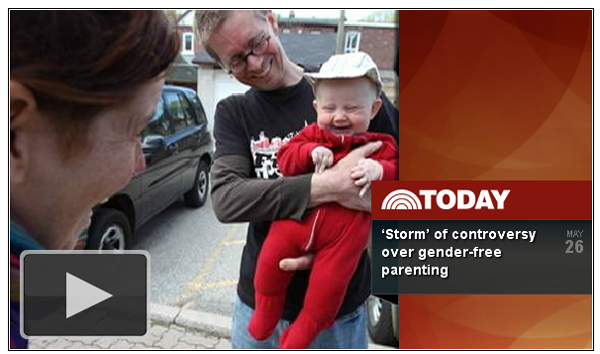
Was the strategic finger position intentional? One can imagine that these parents might just have that kind of sense of humour.
**P.S. Yes, with a doctorate in Educational Psychology (child/adolescent development), I can claim to be an expert on this subject.
22 May 2011
It is no secret, in this blog and in many other things I've written and said, that 1) I believe child abuse, sexual or otherwise, is wrong and society is right to punish offenders, and 2) I believe that the laws and the related Child Abuse Industry go far beyond what is necessary to address the problem effectively.
One reason child predator laws keep getting proposed and passed and are so popular in the media and with the public is that "ordinary citizens" are able to criticise and in some cases control the behavior of other people, almost as if they are part of the law enforcement machine itself.
If you doubt this, just watch the talk shows and pseudo-journalism of commercial television in America and Britain when these subjects come up (and they do come up, nearly every day). When you hear someone talking about pedophilia or predators, just try to imagine that same degree of smug hatred used when talking about industries that pollute rivers, or televangelists who bilk millions out of their dim-witted followers, or health insurers and pharmaceutical companies that overcharge for every service and product they produce.
I'm not suggesting that everyone should talk about all forms of evil with smug hatred. My preference is that people who watch television and consume the news should demand more emphasis on constructive ideas and actions, positive human achievements, uplifting stories.
OK, I'm not holding my breath until this happens.
9 May 2011
Today I received a diagnosis of prostate cancer. We'll see how it goes.
11 April 2011
Rev Terry Jones, pastor of the Dove World Outreach Church in Gainesville, Florida, is an idiot. His burning of the Holy Qu'ran on 20 March 2011 in front of 50 of his supporters - also idiots - is perhaps the most un-Christian act in recent memory, not to mention un-American. Oh, sure, they had an 8-minute "trial" of the scripture, and found it "guilty", determining it must be "executed". What Would Jesus Do? Well, not what Jones did. His arrogance is matched only by his unfathomable stupidity.
And what was his motivation? Hatred of Islam, according to his Web site ( http://www.doveworld.org/about-us). As a result of his action, I now hate him. Should I give him, or his church, the same treatment he gave the Holy Qu'ran? Or does the "golden rule" not apply to him? Oh yes, that same Web site is also littered with solicitation of donations to his enterprise. How crass and utterly contemptible.
Jones should be tried for treason, for putting our troops at increased risk in Afghanistan. As it was, a dozen or so innocent people in Mazar-i-Sharif and Kandahar were killed - KILLED - as a direct result of his action. He should also be tried as an accomplice in their murders.
I would like to get him in a dark alley myself, as I was travelling in a significantly Muslim country (Sri Lanka) at the time and, as an obvious American tourist, could easily have been the target of retaliation. To make matters worse, his name differs from mine by only one letter!
Here's what I recommend. Those of us who are outraged beyond belief at his unholy actions should charter a jet and send him and his 50 co-conspirators to Kandahar with bulls-eyes painted on their sorry asses, and let the Afghans who meet them at the airport have some meaningful target practice.
9 March 2011
A recent broadcast of a pop-culture television show featured an interview with Regina King, one of the stars of the TNT (cable-television) show "Southland". In a video clip from one of the episodes King, who is a police officer, is riding in a car driven by a fellow-officer played by Jenny Gago. Gago's character is upset that King's character has been dating her son.
Gago: "My son's 28, you're, what, 40?"
King: "I'm 36."
Gago (with obvious disgust): "I'm driving around with a child molester."
Several things are happening in this exchange. Gago is using an emotional term ("child molester") incorrectly, to say the least. The fact that she could use, or would even think of such an epithet in the first place derives from the tendency of (Western) society to regard older and older individuals as still being children. Even in that context, however, a "child" of 28 is simply absurd. Also, there is no indication that he was under duress to participate, hence there was no molestation involved. Furthermore, it seems obvious that Gago's attitude is one of over-protection, not simple concern for her son's well-being. Even if the man is totally "whipped" (i.e., controlled by women, in this case his mother), this level of over-protection goes beyond the pale. Simply put, his mother has no business speaking for him here.
Most importantly, mass-culture, in this case the script for a television show, is furthering the demonization of a lowest-pecking-order group of people. This is not that much different from the routine beatings, even occasional murder, of those believed to be child molesters by fellow-inmates (often encouraged by guards) in prison settings.
Why should you care? Because - depending on your politics or religious views or other peccadilloes - you may be next (see entry for yesterday, 8 March 2011).
8 March 2011
News Item: Sarah Ferguson, the Duchess of York, has apologised for accepting money from a convicted sex offender.
Some details: the sex offender in question is wealthy U.S. financier Jeffrey Epstein. There is no allegation or implication that the money was used for any purpose related in any way to children, sexual activity or the promotion or support of Mr Epstein's criminal past. The "problem" seems to be only that Mr Epstein is a "convicted sex offender", also known as a "registered sex offender".
The fact that these labels can be used to affect and, indeed, prevent business activities and other behaviours unrelated to any sex offense or other crime is not a big deal when considering the situation of one or two individuals, unfair though it may be in fact.
The problem for the wider society is this: Who's next?
When one type of social undesirable is allowed to be ostracised, demonised and, in effect, assassinated beyond any legally-allowed punishment, both history and mass psychology tell us unequivocally that other types of individuals or groups will be similarly targeted when their enemies - in many cases "enemies" whose real motivation is that they can profit from their victims or from exploiting their victims' situations - realise that the society is willing to turn a blind eye.
14 February 2011
Happy Valentine's Day.
Today, Good Morning America featured a follow-up to an earlier story (a week or so ago) on "Tiger Moms", who bring up their kids under very strict rules, including enormous pressure to excel in school. The previous story and today's follow-up were reported by JuJu Chang, who says she, herself, was raised by a "Tiger Mom". She says she firmly decided that she will not raise her own children in this way.
Today's follow-up featured interviews with three teens, apparently of High School age (they each looked about 15) - a female (Asian) raised by a classic "Tiger Mom", another female whose parents were described as "Hippies", and a male raised by "Helicopter Parents" (who "hover" protectively over their kids). Note that all three of these descriptions were used by the teens themselves. Note also that all three teens talked about their moms only, not a word about dads; and each teen rated her or his mom with an "A" or "A+" grade, indicating their approval of the ways they're being reared.
The core of the interviews, in my opinion, was when the interviewer asked the "helicoptered" boy about his social, non-school life. He matter-of-factly portrayed his mother as "protective" and freely described his limited social circle and his fear of going anywhere outside of home or school alone. His uneasiness in the larger world, he said, was because he always felt like he needed to be protected, to be watched. He did not seem troubled by any of this. By comparison, the young woman with "Hippie" parents said she felt just the opposite - no fear in public and, indeed, an eagerness to "explore the world".
The fact that the lives of children with "Helicopter Parents", and even those with "Tiger Moms" (are there no "Tiger Dads"?) can be pathetic has never been more clearly demonstrated. Bluntly, that poor boy is in trouble, I guarantee it. If he ever leaves home, he won't last a New York minute.
Immediately after the above-noted segment the network broadcast an advertisement for a new Disney animated film, to open in theatres on 11 March [2011]: Mars Needs Moms, known in Britain as "Mars Needs Mums". (Perhaps its only saving grace is that it's in 3-D.) Our culture has gone beyond absurd. 'Nuff said.
8 February 2011
News item: Catholic church approves confession app for iPhone.
And the absurdities just keep on comin'.
20 January 2011
Evidence that our society regards children as a separate species from all other human beings is found in the simplest of (unintentional?) slips of the tongue.
At the White House state dinner for Chinese president Hu Jintao on Wednesday, 19 January 2011, U.S. President Obama announced a minor, but crowd-pleasing agreement between the two nations to extend China's loan of several giant pandas to a Washington DC zoo:
- Our National Zoo will continue to dazzle children
and visitors with the beloved giant pandas.
--New York Times (online), 19 January 2011
Obama failed to explain just when children "graduate" into becoming visitors themselves. Age of consent? (16 in Washington DC) Age of majority? (usually 21) Age when they have to begin paying adult admission? (usually 12 or 13) When they're old enough to die in the military? (18)
The thing that bothers me the most is that Obama went for the "Awwww" response twice in one sentence: first children ("Awwww") and then pandas ("Awwwwwwwwwwww"). You can't get more condescending than that.
18 January 2011
News Item (wgntv.com/, 18 January 2011):
Two computer hackers, who allegedly stole 100,000 eMail addresses from iPad users who included high-profile politicians and celebrities, were charged with fraud and conspiracy to access a computer without authorization. Both deny the accusations.
News Item (China Daily (online), 22 December 2010): A Dutch Website is under investigation by authorities after "pedophile hunter" Yvonne van Hertum claimed the site hosted exchanges of child pornography. She based this on information obtained when the hackers group Anonymous hacked the site some time earlier.
Without comment on the collateral issues, let's focus for a moment on the basic element of both stories: hacking a Web site without a warrant or other official sanction. In the first case, the hackers were the alleged criminals, in the second case, those whose Web site was hacked are the subject of criminal investigations.
A double standard which condones otherwise criminal activity when the target of such activity is a social problem generally regarded as heinous is the proverbial slippery slope. Today its use against "Group A" is allowed, tomorrow against "Group B", and down the line, people begin to realise that basic rights in a free society, once lost, are very difficult to get back.
16 January 2011
In my view, advertising has a responsibility to be representative of the society whose pockets it is trying to pick. This is a relatively new necessity since, in former times, advertising reached a relatively limited audience. Today, with instant worldwide communications, it reaches a much wider audience and, in Western society, impacts virtually everyone.
With this in mind, why don't we see men with yarmulkes in television commercials? Why are there so few overweight people (except in weight-loss advertisements), compared with the high incidence of obesity that goes along with self-indulgent affluence? When groups of people are seen in print or television advertisements, why don't we see all-Hispanic, all-Asian, or all-black groups at least once in awhile? (For decades, and still today, all-Caucasian groups frequently are used.) Why are obvious gay or lesbian partners invisible when trying to sell products? Why do we so rarely see disabled people in commercials?
Besides simply being unfair, the lack of a diversity of people-types in advertising suppresses the flowering of diversity in the culture, and makes children who are different, or feel different from what they see, begin to question their own worth.
15 January 2011
Why do children - especially boys - dislike getting their hair cut? sometimes to the point of tears.
13 January 2011
The (U.S.) national debate continues about how to tone down violent rhetoric in the media and political gatherings. Actually, it's not so much a debate as a name-calling exercise, with some people saying it happens on both sides and others blaming the side opposite to their own.
Everybody is missing the obvious solution: when a voice becomes too extreme, too strident, too violent for reasonable discourse in a civilised society, the supporters of that voice - the people who agree in general with that person's views and philosophy - need to speak up and complain and, if possible, point out alternative ways to express shared views.
11 January 2011
In The Simpsons, Season 2 Episode 19 ("Lisa's Substitute"), Lisa's regular teacher is replaced by an unusual substitute - a man who listens to the students, encourages them to express themselves, and when necessary, coaxes them out of their shells. Lisa forms a special attachment to him, bordering on romantic, since she is fascinated to meet an adult that seems to understand and accept her on her own terms, unlike most adults, especially her father (Homer). The teacher, Mr Bergstrom (voiced by Dustin Hoffman), responds appropriately, always guiding Lisa to see herself, not him, as the special one.
At one point, when the students are out of the room, Bart's teacher, Edna Krabapple (voiced by Marcia Wallace), comes on to the new substitute in a very seductive manner. He politely declines her offers, saying, "I'm sorry Mrs Krabapple, you're very nice, but it's the children I love." Lisa overhears this from the hallway, and sighs happily.
Lisa confides in Marge (her mother) that she deeply admires Mr Bergstrom. Marge's response is to remind Lisa that Homer has good qualities, too. Lisa seeks out Mr Bergstrom on several occasions, speaks with him alone, and confides in him. Again, he always responds appropriately for a teacher, but it is obvious that he is not distant and uncaring, like most other teachers Lisa and her classmates have known. When the regular teacher comes back suddenly, Lisa is distraught that she may not see Mr Bergstrom again. (Remember as you read this that Lisa is not yet 8 years old. She celebrates her 8th birthday later in this second season.) She goes to his apartment house and asks the landlady where Mr Bergstrom is. The landlady tells Lisa that he is probably at the train station, and in the process expresses her own admiration for the man. Lisa says, "I see he touched you, too", and they both sigh.
At the train station, Lisa catches Mr Bergstrom just before he boards the train. Alone on the platform, they have a touching good-bye scene, with the teacher holding Lisa's hands, then hugging her. He gives her a note, saying that this is all she will ever need. "Goodbye, Lisa, honey. Just read the note." Lisa runs alongside the departing train, like so many romance movies of the 1940s, and Mr Bergstrom is gone. Lisa reads the note: "You are Lisa Simpson", it says simply.
The show's original broadcast date was 25 April 1991. That script could not be written for any American TV show today. There are so many things in it that the public just doesn't accept anymore. What a great pity.
[added on 15 January 2011]: Maybe I should start a list here of films or television shows that once were produced without question or comment, but could not be made today because of changed attitudes in society.
In addition to the 1991 episode of The Simpsons, discussed in the 11 January 2011 post in which this addition appears (and any number of other shows or situations depicted in that show over the years), I would add:
- Charles in Charge, which debuted in 1984 (CBS television). In that show, Charles (Scott Baio) is a college student who is living with a family and, in exchange for paying no rent, is resposible for their three children (two boys and a girl, all younger than 15), as a nanny or governess would have been in former times. In several online (Web) descriptions, he's called a "live-in babysitter". In 2011, a male babysitter, live-in or otherwise, seems out of the question.
10 January 2011
It's about time for the major U.S. television network morning shows to add some openly lesbian or gay anchors to their programs. The shows I'm referring to are ABC's Good Morning America, NBC's Today Show, and CBS's Early Show. A generation ago, it was time for our society to have the benefit of minority faces and viewpoints on these shows, and we got them, and very few would disagree that we're all better off for it. I can't imagine the last 20 years of television without Al Roker (NBC's Today Show weather anchor), for example.
One of the minor reasons for suggesting this is that I'm just fed up with heterosexuals flaunting their parenthood, with every other comment being about what their kids had for breakfast, or how they got potty trained six weeks earlier than most other kids their age, and so on ad magnam nauseam. Parents who invest their entire worth in their kids are boring at best, and are almost certainly doing their kids, as well as their viewers who see them as role models, a very big disservice.
More importantly, openly gay and lesbian anchors on the morning programs would reflect the current reality of our social progress and provide the viewers some perspective on how to live differently. (The ability to live differently is going to be one of the most valuable, and vulnerable, human experiences of the next few decades.) It is not enough to have heterosexuals sympathetically interviewing gay celebrities - as was the case this morning on the Today Show, when Meredith Vieira was interviewing Olympic figure skater Johnny Weir - though this is definitely an improvement over the treatment of gays in the past which, in many cases, was silence.
It's time to take the next step. Without naming names (ahem, Good Morning America!), the first step could be for certain anchors who are already part of the show's lineups to let us know about their own gay identities, as many of us have suspected. Come on, networks, Get Glee!
8 January 2011
Within hours of the tragic shooting of U.S. Representative Gabrielle Giffords and a dozen or more others in Tucson, Arizona, pundits were beginning to see a possible connection between hate-rhetoric, as amplified in today's media-saturated atmosphere by radio shock-jocks and day-and-night cable TV propaganda, and the level of violence recently noted against elected officials and people running for office.
People who are society's current outcasts, particularly those whose sexual behavior or preferences allows them to be demonized without any measurable opposition, know well how this cycle works, and it has been so throughout our sorry national history. So, apparently, a U.S. representative had to be shot, and several of her supporters killed as they came to meet and greet her, before it dawns on people that hate-rhetoric is uncivilized, and has grave consequences. This is both reprehensible and par for the course.
Note that regulation or censorship as a solution is not acceptable. Vocal opposition to hate-mongers, including boycotts of their sponsors and media outlets, will turn the tide when it is motivated by compassion and when viable alternatives to the vitriol are proposed and encouraged.
In one astounding example of just how mechanical people are with their ability to hate, one U.S. Representative (not involved in the Tucson shooting incident) on a talk show said - and I will have to paraphrase, as I don't have his exact words - that the level of hateful rhetoric on both sides [right and left] has to be toned down, even if this particular incident was not politically movated but was carried out by this deranged, evil monster [the alleged shooter]. In one sentence he calls for less-hyped rhetoric, and he demonizes the man accused of the shootings, even though that man might well have been delusional and insane. Only in America. Oh yes, also Britain, and, well, pretty much everywhere else where human beings haven't fully evolved yet.
6 January 2011
When adults are near boys of almost any age up to adolescence, it is very common for them to "ruffle" the boy's hair. You know what I mean, put your hand in and mess it around. It's endearing and, most likely, a sign of affection.
It is such a common behavior that it was included as a plot element in the 1948 film, The Boy With Green Hair. Dean Stockwell, as Peter, would go walking with Pat O'Brien, as Gramp Fry, and everyone in town would ruffle his hair. Peter would frown, and pat his hair back into place. Of course, soon after, his hair turned green overnight, leading to the central theme of the film - people's treatment of someone who is different.
I've noticed, however, that no-one ever does this with girls. I wonder why that is. I also wonder why adults ruffle boys' hair in the first place.
I think there's a lot to this - folklore, psychology, maybe even some primordial needs - but, like so many things that I don't know much about, I'm going to leave it there.
29 December 2010
I've written and said for years that children should be prepared for life more than protected from it. Today, while searching for information about the 1992 film Radio Flyer, I happened upon a Web site called "Movieguide - The Family Guide to Movies and Entertainment", (https://www.movieguide.org/reviews/movie/radio-flyer.html) which describes their information on this film as a "Christian Movie Review". There I found perhaps the most absurd example of child-protection that I've seen yet.
Under the section titled "Content", which is at the top of the page, I found their claim that the film had
-
6 obscenities & 11 profanities (7 are exclamatory profanities)
(I presume any Christian would know the difference between "exclamatory" profanities and whatever the opposite is, as well as the difference between profanities and obscenities.)
I realize I'm losing my objectivity as I write this, so I'll just leave it at that . . . except to express my amazement that someone (probably a volunteer? I mean, what business would pay people to do this) sat in a darkened room with a tablet and pen, and counted up obscenities.
Oh, my God. It just hit me. What if they were wrong, and there were 12 profanities? Could they be sued when a child who has seen the movie grows up and, oh, I don't know, spits in the street or farts in a nice restaurant and blames it on her boyfriend?
* * * * *
Wait. Regarding the same Christian Web site film review mentioned above, I've just found something else - something much more serious. The following statement they make begs for some comment:
-
Suffering is real, and problems are not solved through magical
thinking. Our hope is not in an impersonal force, but in the
sovereign Lord who delivers us from evil.
The suffering they refer to is the physical abuse and aftermath that Bobby, the central character of the film, struggles with and, in his own way, overcomes. The Web site's statement, however, can be critiqued without knowing any of the background.
It's quite simple. Faith is itself a type of "magical thinking" that people use - often quite effectively - to solve their problems. Until the sovereign Lord can be seen, the source of power must be placed in the same category as Iceland's unseen Huldufolk, Ireland's leprechauns and any culture's ghosts. Medieval Christian revisionists, after all, made the "Holy Ghost" part of the trinity, so my association of these cultural traditions is not so blasphemous.
Oh yes, the point that "suffering is real". Yes, it is. My view is that almost any means of dealing with suffering - including Christian faith, but not, by any means, only that - is worth employing provided that it does not sanitize nor compound the problem, and the suffering person retains the benefit inherent in having suffered. (Yes, I said benefit.)
25 December 2010
Unrelated thoughts on Christmas Day, 2010:
1. Be suspicious of every situation in which someone is trying to sell you something. In other words, always be suspicious.
2. I wonder if left-handed Catholics cross themselves "backwards"?
13 December 2010
Graffiti seen in the Doe Library at U.C. Berkeley (where else?):
∞ · 0 = 1
8 December 2010
jmbernard86 has posted a YouTube video of the Bethany College Choir and Orchestra performing the "Hallelujah" Chorus from Handel's Messiah. It's a very good performance.
rockerdriver has added a comment in the blog below the video: "This will always be the most beautiful song in the universe! If not for Jesus Christ it never would have been written!"
What drivel!
First of all, it's not a song. Second, if it really will "always be the most beautiful", then why don't all composers just give up and become electricians?
Finally, "If not for Jesus Christ it never would have been written" - Right, but if not for Jesus Christ, the Templars and other "Christians" wouldn't have slaughtered hundreds of thousands of people (mostly Muslims, by the way) in the Crusades that began in the XIIth Century and continued through most of the last millennium.
Using Jesus as a reason (or excuse) for human accomplishments (or mistakes) works both ways.
5 December 2010
Some discrepancies in our society remain unexplained, and as long as they remain so, our failure to deal with them aggressively is unacceptable.
Young people in their early teens - 13, 14, sometimes even younger - can be tried and punished as adults for serious crimes, The assumption underlying this barbarity is that "They are old enough to know what they were doing". Youngsters of the same age may not, however, say "Yes" in sexual situations. The assumption underlying this anomaly is that "They are incapable of giving informed consent". Quite simply, one of those ideas has to be wrong.
On a similar note, many in America vigorously resist sex education in schools and embrace the notion that persons under 18 - or in some people's opinions, even older - are "children" and, consequently, are not supposed to be sexual. Girls of 12 are being impregnated by boys of 13 (for example), in cities and rural areas all over the country. Quite probably, one of these scenarios is faulty.
Some in America hold the (blatantly ignorant) opinion that it is impossible for an adolescent to know that she or he is lesbian or gay. Gay and lesbian adolescent suicide rates are considerably higher than those of their straight counterparts. Quite obviously, one of these things has to be an illusion.
2 December 2010
It is a significant problem that if I were graduating High School today, it would be near-impossible for me to set out on a career such as the one I began 40 years ago.
In the first place, I wouldn't have the motivation in that direction. Men today typically don't even consider that they could be teachers of young adolescents (my occupation in the first decade of my working life). What High School counselor would even suggest this option to a boy? That's a woman's profession.
Second, if I somehow were so motivated and could envision myself as a Middle School teacher, it would be exceedingly difficult for me to get a job. Again, the society regards teaching as a woman's profession.
Finally, if I ever did get such a job, I would be under much more scrutiny - even suspicion - than any of my female colleagues. "Why did he become a teacher?", would be the common whisper. "He must have ulterior motives."
Unfortunately, when the teaching profession is not gender-balanced, students and our society are the losers.
30 November 2010
What does our culture learn, so to speak, from fast food?
The customers learn to be satisfied with mediocrity. They should be learning (but probably aren't) that they are paying many times what it would cost them to make the same hamburgers and tacos at home. All this as they exercise their freedom (?) to become obese and dependent.
The employees - mostly teenagers in their first job - learn that work is not a place for creativity or individuality. They wear uniforms, for God's sake. They learn that self-expression is not welcome in the workplace ("Do you want fries with that?" is their script). They work ultimately for "The Man", as the counter-culture (no pun intended) used to say. They are the robots of today, as society waits for the truly mechanical ones to become affordable.
Fast food is a direct product of society becoming too big. The familiar franchises flourish worldwide, making literally billions of people feel more comfortable with social structures that don't even know that individuals exist. These companies, in their own self-interest of course, also serve to perpetuate this Super-Sized culture that long ago became too big for human consumption.
[ADDED 2014.06.19: Last night, in my perverse need to amuse myself with Chuck Lorre television shows, I saw one of his Vanity Cards that discusses this issue in very similar terms. It's No.392, first aired at the end of "The Decoupling Fluctuation", an episode of The Big Bang Theory, which aired on 1 October 2012 (according to Lorre's Vanity Card Website) or 4 October 2012 (according to IMDb.com/). Lorre's Vanity Cards are the one-second screen flashes of messages at the end of episodes of TV shows produced by Lorre. They can only be read by freeze-framing a recording of the show in which they appear, or searching them online.]
28 November 2010
Have you ever seen a photograph of a handshake, where one hand is white (Caucasian, for example) and the other is black? Of course you have. It's a cliché.

Have you ever noticed that the black hand is almost always the one in front (i.e., closer to the camera)? Go ahead, do a Google Images search on the simple term "handshake" and count 'em up for yourself.
Oh yes, and they are always men's hands.
The only point I want to make is that we must pay attention when clichés are used. They tend to manipulate our minds and push us away from diversity and into conformity.
14 November 2010
What is a celebrity today without a charity to sponsor? I'm about to criticise this trend, so get ready.
It is difficult to find fault with a charity that helps children, but why do so many celebrities, news organisations, politicians and businesses choose them, and only a very few others, as their "pets"? What about other causes that one never hears about? Homeless men. Human rights violations (other than the celebrity-studded "Women's rights in Muslim countries" cause). AIDS and other diseases all over Africa? Persons (OK, almost always men) falsely accused of crimes?
This is not to say that the short list above, and many other worthy causes, do not have their supporters, nor that glamorous charities for children or any other cause shouldn't get their fair share. Of course they should. It's just that as I hear more and more famous people pushing their favourite causes, I begin to think (cynic that I am!) that they may be motivated more by the career boost, as well as tax benefits, of trumpeting their support for sentimental favourites like charities that benefit children, or finding a cure for breast cancer. Shouldn't we be equally concerned for people of any age who are in distress? Shouldn't we be lobbying for a cure for "all" cancer?
14 November 2010
Sitting down to watch a DVD of a fondly-remembered film sometimes gives you more than you bargained for.
Turner Classic Movies and the Warner Archive recently made available In the Mood [aka The Woo Woo Kid](1987), which I've wanted to see on DVD for a long time. The film tells the true story of Ellsworth 'Sonny' Wisecarver and his troubles with Los Angeles-area law enforcement in 1944. Sonny is played artfully, passionately and believably by Patrick Dempsey (who was 21 when the film was released). Dempsey gets us on Sonny's side, and never lets us go! The film's opening narration sets the stage pretty well:
-
My name is Ellsworth 'Sonny' Wisecarver.
When I was 15 years old I had a couple of misguided but highly
publicized affairs with two significantly older women. [NOTE: the women
were 21 and 25 years old at the time.]
Now if a kid did that today it wouldn't raise an eyebrow, but back
then I was sharing headlines with Hitler. . . . Society condemned me,
kids idolized me. The newspapers had a field day.
Sonny tells us that it is now "43 years later", which would put his narration into the context of 1987, when the film was released. His comment that his "flings" with adult women would go unnoticed was probably a bit naïve for 1987. But the real shocker for me viewing the film in 2010 was just how much society has changed in attitudes toward the kinds of things that Sonny got involved in. In case there's any doubt in this short overview, there isn't any when you view the film: Sonny had sex with both women (not explicitly shown, but clearly understood), and, by his accounts, enjoyed it thoroughly. After his first erotic encounter, he says it succinctly: "Women are good".
In Sonny's day, the weight of the legal system came down on him, as he was sent California Youth Authority (in effect, a prison for juveniles) where he was supposed to stay until he turned 21 (six years). The women he was involved with - he married the first one - faced charges related to helping a runaway. The first woman was given probation, and charges against the second were ultimately dismissed.
In the 66 years since Sonny Wisecarver's momentous 15th, society has done a complete about-face and, in my opinion, has gone far beyond what is needed to address even its own redefinition of the problem. If a Sonny Wisecarver ran away and had a sexual relationship with an adult today, Sonny would be regarded, perhaps even hailed, as a victim. The adult almost certainly would go to jail, and would be required to register as a sex offender, effectively a lifetime punishment. The harshness of the punishment and disapproval of society, moreover, would increase if the participants were both male, or if the liaison involved an underage female and an adult male.
Once more, let's take a look at the Sonny Wisecarver case: girls as well as middle-aged women swooned, boys and men expressed open admiration, and newspapers focused on quotations from Sonny's two adult partners that described him as more of a man than their husbands ever were.
My point has to be this: neither the hoopla of 1944 nor the overreaction of 2010 is an ideal social reaction to sexually intimate behavior between an adult and a mid-teenager. By the same token, such behavior cannot simply be ignored in a society such as ours. Perhaps a solution between 1944 and 2010, so to speak, is what we need. But how will our society's hysterical approach to such matters ever allow us to find it?
Postscript: To illustrate society's ambivalence between viewing this case as serious or frivolous, consider the taglines on the video release artwork, presumably from the mid- to late-1990s, posted at IMDb (click here to view the artwork; taglines are above the title and just below the photograph of the girl kissing Patrick Dempsey): "Lock up your mothers - It's the Woo Woo Kid. He's more of a man at 15 than most men are at 35."
1 November 2010
I just ran across an article I wrote in the mid-1970s about the remarkable film (and book) Lord of the Flies (the film was released in 1963). As most people know, the story was about a group of choirboys who survived a plane crash in which all the adults were killed, and how they lived, and formed groups, and fought and survived in the weeks and months before they were rescued. It is, of course, an allegory about the basic nature of human beings.
The fact that boys were used to tell the story seems completely natural and appropriate. On re-visiting my article now, however, it crossed my mind to wonder whether the same story could be told with girls as dramatis personae. The more I think about it, the more improbable the idea seems. Not only would it not work as an allegory, it would raise a number of issues never intended by William Golding, the story's original author.
What does this mean? Neither you nor I have enough time to consider that question. Perhaps an enterprising doctoral student might consider it as a dissertation topic . . .
31 October 2010
News Item: The mayor of Belleville, Illinois, near St Louis told reporters that he had to set a trick-or-treating age limit of 12 because senior citizens and single moms were frightened by 6-foot-tall kids on their doorsteps on Halloween.
Aside from the fact that this is another example of creeping "mom power", it is one further indication of our society's ambivalence about childhood itself.
Are teenagers children, or are they adults? 13-year olds pay adult prices at movie theatres and amusement parks, but in most areas can't drive until they're 16, can't buy tobacco or legally have sex until they're 18, and can't drink alcohol until they're 21. Much more importantly, teenagers and sometimes even pre-teens can be charged and sentenced as adults in criminal cases.
We really need to make up our minds about this. Children are not only unprepared to assume adult responsibilities when the time comes (if it ever does in our society!), but they are actively confused by their "handlers" about what adulthood means.
As for Trick-or-Treating on Hallowe'en - ENOUGH RULES ALREADY. Let it be about creativity, spontaneity and (non-destructive) hooliganism, as originally conceived by those in the great beyond who only get one "night out" each year.
26 October 2010
It fascinates me to see how much attitudes have changed just in my lifetime.
Recently I acquired a DVD of 39 episodes of The Jack Benny Program, a very successful and popular television show of the 1950s and 60s. (I must have seen some of the original broadcasts when I was growing up.) In a 1951 show, Jack's featured guest Dorothy Shay introduces a hilarious sketch in which Jack comes out with a group of his musicians dressed as hillbillies, along with Lynette Bryant. According to the www.tv.com/ description of a subsequent show on which Lynette Bryant also appeared, she was 10 years old at the time.
While Jack and the musicians ham it up, the girl stands there doing nothing. At one point in the sketch, Jack introduces everyone and, when he comes to her, he says, "And this is mah wife!" The audience erupts in hysterical laughter (and I fell off my La-Z-Boy). The line is nearly as funny as his legendary response when a robber demands "Your money or your life", and Jack says, "I'm thinking it over".
After the sketch, Jack brings the young actress out for a curtain call and kisses her on the lips.
It would be absurd to suggest that anything other than good, clean fun was involved in that spoof. Still, it goes without saying that such a joke - the concept of any female under 18 (let alone 10!) being the wife of a 39-year-old man (!) - would not be viewed today in the same way it was in 1951.
22 October 2010
In this round of American elections (November, 2010), I'm wondering:
- Why do very wealthy people want to be governors or senators, and
- Are they all (except for members of the Kennedy family) Republicans?
20 October 2010
For the second time in two weeks I've seen television coverage of the Princes William and Harry (England) that featured their significant humanitarian and charity work (which most members of the British Royal family engage in, to their credit). In both cases, the two different (female) reporters ended their segments with the comment, "I can't help but think their mother [Princess Diana] would be so proud".
This simple comment instantly emasculates these young men, now in their mid- to late-20s, reducing their real accomplishments to the equivalent of childish attempts to please their mother.
SHE'S DEAD. Get over it, and give these guys the credit they deserve for inventing and accomplishing their own lives, without Diana's hovering ghost having to approve everything.
17 October 2010
The great struggle of my life is to try and make sense of everything I see, to somehow find, for every sight, sound, thought and deed that enters my awareness, its place in some "stupendous whole", in the words of Alexander Pope. Sometimes I think - wait for the pun while I apologise in advance - that it's all just "one stupendous hole".
The great tragedy of my life is that (so far) I have never been a long-term resident of New York City. I'm jealous, Mayor [Michael] Bloomberg, and I have been ever since my first visit when John V. Lindsay was mayor.
As small consolation, I did see Marlene Dietrich live in concert once, and I shook hands with Jerry Morris (not on the same occasion). [An explanation of why the last item is important is available on request.]
15 October 2010
I have the greatest reverence for the Prophet Mohammed and for Jesus Christ, both of whom gave the world great gifts of understanding and new ideas about how human beings can live, love and contribute.
Centuries have come and gone, and things have changed. Today, sadly, Islam is just as bad as Christianity.
OK. Let the death threats begin . . .
P.S. As Georg Brandes said, "It would be as impossible for me to attack Christianity as it would be impossible for me to attack werewolves." (Selected Letters of Friedrich Nietzsche, Brandes to Nietzsche, 23 November 1888)
11 October 2010
Social networking - for example, Facebook, Twitter, MySpace - (perhaps unintentionally) serves the social purpose of homogenizing the culture. (See the Wiki list of social networking websites for descriptions of many, many such sites.) It accomplishes this by reducing users privacy, or eliminating it altogether; by making conformity a virtue; and by exposing diverse points of view to the unrealistic criticism and (often) condemnation of virtually the entire world. Naturally teens, the most vulnerable to conformity pressure and at the same time the most in need of developing their individual, diverse identities, are social networking's most active participants.
Social networking is just one of many media-driven pressures on modern society to develop, think and behave in "acceptable" ways. This is part of the overall " dumbing down" of our culture that has been well-documented by Mark Bauerlein* among others, but the pressure toward conformity is more than mere dumbing-down, and much more serious.
Commerce - the process of selling things to as many people as possible - is ideally positioned to take advantage of these trends, as homogeneity - sameness - in the culture makes product development and marketing much easier.
But the individual is the (very big) loser.
-
_______________________________________
*Mark Bauerlein. The Dumbest Generation: How the Digital Age Stupefies Young Americans and Jeopardizes Our Future. New York: Jeremy P. Tarcher/Penguin, 2008.
4 October 2010
As far as I know, humans are the only species where individuals who reach puberty are not ready to begin behaving as adults in their groups.
I wonder if we've got it wrong . . .
ADDED 2016-07-03: I've discovered some writers who have agreed with me - unusual as this seems! - and, in fairness, just in case my idea is subliminal plagiarism, I include some references here:
-
[Psychiatrist Harry Stack]
Sullivan distinguishes two stages of childhood between infancy and
adolescence. By "childhood" he refers only to the first of
these. . . . Later childhood, or roughly what Freud called the latency
period, Sullivan speaks of as the juvenile era. [He goes on to
distinguish both of these phases from adolescence, which begins
at or around puberty.]
--Edgar Z[odiag]. Friedenberg. The Vanishing Adolescent.
Boston: Beacon Press, 1974, pp.18-19
In sexual education as in other education, one should also not forget that
we are bringing children up not to be children, but to be adults.
--Fredric Wertham, M.D. Seduction of the Innocent.
Laurel NY: Main Road Books, 1954/2004, p.175
It was the Convention on the Rights of the Child of 1989
[UNICEF - United Nations International Children's Emergency Fund]
which first did away with the distinction between
children and adolescents and labelled all minors under 18
"child" (Art.1).
--Helmut Graupner. Keynote lecture delivered at 8th International Conference
of the International Association for the Treatment of Sex Offenders (IATSO)
Athens, 6th-9th October 2004
2 October 2010
A Leave it to Beaver (TV show, 1957-63) episode where Beaver reads Scott's Ivanhoe, then sets out to "defend womanhood and right wrongs" (not to mention "slew dragons", which is how he put it!) made me realise yet again the basic, overriding and deadly difference between how children get growing-up messages from the culture now, as opposed to then: today, virtually every method and route that delivers cultural messages to children is controlled by advertising.
This, as I've written before and will again, is very bad news.
1 October 2010
Religion of rules is a tool for social control and, in some societies, serves a purpose. It isn't really religion, though, but politics. Religion of ideas instead of rules is better.
Even more useful, religion of feelings that can vary from person to person is true religion. These various versions of religion are not always compatible. When they conflict with each other, the religion of feelings must prevail.
Islam, Evangelical Christianity and some forms of Judaism are examples of religion of rules. Unitarianism, the original version of Christianity and perhaps Presbyterianism and the like are examples of religion of ideas. Buddhism, Transcendental Meditation and study of The Tao are religion of feelings.
1 September 2010
Spontaneity and originality seem in short supply these days. It seems that everything from public events to scripted entertainment programs are conceived and executed according to formulas, as if their creators feel to deviate from the "plan" would mean less support, less attendance, and hence less income. No doubt they're right in most cases, but the culture suffers when originality gives way to predictability.
Some examples. Movies must have noise, special effects, and explosions, while those films with serious themes or well-crafted stories and characters have a tough time finding an audience.
Sporting events must have all the "bells and whistles" that once were novelties - the seventh-inning stretch, the organ playing "charge", the "wave", the mascots - or the fans don't think they're getting their money's worth.
People can put up with bad music (or maybe they don't know the difference these days?) at Summer outdoor concerts, as long as they have fireworks.
Tragic deaths are followed by candlelight vigils, and "spontaneous" memorials appear, consisting of cards, photos, candles, balloons, flowers and stuffed animals. The size of the memorial seems to be in direct proportion to the amount of publicity the tragedy has had.
Congregations in churches applaud at weddings when the groom and bride kiss. If this didn't happen, it seems the wedding wouldn't be complete and, presumably, would have to be done over.
Broadway and (gasp) even London stage shows fully stage, block and script their curtain calls. If anything should be left to the moment, it is the acknowledgement by actors of their audience's applause. On the contrary, the manufactured "spontaneity" oozes and drips from the performers onto the gullible theatregoers who, if they go again in a week or so, will see the same phony show of "gratitude". Gone are the days of the likes of Al Jolson, asking for the house lights to be turned up, and then, honestly and sincerely, interacting with the audience.
And popular music, all based on one or two rhythmic patterns and harmonic progressions of no more than three chords - except Rap, which uses no actual music at all - has for several decades been nothing more than entrepreneurs copying the real pop music geniuses of the past, like Michael Jackson and . . . well, Michael Jackson.
The solution? Teach kids to reject the ideas that (financial) success is everything and that copying what's been successful in the past is the path to greatness.
02 September 2010
A commercial for Chrysler SUVs on network television shows a boy, about 10, running through a wooded park, apparently trying to escape from some bullies.
An SUV, its back door conveniently open, waits for him in the parking lot, and in a single, fluid motion he jumps in and shuts the door behind him. We see him arrogantly sticking out his tongue at his pursuers as the vehicle pulls away.
Guess who's driving?
Yes, of course, it's Mom.
29 August 2010
The 62nd Annual Emmy Awards program, broadcast in America on the NBC television network, had (of course) lots of commercials. Most were directed to the products and concerns of adults, but one ad jumped out at me, so to speak, as it was for Tonka trucks, toys most often used by pre-teen boys. The ad showed two boys who seemed to be about seven or eight years old, romping in a living room and playing in typical ways with these large, plastic trucks.
About two-thirds of the way through the commercial, I said to myself, "Before this is over, the Mom is going to show up". Sure enough, for a second or two just at the end, Mom appeared in the doorway behind the boys, for no reason at all, serving no purpose.
I've discussed this issue before in this "column", but never before has Mom's omnipresence seemed more silly and pointless.
19 August 2010
The local television morning news program today featured a beauty expert "showing moms how to look their best when dropping off kids at school".
There is so much wrong with that concept that I can't even begin to comment.
12 August 2010
If you're ever inclined to trust a psychiatrist, think twice. The grand tradition of that profession is perhaps best-exemplified by Dr A.A. Brill's appearance in a Paramount newsreel in 1938, warning of the evils of current popular music (click here to see the video clip).
He said, "Swing music represents a regression to the primitive tom-tom-tom. A rhythmic sound that pleases savages and children alike, the main effect is to narcotize them. It acts as a narcotic and makes them forget the reality. They forget the depression, the loss of their jobs, [and] all terrible things that beset them. It is like taking a drug."
And forgetting these things (temporarily) is a bad thing? No-one ever claimed, though Brill clearly is implying it, that Swing Music caused permanent loss of memory. Of course, the same things have been said about jazz, rock-and-roll, heavy metal and rap (though I must say that rap music deserves its critics).
5 August 2010
A commercial for Rice Krispies Treats is being shown on American television, in which a mother is bringing her son to school for his first day of what appears to be Junior High or Middle School (grade 6 or 7). The boy is clearly embarrassed at his mother's presence on the very steps of his school, and finally tells her, "Mom, I can walk from here". As he departs, she calls out, "Do you know your . . .". "Yes, mom", he replies with exasperation.
Cut to inside the school, as the boy approaches his locker, pauses, then realizes he has forgotten his combination. He appears dejected, shoves his hands in his jacket pocket, and discovers something there . . . a packaged Rice Krispies Treat, on which is written his locker combination along with a smiley-face from Mom. The tagline is, "You're never too old for a little something sweet."
This is an example of child abuse, perpetrated for the sole purpose of making the mother feel better because her child is still dependent on her. (A common complaint of mothers is that they regret their kids can't remain small - and dependent - forever.) The abuse is subtle, and its detrimental effect will be felt years later, but it is abuse nonetheless, as it robs the young person of a critical opportunity to take responsibility for his own actions and solve a problem himself. If he doesn't learn it now, when will he? Or, more to the point, when will his mother let him?
The company (Kellogg's) shares responsibility for this type of abuse, as they are choosing to portray a mother's meddling in the development of a young adult as a recommended way to relate to her son and continue to feel instrumental to his well-being.
For this, and a million other reasons in advertising and elsewhere, you can just kiss American youth goodbye, as their future becomes more and more hopeless.
15 July 2010
Remember the Equal Rights Amendment (ERA)?
-
Equality of rights under the law shall not be denied or
abridged by the United States or by any state on account of sex.
It seems now to be an idea whose time was not necessary. Except, consider this: what if someday in the not-so-distant future the trajectory of women's power in our society continues to the point where men might actually need such an amendment to retain or regain their equal rights.
Those sexist windbags who shot down the amendment (by a razor-thin margin) in its original form in 1982 might have wished they'd supported it when they had the chance.
8 July 2010
This is really weird.
In a discussion about Father's Day on the ABC network morning program The View (originally aired during the week of June 9, 2010 and re-broadcast today), co-host Sherri Shepherd mentioned that she had heard that some little boys "moon" their mothers on Mother's Day. She commented that she would really like her son Jeffrey (who is five at the moment, born 22 April 2005) to do that. No-one at the table batted an eye. The only comment was, "don't you see his butt often enough?", which was spoken as a throwaway joke.
For anyone who knows what "mooning" is, you will also be aware of the sexual content of the act. For those who don't know what it is, let's just say that if an adult had a photograph of anyone under 18 doing it, he or she could be prosecuted for child pornography and required to register as a sex offender for life.
In other news, or rather on another installment of The View, which aired around 20 February 2008, the discussion was about women who go around naked in front of their young sons. The same Sherri Shepherd reportedly said, "I am flying home to see my kid, and I cannot wait to take my clothes off . . . right now [age 2] he just goes, 'mommy boobies', and he laughs".
This account was posted to The Huffington Post (www.huffingtonpost.com/2008/02/20/sherri-shepherd-i-cannot-_n_87603.html), and went on to say that Shepherd is not so liberal when the subject is fathers who might go around naked in front of their daughters, which she believes would be traumatizing. In her case, however, the blog notes, "My breasts do not traumatize my kid."
What, in God's name, is going on here?
29 May 2010
On a television morning news program today, the entertainment reporter noted - with the requisite video clip - that in a recent stage appearance, Miley Cyrus planted a full-lip, lengthy kiss on the face of one of her female dancers as a choreographed part of the routine.
So much for Disney® innocence, eh?
In my opinion, the kiss itself is a mere blip on the radar, remarkable only for the transparent attempt to raise eyebrows and, inevitably, get publicity for the performer.
The reporter's apparently unscripted comment, however, was what really caught my attention. He asked, rhetorically, if Cyrus might be a Lesbian - so far, so boring - but then went on to comment to the others at the news desk, "Can we even talk about this now? Is she eighteen yet?" The consensus was that she was seventeen (she was born on November 23, 1992, which, by my abacus, makes her eighteenth birthday later this year, so they are right), so it was inappropriate to discuss her sexuality.
Another astounding leap of logic in a country that never stops leaping. Give me a break. The young woman herself, and her promoters, made a conscious and deliberate decision to portray same-sex female sexuality in front of thousands and, by YouTube extension, millions of people. There is no other way to interpret a ten-second lip-lock in the classic ballroom-dance "dipped" position. We can bloody well talk about it, and her age is (or should be) irrelevant.
29 May 2010
In 1963, newspaper and magazine writer and editor Martha Weinman Lear noted in her book The Child Worshipers that American parents were "making the child a new status symbol and parenthood a competitive sport". Many social developments later, it seems that trend is now the norm, even as other norms of the early 1960s - two-[heterosexual]-parent households, Caucasian majorities in most large cities, and overwhelming male dominance of the public sphere (to name a few) - have yielded to more realistic and inclusive views of how people should live.
But what of this "new society" in which the child is the central focus? Is this conducive to healthy child development? Probably not, unless we are prepared to support a nation of self-centered, bratty adults who see themselves as victims, compulsively overindulge in everything from food to prescription drugs, and continue throughout their lives to seek the unconditional affection that was lavished upon them when they were children, then denied them from adolescence on. (See comments below, entered on Mother's Day, 9 May 2010, including observations from the late 1920s by behaviorist John B. Watson on this topic.)
In case the reader needs evidence that ours is a child-obsessed society, consider a survey published in an American regional magazine this month, in which women (the theme-topic of the entire issue) were asked to share their opinions on a range of topics.
"Who is your hero?" was answered by the following: 1. My dad; 2. My husband; 3. Oprah; 4. Jesus; 5. My children; 6. Mother Teresa; 7. Michelle Obama. Children as heroes for their mothers? This may be the ultimate narcissism.
"What's your proudest moment?" is perhaps the clincher for evidence of the child-obsession of today's women (i.e., today's society, as most men lack the cojones to question the trend): 1. Children and grandchildren; 2. Adopting children; 3. Children's college degrees. First of all, these are not so much moments as they are stages of life, but that's nit-picking. The fact that all three of the responses involved children is the key point. This is well beyond the borderline of obsession.
Other responses include these, to the question " What makes you laugh?": "The funny things that come out of children's mouths"; and "Children. Kids are so truthful and funny." (No further responses to this question were offered.) And the following solitary entry under the category, "Additional comment on the survey": "Be independent, but remember family comes first." Can they have it both ways? Furthermore, in a society as conformist as ours is today, what constitutes this independence that the survey is suggesting?
In fairness - and hope? - I should note that no claim to scholarly accuracy or a representative sample was made, and there was no indication of who conducted the survey, their methods or their credentials. Maybe this was just a popular magazine article, after all, concocted by the publication's editors and writers to present what they believed their readers wanted to believe. Yeah, right.
12 May 2010
Yesterday, Tonya Craft, an Oklahoma teacher, was found not guilty on 22 counts of molesting three girls aged 5 and 6, one of whom was her own daughter. My reaction was, OK, fine, the jury has spoken, and I presume justice was done.
Then the news program where I heard the report mentioned the fact that she and her family had spent over $500,000 defending her. My reaction changed to outraged, which soon escalated to infuriated as I remembered just how easy it is for such charges to be brought against someone, especially a teacher, and how difficult it is for those innocent of such crimes to ever recover their lives anyway. HALF A MILLION DOLLARS!
All my adult life, I have believed that when a state or federal prosecutor chooses to bring a defendant to trial and then loses, the government ought to pay the defendant's legal fees, just as when the defendant loses, she or he must pay the penalty set by law for the crime. Such an approach, if nothing else, would certainly change the face of law enforcement in America, by making the state accountable for its prosecutions and, perhaps, for its occasional excesses and mistakes.
Half a million dollars. I just can't get over it!
9 May 2010
Today is Mother's Day in the United States. It was first declared as an official holiday by President Woodrow Wilson in 1914, preceded by the first "International Women's Day" in 1909, and Julia Ward Howe's "Mother's Day Proclamation" written in 1870. Some say it is another of those "Hallmark Holidays" like St Valentine's Day or National Secretary's Week, since appreciation for good mothers and all the beneficial and significant people in our lives should continue year-round.
When you get a little deeper into the idea, you begin to wonder why the "holiday", which is celebrated in many countries around the world, came into being in the first place. In ancient times, also in the Spring, goddesses representing women, such as Cybele and Juno, were honored in festivals, obviously in celebration of the miracle of procreation. The tradition as we know it, however, is relatively recent. Were mothers mistreated, or ignored, or forgotten about? Was motherhood considered menial, or taken for granted?
The marking of a special day of recognition for mothers developed around the same era as the dawn of feminism itself. My guess is that the grand subconscious of society began to feel that as industrialisation was giving more and more importance to work done outside the home - in other words, "men's work" - the roles typically ascribed to women needed to be highlighted. So far, so good.
In today's world, however, we must ask if we have gone too far, or continued the "Hallmark moment" too long. Recently I ran across an essay written by John B. Watson, the psychologist who developed the philosophy of behaviorism. As long ago as 1928 he observed that mothers were getting too much attention, and that this was encouraging over-mothering, leading him to use terms like "loving our children to death", and to warn that there are "serious rocks ahead for the over-kissed child". He also noted that public response to his ideas on this subject was emotional and widespread. Apparently the notion that motherhood was "sacred" had already taken root.
Like the necessary, righteous fight for women's equality in society and the essential, beneficial programs of affirmative action for education and jobs, pedestal-motherhood must continually be re-evaluated as the need for over-compensation wanes and the ideal, organic balance becomes reality.
As for Dr Watson's essay, it is from his book Psychological Care of the Infant and Child, New York: W.W. Norton, 1928, and was reprinted as "Against the Threat of Mother Love", pp.470-475 in The Children's Culture Reader, edited by Henry Jenkins, New York/London: New York University Press, 1998.
23 April 2010
I have a prediction for you. The next time you see a television commercial or print ad that features people of color in a relationship - dating, married, living together - the man's color will be darker than the woman's.
It was common knowledge in the 1960s, as black people (finally!) began participating in society as equals to whites, and not just their servants, that darker-skinned people - especially males - were less equal than others. Lighter skin was viewed even by blacks themselves as more desirable. What they really meant was that lighter skin was more acceptable within the gradually eroding prejudice.
It is astounding that such superficiality would still be evident today, but I use this specific example to highlight a much larger problem with mass advertising. The elements of each advertisement are chosen - always deliberately with respect to every detail: there are no accidents - based on the instincts of the agency people and available market research as to what is best for that particular ad. No thought is ever given to the broader questions of whether the ad promotes stereotypes or is representative and fair, unless of course the market research says that's important to selling the product.
The result is that we have relentless images of bumbling fathers and other incompetent men while women are cool and in control; girls, not boys, always win when the family plays board games; all romantic relationships are heterosexual; we rarely (if ever) see males in teaching or care-giving situations; and black husbands and boyfriends are virtually always darker than their partners.
This is not trivial. Advertising is more pervasive (I'd rather say intrusive!) than it ever has been in the past, due to instant, world-wide communications media. As children and teens develop, whether we like it or not, they learn most of their attitudes from these media depictions. It does not bode well.
(By the way, I use the term "people of color" because not all such folks are African American. Use of that latter term is just political correctness, which I don't bother with.
Of course, all human beings are people of one color or another, but the point I'm making in this journal entry requires a distinction between Caucasian whites - who still, whether we like it or not, hold the power in Western society - and non-whites.)
21 April 2010
People seem to think their opinions, and hence their very way of life, are always welcome and appropriate for everyone, sort of a "majority rules" mentality. Consider the following, both of which I learned about on ABC's Good Morning America:
On 19 April 2010 there was a feature about "unschooling", a technique used by some parents in place of home-schooling (and in place of public or private formal schools) to educate their children through experiential and self-guided learning. (I'm not an expert on the topic, so please visit en.wikipedia.org/wiki/Unschooling as a place to start if you don't know what unschooling is.) As he introduced the piece, host George Stephanopoulos unabashedly declared, "I think it sounds crazy". (So much for objective journalism, eh?)
On 21 April 2010, the same program had a feature about Jordan Romero, a California boy who happens to be 13 years old and is attempting to climb Mount Everest in Nepal, as part of his goal to conquer the highest peaks on each of the seven continents, and to be the youngest person ever to do so.
In both cases, the GMA host noted that people were questioning whether this was really "responsible parenting", including a moment in which Stephanopoulos held up a ream of paper, noting that this was "just some of the eMails" they had received on the subject.
Here's my response to would-be critics:
BACK OFF.
It's none of your damn business.
Who asked you, anyway?
20 April 2010
I'm still working on the project noted in my post of 11 April 2010, and it's offering me more and more insights into the behavior of some of America's more vocal commentators, specifically those whose message centers on how society's values and standards are in grave danger.
Most of these people are doing what we used to call "preaching to the choir". Their rhetoric is not well-suited to winning over skeptics or those who are undecided, but to inflaming those who already believe to even greater frenzy of believing. I saw this kind of approach every Sunday as I was growing up, in the fundamentalist church we attended. These days political pundits like Ann Coulter and Rush Limbaugh, and radio-therapists like Dr Laura Schlessinger (is she still around?) are the cases in point.
I never quite understood why articulate people seem to waste their time explaining things to those who already agree with them, until I immersed myself in this particular dialogue (again, see my 11 April 2010 post). It is now obvious to me that the best application of "preaching to the choir" is when you've got something to sell or, more to the point, an enterprise that needs the (financial) support of lots of people. For the church I went to, the more people the bigger the collection. For the abovementioned pundits, the better their ratings, the more star power (i.e., income) they have.
I'll call it the "hate state". Can you imagine the opposite? People whipping other people into a frenzy of liking each other, and tolerance, and getting along? I'm not holding my breath until that happens!
18 April 2010
Former U.S. President Bill Clinton warned last week that some right-wing rhetoric can lead to violence such as the Oklahoma City bombing of 1995 or the recent (2010) incident in which a pilot flew his plane into a building housing U.S. Internal Revenue Service offices as a protest against the government.
Clinton was highlighting the common practice of "demonization" in which opponents are marginalized and portrayed as less than human, unworthy to exist. "We shouldn't demonize the government or its public employees or its elected officials," he said. "We can disagree with them, we can harshly criticize them. But when we turn them into an object of demonization, we increase the number of threats."
In my lifetime, I've seen the technique used against Germans and "Japs" (World War II), Russians (1950s and 1960s "Cold War"), and more recently Moammar Qaddafi, Saddam Hussein, the Taliban, and most obviously, Osama bin Laden. And it's not just limited to government or foreign enemies. It's also used here at home in the so-called "culture wars" and has a long, despicable history. Blacks were demonized in the South well into the 20th Century, John Wayne shot Indians (in films) for very little reason, and Anita Bryant warned that homosexuals were corrupting our youth. Demonization is the mental transformation that leads to animal-rights activists throwing blood on women wearing fur coats, people killing abortion doctors, and Jihadists flying planes into 110-story buildings in lower Manhattan.
The fact that the radio-talk sewer, in the person of Rush Limbaugh and others, got defensive immediately about Clinton's words only proves his point. In a stunning perversion of logic, Limbaugh "warned" that "future acts of violence would be on the former president's shoulders". This is the Mafia threatening those who don't pay their protection that they are going to be hurt!
Demonization should raise a red flag for all of us. The person or group that resorts to this method of getting their way is the ultimate playground bully who is at once desperate and stupid. Causes that cannot be championed by discussion and reason deserve to fail, and it is the duty of those who value truth and fairness to see that they do. Thanks to President Clinton for pointing this out.
16 April 2010
Yale University (New Haven, Connecticut, USA) has banned sex between professors and undergraduate students - any student, not just those in the professor's classes ("University bans faculty-student sex", by Carole Bass, Yale Alumni Magazine, March/April 2010, yalealumnimagazine.com/issues/2010_03/lv_sex015.html). According to Deputy Provost Charles Long, who says over the years he has seen many such relationships, "Most turn out fine, but others are destructive to students."
This kind of behavior regulation is absurd, and the Web magazine broadsheet ( www.salon.com/life/broadsheet/2010/04/06/student_professor_sex seems to agree. This is just another case of a corporation - in this case, arguably one of the premier educational institutions in the world - engaging in CYA ("cover your ass") tactics to avoid lawsuits.
The real losers here may just be Yale's students, who will learn that having the university protect and make decisions for them is more effective - or at least easier - than learning to protect themselves and make their own decisions. It extends the mistake our society already makes with adolescents well into the first decades of adulthood.
Oh yes, if you're tempted to think that I take this position because I think professors having sex with undergraduates is a good thing, then you're part of the problem. I've said (in writing) for years that we need to spend more time and energy preparing young people for life, and not worry so much about protecting them from it. Sooner or later, they're going to have to live on their own, right? Oh, wait. We'll always have lawsuits for our society of victims to fall back on, so maybe they will always be able to depend on someone. Unless they want to become lawyers . . .
14 April 2010
Society gets bigger every day as the speed and scope of electronic media continue to outpace our true need for them. Where the neighborhood used to be our context, now increasingly it is the world.
One of our candidates for public office is promising to make the government run more like a business. I saw the same thing happen at the university where I studied and worked for decades.
For some institutions like government and academia, the logic of the "business solution" is a fallacy. The primary goal of the typical business is to make money. It follows, then, that if you can conform all the component systems to that one goal, you are more likely to make more money. Originality is encouraged only as it contributes to the bottom-line of measurable productivity.
The goal of a government or a school is fundamentally different. Those institutions must serve and prepare their component parts - i.e., people - to reach their separate goals, by nurturing and enhancing their individual and often very different strengths.
Running a government or school like a business may work, but it will change the nature of the government or school at its very core. Diversity and individuality will suffer and, in extreme cases, be lost completely. When you hear that politicians "waffle" on issues, or that academic freedom is in danger, you can expect that someone is pushing an "assembly-line" mentality.
Some people act as if society needs to be controlled, which is understandable when society gets too big even to comprehend. Such people are acting from a defensive motivation. Others act as if the most important thing is to encourage and facilitate. These people are acting from a constructive motivation.
Pushing a "business model" too far in a government or academic institution is more defensive than constructive.
(I first encountered the seminal and brilliant dichotomy of constructive and defensive motivation in graduate school, in the work of Stanford University professors Lee J. Cronbach and Richard Snow. For a developing and, in time, more detailed discussion of these constructs as I understand them, please see my essay on the topic, posted at my Web site, exitinterview.biz/.)
11 April 2010
I've spent much of the last three days researching Web resources regarding the publication and social condemnation of an article by Dr Bruce Rind, Philip Tromovich and Dr Robert Bauserman entitled, "A Meta-Analytic Examination of Assumed Properties of Child Sexual Abuse Using College Samples" (Psychological Bulletin Volume 124 [1998] No 1, pp.22-53). The authors meta-analyzed 59 previous research studies of child and adolescent sexual contact with adults concluding, among other things, that popular assumptions regarding the effects of such contact are not always accurate and may lead to ineffective strategies for dealing with the problem.
Normally such a dry, technical paper would be read and critiqued primarily by scholars, but this one drew the attention of conservative talk-radio (in the person of Dr Laura Schlessinger, among others) and ultimately became apparently the first scholarly research to be condemned by a Congressional Resolution (H.Con.Res. 107).
In a particularly smarmy retraction under pressure, the American Psychological Association, which publishes the journal in which the article appeared, claimed that they may have erred in publishing the article, despite the fact that it went through the usual several-month process of peer review and met all editorial and scholarly standards.
After reading a slew of opinions, professional and "popular", on both sides of this controversy, I finally arrived at a clear, simple picture of what is going on.
No-one supports child sexual abuse. I don't. Yet I've always been puzzled about why some who speak out against it are so angry, seemingly unreasonable in their hatred, and so extreme in their views on what should be done to adult perpetrators.
I now see that their motivation really has little to do with child abuse itself. Their objective is to control the socialization of youth, from cradle to mid-adulthood. They see this as necessary to restore society to an ideal that they believe is being lost, but which may never have existed except in fantasy. Nothing less than "our entire way of life" is at stake in their minds, and they've learned that framing the issue in terms of the exploitation of innocent children is a way to further their agenda without measurable opposition.
Exploitation and abuse of children, and anyone else in society, is unacceptable. Paradoxically, high emotion and demonization perpetuates the problem by stifling thoughtful examination of alternatives and possibilities and creative solutions that otherwise would flow naturally from the culture's innate process of self-preservation.
28 March 2010
This morning I overheard a conversation between two old women operating a "garage sale", just after a man and a small child had left their driveway. "Lately it's just the men and the kids" [coming to look at what's for sale], one said to the other. " Normally it's the husband and wife, or the mother and the kids. All you see now is men and kids. It's weird."
Her inflection of "weird" left no mistake that she thought this was somehow unnatural. I could hardly believe that average, middle class people have come to the point where they can speak such an opinion out loud, without thought of being contradicted. Our society is in more trouble than I thought.
25 March 2010
As a result of the passage of America's Health Care legislation, members of Congress who voted for the bill have become targets of vandalism and hate speech, including death threats. Criticism of these primarily anonymous attacks is widespread. For example, the co-hosts of The View (ABC-TV, 25 March 2010), showing unanimity that isn't always the case on that show, condemned not only those who threw bricks and left recorded hatred, but, in the words of a very angry Whoopi Goldberg, also the "talking heads" such as radio commentators and Web site operators, who, she said, incite their followers to action but don't participate or risk "their own behinds".
One of the most vocal opponents of the legislation, often expressing hatred himself in his rhetoric even on the floor of the House of Representatives, is Rep John Boehner (R-Ohio). His response to news of the violence that he may have helped create was that such behavior is "un-American". Don't be fooled. This is "code" for "right on, guys, just don't get caught". The hatred and violence, on the contrary, is very American, or more precisely, has become the American way to deal with many emotional issues. Anonymous hatred and threats is the unchallenged norm in issues such as pedophile priests or restrictions on sex offenders.
Among critics of the cowardly, hate-filled actions, the consensus is that hate speech and violence beget the same, and such behavior replaces, even stifles, reasoned discussion of different viewpoints by well-informed people. It doesn't matter whether the public are more or less evenly divided, as is the case with Health Care laws, or virtually unanimous in opposition, as is the case with child sexual abuse. Every issue needs full and open discussion, without those who have something constructive to say being intimidated into silence by thugs with bricks and blog-anonymity.
10 March 2010
I'm concerned about a fringe group of people, perhaps larger than we think, and perhaps encouraging similar behavior in others, expressing themselves on no-risk Web pages in a way that indicates they may be mentally ill. Some of them may be a danger to themselves or others, not by what they are saying (writing), but by the very fact that they are capable of such expressions.
The issue of child sexual abuse is an emotional one for most people in our society. This includes America and Britain (but not so much the rest of Western Europe; they don't tolerate it, but also don't obsess about it). My own position has been posted on this site and elsewhere since I began posting on the Web: I advocate complete abstinence from sexual contact between adults and persons under the age of consent, as I believe harm to both parties is inevitable. I also advocate restraint when such behavior is discovered, since studies show that more harm to children comes from overreaction by parents and community than by the contact itself.
The expressions of the fringe I mentioned above go far beyond overreaction. Usually with protection of anonymity on a blog provided by an already-sympathetic Web site, they spew venom at their demons, human beings unknown to them except by reports in the media or "exposés" by religious or conservative-political leaders who are often well into mental illness themselves. It is not unusual to see near-illiterate posts that use words like "scum", "pervert", or "baby-raper". Some call for life imprisonment, others actually advocate a death penalty. Most insidious of all, many of the posts advocate the suspension of Constitutional rights, such as freedom of the press and free speech. This is simply, unequivocally, un-American. Sometimes the reports or exposes aren't even true. Sometimes, as in the case of U.S. Representative Mark Foley of Florida, the behavior, while it may appear sleazy, isn't even illegal.
Among the many problems these individuals have is that they seem to need to demonize someone else. They have an irrational need for a scapegoat, probably for insecurity or even guilt of their own. A hundred years ago, depending on the region in which they lived, their counterparts then thought blacks or the Irish or Hispanics were "less than human". Fifty years ago, it was homosexuals, Communists or atheists who were fair targets for humiliation and imprisonment. The vitriolic outbursts of these types of people today are probably partly a backlash to the countercultural 1960s, and compensation for the fact that slurs against racial minorities, homosexuals, Communists and atheists are no longer tolerated by most of society.
As further evidence of their distance from reality, they almost always call for tougher and tougher laws, in order to "put and end" to the victimization of children. To any sane person, it is not a "news flash" that crimes, both mundane and the most horrible, will always be a part of society. If the cowards who simply rant and vent had any guts, they'd get together and creatively devise preventive strategies to minimize the occurrence of behavior they don't want to happen.
I encourage these people to seek professional help, and their families and friends to carry out interventions and provide support for their full recovery from the debilitation hatred causes. I also encourage anyone who is slandered by these hate-filled people to show no mercy in suing them for all they're worth.
8 March 2010
Sandra Bullock's acceptance speech at the 82nd Annual Academy Awards last night made me sad, yet again, for the lack of respect today's culture has for the role of men in helping to nurture children. She said, "I would like to thank what this film is about for me which are the moms that take care of the babies and the children no matter where they come from." Her comment was followed by the inevitable, knee-jerk sympathy applause we've come to expect every time the word "moms" is used in conjunction with the word "children".
It seems to me that moms have always taken care of babies and children. If this is true, then spotlighting it in this way can only be a subtle way of reinforcing the idea that men have no business interacting at all with children. It also implies that until she came along, nobody cared about children growing up at all. That lie ignores the contributions of men throughout history who have taken apprentices, or functioned as "big brothers", or simply befriended growing boys. In case anyone doubts this premise, Hollywood films of the 1930s and 1940s are full of such stories. (A list will be provided upon request.)
(I'm not ignoring girls here; in Western society before the 1960s, girls usually were cared for by mothers and grandmothers, within the family at home, until they were young adults and, typically, got married. I'm not saying that's the way it should be, but there's little doubt that it's the way it was. Girls without family support were much less common than boys left on their own, even in their early teens, to make their way in the world.)
Bullock's statement is doubly disingenuous, since her character in the film takes care of a strapping, late-teen athlete - not a baby or child in any sense.
I won't put words in anyone's mouth. People say what they mean in acceptance speeches, and all I can - or should - do is observe and comment. I'm just looking forward to the day when the reference isn't "moms that take care of the babies and the children", but instead people will express their gratitude for "the women and men who sacrifice of themselves so that kids, whether their own or not, can have a better life".
1 February 2010
Yesterday, I got a DVD copy of a film I've had in other formats for many years - The Adventures of Tom Sawyer (1938) - and I noticed more than ever how different was the education of the period, as shown in the film. At one point, the schoolteacher, Mr Dobbins (Olin Howland) decides that Tom (Tommy Kelly) needs to be punished for something, so he tells Tom to go sit with the girls. As much as Tom likes girls - at least the new girl in town, Becky Thatcher (Ann Gillis) - still he is humiliated to have to leave the boys' side of the room and sit with them.
Already we see two major differences between then and now: the girls and boys are seated separately, and the teacher is male. Of course, very soon, Tom needs to be punished again, and this time the teacher whacks him with a stick, in full view of the other students!
Throughout the film we are aware that Huckleberry Finn (Jackie Moran) doesn't attend school at all, and nobody seems to care.
Aside from the fact that corporal punishment is no longer a "feature" of schooling in Western culture, the other differences made me wonder which approach is better: the method shown in rural 19th-Century Missouri, or today's completely gender-integrated, compulsory-attendance schoolrooms with all-female teachers.
No answers right now, just food for thought.
17 January 2010
There is an unassuming, Bible-belt-style Christian church near where I live that has a billboard near the street on which they post times for services and, like many such churches, clever sayings to get the attention of passers-by.
Last week the cleverness was, "People say our church is full of hypocrites. It's not true - we have plenty of room for more."
What they're saying, of course, is that there is room for visitors and new members, but it is easy - and, I must say, tempting - to read this as an admission that the people in many Christian churches are, in fact, hypocrites!
1 January 2010
As 2010 dawns, apparently women have taken the final step in their struggle to be recognized as full participants in society.
From now on this
 beats this

(He doesn't look too happy, does he? Oh, well.)
Happy New Year!
(P.S.: I'm indebted to the late, great Benny Hill for this idea!)
28 December 2009
Let's talk about real-life role models. Girls have them all over the place today. Boys are fast losing most of theirs, including their fathers. The image of fathers, and men in general, is becoming weak, ineffective, sometimes dangerous. Boys are getting the message that women are the only truly safe adult alternative, in school, in the community, in the home.
Are women as effective being role models for boys as men are (were)? The basic truth is that we don't know. As a developmental psychologist, I can tell you that there is almost no published research that answers the question one way or the other.
I first noticed this as a beginning graduate student in the early 1970s when some of the points I was trying to make in papers for classes needed research references. I couldn't find any, though professionals and ordinary citizens alike often expressed the assumption that a boy growing up without a strong male role model was missing out, at least, if not at risk.
My conclusion at the time was that the research wasn't being done because it was such an obvious part of the fabric of human life that research was seen as unnecessary. It seemed to be taken for granted that boys needed male role models duing childhood and adolescence, and girls needed female role models. The women's movement rightly pointed out that children also needed strong, effective images of the opposite sex, an idea which I supported (and still support) totally.
The shift was gradual, but over time women claimed that they could raise boys alone just as effectively as in a two-parent household, though external male role-models such as uncles or "Big Brother" program volunteers still were seen as desirable for boys' optimum development. Gradually this morphed into today's widely-held assumption that men are not needed at all as salient role models during children's development. This belief saturates movies, television and (especially) advertising.
As noted, in the early 1970s I assumed the research about male role models wasn't being done because everyone assumed they were necessary, either as fathers or in the form of surrogates. Today the research still isn't being done, and now I have to assume it's because it isn't politically correct to question the dominance of women in the raising and education of children.
I didn't anticipate a complete take-over of child-rearing by women, but I was well aware of the decline of positive male role models in society. Films were a great interest of mine, and as I learned more about film history, I noticed that they (perhaps predictably) were mirroring the deteriorating image and position of men, so I put together a survey of father-son relationships in movies and got it published in a popular British cinema periodical:
-
Where
Have All the Fathers Gone?
Films and Filming June (pp.22-27) and July (pp.22-28) 1974
The title is a play on the words of Pete Seeger's famous anti-war (or pro-peace, depending on your point-of-view!) song of the 1960s, "Where Have All the Flowers Gone?". Reading the article again after 35 years is eerie and, to be honest, discouraging. I ended the piece with an optimism that was characteristic of my outlook on everything back then. I am sad to say that, while the deterioration of men's position has accelerated, the optimistic predictions of a turn-around "when society again finds its balance" are nowhere near fruition.
An interesting footnote to all this is that, when I entered my article's title into a Web search engine to see if it might come up as a "hit", it didn't - but there were literally scores of pages of "hits" leading to articles written in the past two or three years that used the same title. Some of the articles are about deadbeat dads, others are about how difficult it is to attract men into the (Catholic) priesthood these days - yes, those kinds of fathers! - and quite a few make virtually the same points that I was making in 1974: the image of men has been suffering, and the development of boys is suffering as a result.
11 December 2009
Sometimes these days, when hard-line conservatives seem (at least to me) more and more relegated to the fringe, I forget how recently they were very much mainstream, primarily in the guise of Christians, in the United States.
Recently, while researching some obscure movie shorts from the 1920s, I ran across the following letter among the correspondence of Mr Ivan Kahn, who was a Hollywood agent, talent scout, producer and director of the 1920s through 1940s. (He died in 1951.) I will let the letter speak for itself. Get ready!
[Letterhead:]
Wheaton College
"For Christ and the Kingdom"
Wheaton, Illinois

Office of the President

October twenty-six 1937


Mr Ivan Kahn
Twentieth Century Fox Company
Beverly Hills, California

My dear Mr Kahn,

Your telegram dated October twenty-first has just come to my
attention.

I am very thankful to be able to inform you that we do not
have dramatics on the Wheaton College Campus.  I should
consider it a disgrace if any of our graduates became moving
picture actors, or actresses.  I should be deeply grieved
if any action of mine would be contributory to any such
results.  Our young people are not open to the sinister
influence of your scouts.

Very sincerely yours,

[signed] J. Oliver Buswell Jr
[President]
8 December 2009
All-male institutions? All-female institutions? As for schools, I've stated and explained elsewhere my view that at least through middle-school, education is best served by sex-segregated instruction. But what about the late adolescent and adult institutions such as all-women colleges (e.g., Mills College in California) or the military academies? Is there something useful in those types of settings as well?
Today on Good Morning America (ABC-TV in America) there was a segment in which they looked back to the Fall of 1995, when Shannon Faulkner fought successfully to gain entry to The Citadel, a (previously) all-male military college in South Carolina. Shortly after her formal entry, she dropped out, citing a near-emotional collapse, a weight gain to nearly 200 pounds (which, by the way, she seems to have maintained as evidenced in her interview for today's program), and the fact that she was unable to form any friendships with other cadets.
GMA showed footage of the reaction of the cadets upon learning she had dropped out: they went running through the halls and courtyards of the institution, cheering and celebrating as if they had won the big football game. An article on the National Organization for Women (NOW) Web site (http://www.now.org/nnt/11-95/shannon.html) reports the sight (which they called "appalling") of "cadets cheering, hugging one another, riding mattresses across the floors and jogging through the streets in formation chanting 'We are . . . all male.'"
Such a sight may be appalling with respect to the deserved advancement of women in our society, but it also may speak volumes about how important it is - or was - to the people involved to be a part of a male-only structure. Without hesitation, it also begs the question of whether the women of Mills College, which still in 2009 is all-female (though they have co-ed graduate programs), or other similar institutions would have the same reaction if the situation were reversed.
Just how important have all-female or all-male social situations been to people who have been a part of them throughout history? I feel sure if we interviewed those still living who have had those experiences, they wouldn't have changed them for the world.
That doesn't make mixed-sex institutions wrong. But it does make us - or at least me - think long and hard about where our mixed-sex-mandatory society is going, and whether we shouldn't keep including some all-female and all-male options available.
29 September 2009
Roman Polanski was arrested last weekend in Zurich as he arrived to receive a lifetime achievement award from a Swiss film society. The warrant that allowed his arrest was for his failure to appear for sentencing in 1978 on a charge of having sex with a 13-year-old female, to which he had pled guilty and for which he had already served a month or so in jail. (His understanding was that his plea bargain would spare him a long jail term, but he learned before sentencing that the judge - who is now dead - had changed his mind.)
There is no way he can receive any semblance of justice in this situation. Every aspect of the case is different today than it was then. The laws are different, the players (except for Mr Polanski, of course) are different, and society's attitudes toward men having sex with sexually mature but underage girls is different. True, it was a crime then and it is a crime today, but in the late 1970s a new response to this kind of crime was just beginning. Then society's attitude was closer to disgust while today it is well within the realm of hysterical hatred. That hysteria has put the crime, and its punishment, on a par with murder. It is common, for example, to read blogs or other internet postings written by people advocating execution for "child molesters".
If Polanski is returned to Los Angeles to meet his "justice", he likely will be judged and punished by today's standards, not those operational when the crime occurred, unless he can argue successfully his claims of judicial and prosecutorial misconduct. That won't be easy. Courts don't apply the same rules to cases of this type, reasoning that the crime is so heinous that judicial standards need not apply.
One more note: it is common to hear newscasters today say that Polanski fled from a charge of "rape" of a child. The truth is that the charge was "statutory rape" or, even more accurately, "unlawful sex with a child under 14". I'm not making the distinction to excuse the crime, but rather to criticise some members of the media for their all-too-common attempts to sensationalize their stories.
In recent interviews, the girl involved says she has forgiven Polanski, and has put the incident, which everyone agrees was unfortunate, far behind her. Los Angeles law enforcement should do the same.
10 July 2009
Bob Mitchell, a mentor and I'm proud to say friend for more than 40 years, died on the Fourth of July (2009) with 96 years of remarkable life behind him. Today is his funeral at Christ the King Roman Catholic Church in Los Angeles. To put his life in perspective, consider this: when he was studying in London, he met and performed for King George V and Queen Mary - Queen Elizabeth II's grandparents!
Most current accounts of his life focus on his career as an organist. He played in theatres to accompany silent films, then that career ended when he was 16 with the advent of "talkies", which he said at the time "would never catch on"! In his later years he returned to silent films, providing the music for them once again at the Silent Movie Theatre, a Los Angeles venue dedicated to preserving the art form. In a remarkable full-circle, at his 90th birthday party at the Palace Theatre in Los Angeles in 2002, he played the accompaniment to Buster Keaton's 1926 film "The General" just 76 years after he did the same for the film's debut engagement in Pasadena. That party, by the way, filled the Palace to capacity. I was lucky enough to have a seat there for that memorable night.
In the 1950s he became the "house musician" for the Los Angeles Dodgers baseball team, playing organ during games at the stadium for many years.
The real substance of Mr Mitchell's career, however, has to be the phenomenal success of his Boys Choir, variously called the Mitchell Singing Boys, Bob Mitchell Boys Choir, and other names. It began as the Choir of St Brendan's Church (Los Angeles) in the early 1930s, and soon thereafter was finding its way into Hollywood films. Mitchell's choir performed in over 100 films before changing times and tastes spelled the end of the organization in the 1980s.
There is no question for those who knew him even marginally that the Choir was his life's work. When I was a music student in the 1960s, I followed the choir for a year or so, learning more perhaps from observing their performances and rehearsals than any class I had in music education (which was my undergraduate major). They were best known for their movie appearances, but the life of the choir was much richer than that. I heard them in concerts at school and community auditoriums, at the Founders Church of Religious Science (Los Angeles), at Catholic masses, and at High Holy Days and regular shabbat services in Synagogues and Temples. I even attended a live radio broadcast over KFI in Los Angeles, a show they did in front of a live audience. Those days are long past, of course, but I doubt that any boy who ever sang in those select groups will ever forget them.
The obituary in the Los Angeles Times ends by noting "Mitchell is survived by several cousins". The Daily Telegraph (which incorrectly noted his death as being on 1 July) ends with the archaic code, "Bob Mitchell never married".
I am reminded of the ending of James Hilton's Goodbye, Mr Chips in which Chipping's colleagues from Brookfield boys public boarding school are standing around his death bed, reminiscing and remarking how sad it was that before his beloved wife was killed in the war (World War I) they hadn't had any children. Chipping comes briefly awake and, in perhaps his dying words, says, "Oh, I had children. Hundreds of them. All boys."
Such is the legacy of men like Chipping and Mitchell. They leave behind hundreds of lives changed for the better.
2 July 2009
-
Man does not die like a dog in the streets.
He dies in his place in history.
--Boris Pasternak, Doctor Zhivago
When Jackson's troubled personal life is discussed, people inevitably want to talk about what made it so difficult for him to find happiness. Jackson's own explanation is usually taken as the cause: pressure (including beatings) from his father to perform and the fact that he missed his childhood by having to work all the time.
Carole Lieberman, M.D. added another possibility when she, quite predictably, was asked to comment on one of the wall-to-wall coverage TV shows. She claims that Jackson was sexually abused as a child, because his brothers brought women back to their hotel rooms when the Jacksons were on tour together.
What? This has to constitute the weakest attempt to serve up a definition of sexual child abuse in the history of psychiatry.
No-one seems to care about the possibility of psychological abuse from making a 10-year-old sing lyrics about passionate heterosexual love years before he might be ready to understand it. This kind of mistreatment is common with young pop singers and actors. It is particularly abhorrent when we find out as they become adults that the youngsters actually were going to be gay all along. Why don't we ask Neil Patrick Harris, Jodie Foster, Clay Aiken, Ricky Martin, Chad Allen, Glenn Scarpelli - all of whom are living openly gay lives - or the dozens of other actors and singers who may or may not be out of the closet, how they felt about "playing straight" and by implication letting everyone assume they were, in fact, heterosexual. They should be angry as hell at their managers, and indeed at the public for requiring the charade.
I'm not saying Michael Jackson was gay, but he wasn't your garden-variety heterosexual either, was he? The point is that we should consider what effect it has on young performers to expect them to perform as heterosexuals long before they understand what that means.
By the way - Carole Lieberman, M.D. was the expert witness who filed the first complaint with Child Protective Services that launched the investigation in 2003 that led to Jackson's 2005 trial. The concept of professional impartiality takes another major hit!
27 June 2009
For many years I have thought that Michael Jackson's life would end early. It is difficult to explain why, but somehow the image that Jackson projected, first in beauty and grace and later in power and energy, then weirdness and mystery, just didn't seem capable of growing old in the physical sense. Jackson's trial in 2005 and the certainty of prison if he were convicted reinforced this thought that his life would be short. The concept of Michael Jackson in prison for an extended period of time simply was inconceivable, and even when he was acquitted, the rehabilitation of his image seemed equally unlikely. Death has given him the rehabilitation he could never have achieved in life. His massive and stratospheric career now has completely overshadowed the tabloid preoccupation with his difficult personal life.
This morning, less than 24 hours after his death, it already seems to me that the inevitable is happening, that some higher plan is playing out the way it has to.
It is well known that many people whose lives make an impact on the popular culture die early, and that their death gives them a status in popular memory that they couldn't have had if they had lived a more normal lifespan. Think of James Dean. Edith Piaf. Martin Luther King Jr. Judy Garland. Will Rogers. Joan of Arc. Abraham Lincoln. Jesus. Elvis Presley. Then compare these with Katharine Hepburn. Al Jolson. Helen Keller. Norman Vincent Peale. Ronald Reagan. All these people are deservedly respected for their achievements, but those in the first group have an extra something often called "cult status", and several also had premonitions of their own end. Martin Luther King Jr, for example, in his "I've been to the mountaintop" speech to the Memphis sanitation workers the night before he was shot, told his followers that they would reach the promised land, even though "I may not get there with you".
I expressed these ideas in eMail to a friend the morning after Michael Jackson's death. Later that day, the media began carrying stories about Jackson's own premonitions of death, as reported by his former wife Lisa Marie Presley on her MySpace blog:
-
Friday, June 26, 2009
He Knew.
Years ago Michael and I were having a deep conversation about life in general.
I can't recall the exact subject matter but he may have been questioning me about the circumstances of my Fathers Death.
At some point he paused, he stared at me very intensely and he stated with an almost calm certainty, "I am afraid that I am going to end up like him, the way he did."
I promptly tried to deter him from the idea, at which point he just shrugged his shoulders and nodded almost matter of fact as if to let me know, he knew what he knew and that was kind of that.
. . .
As I sit here overwhelmed with sadness, reflection and confusion at what was my biggest failure to date, watching on the news almost play by play the exact Scenario I saw happen on August 16th, 1977 [the date of Elvis Presley's death] happening again right now with Michael (a sight I never wanted to see again) just as he predicted, I am truly, truly gutted.
Do people decide when they "need" to die? Suicides do, of course, but what of self-destructive abuse of drugs? What of those who ignore common rules of good health and smoke or drink excessively, or fail to get medical checkups? And what of those who qualify as "none of the above", but still, inevitably, die?
It is tempting, at least to me, to think that aside from disasters such as hurricanes, plane or car crashes, plagues and the like, something unknown, perhaps unknowable, inside us all makes the decision when it is time to leave this life.
Yes, I believe Michael Jackson decided it was his time, and I also belive that if he did, he had the right to do so.
Rest in peace.
20 April 2009
If a picture is worth a thousand words, how many [words] is an annotated picture worth?
 This graphic usually is used as a school-crossing sign.
(I've always considered it a bit sexist, as it apparently
depicts a big boy guiding a smaller girl to school.
It is difficult to imagine such a sign with a big
girl and little boy, but that's a subject for another time.)
In this case, I found it in the middle of the park, to
indicate a walkway between the park itself and the parking
garage.
This graphic usually is used as a school-crossing sign.
(I've always considered it a bit sexist, as it apparently
depicts a big boy guiding a smaller girl to school.
It is difficult to imagine such a sign with a big
girl and little boy, but that's a subject for another time.)
In this case, I found it in the middle of the park, to
indicate a walkway between the park itself and the parking
garage.
An urban commentator had added a single word which redefines the people depicted as an adult man and a smaller woman, perhaps a child.
Urban commentators can express, often without being aware of it, the prevalent notions in society. With a few strokes of paint, we see that any man extending his arm to any female - or perhaps any child - is to be treated with suspicion, since it is common knowledge (!) that the only thing on his mind is . . . Well, you can read the sign.
17 April 2009
Television viewers who watch shows in syndication are not seeing the original product. Half-hour shows in first-run are already limited to 22 minutes, leaving 8 minutes (27%) of the broadcast time for commercials. When the shows are re-run in syndication - usually two to three years after the show's debut - they are cut further to allow for even more advertising.
Malcolm in the Middle episodes, for example, originally were 22 minutes long in their first runs on the Fox network. Sampler CDs distributed by Fox for Emmy consideration in Seasons 5 and 6 of the show (2003 and 2004) contain these full-length episodes.
The syndication on Fox and their companion FX cable networks had the shows pared down to 20 minutes 45 seconds, leaving 9-1/4 minutes (31%) of the half-hour slot for advertising. In April 2009, when FX began broadcasting the shows in their widescreen versions, they cut them even further to 20 minutes 15 seconds, leaving nearly 10 full minutes (33%) of a half-hour slot for advertising.
I realized this when I viewed episode no.129, "Mrs Tri-County", recently, and noticed that the brilliant ending I remembered was totally gone. In the episode, Lois participates in a "beauty pageant", and Reese, after reading the Judges' Manual, deludes himself into thinking he has a perfect face and decides to embark on a modeling career. In the end, a pageant "coach" informs him that the criteria noted in the Judges' manual apply to middle-aged women. "If you want to have a sex-change, come back in 20 years and we'll talk", the coach tells him.
The syndicated (read: mutilated) version ends with the family - minus Reese - around the dinner table celebrating. There is no mention as to why Reese is absent. In the original, the final scene comes full circle when Lois complains that Reese is sulking, and missing the celebration, after which we see Reese in the empty pageant auditorium, tears streaming down his face, picking up discarded roses, and fantasizing that an audience is cheering for him as a beauty pageant winner. (It's a brilliant bit of comedy writing, and an Emmy-worthy performance by Reese [Justin Berfield], in my opinion.)
Sometimes I think those who produce television shows, not to mention the writers and actors whose work is butchered, should herd the advertisers into a dark alley somewhere, and cut off a leg and four fingers from each one, to see if they can function properly without 30% of their bodies. They could, of course, but they wouldn't want to!
UPDATE, added 1 May 2014: The episodes of The Big Bang Theory contained on the Season 5 DVD (original air dates 2011-2012) clock in at a pathetic 19:35, including end credits. (Presumably these are the original, unedited versions, as there is no need to make space for commercials.) Where will this end? A 50/50 share of the half hour, with 15:00 for program and 15:00 for commercials? Maybe not even there. Greed trumps everything. Even art.
9 March 2009
While strolling on the edge of the park today, I saw in the street a Lexus SUV that had been retrofitted as a "boom-box" car. The sound coming from such vehicles often can be heard literally hundreds of feet away and as such is clearly illegal in this city, though the law is unenforced. Of course, the sound emanating from the gut of this Lexus was Rap.
When I was an undergraduate in the 1960s, I wrote a piece of music as a setting for the words of a poem by Edgar Allan Poe. (Miraculously, the piece was performed in public.) Even that song was better than Rap.
Rap is not music. In most cases, it's not even the poetry that it could be.
Rap is garbage.
(Maybe someday in the future, I'll write more about how garbage, untreated and undisposed-of, is a health hazard. For now, I will just be satisfied knowing that the driver of the above-mentioned Lexus will be deaf in ten years.)
25 January 2009
Speaker of the (U.S.) House of Representatives, Nancy Pelosi, was interviewed this morning on ABC's This Week by host George Stephanopoulos, who asked her to describe her impressions as she escorted the new president Barack Obama to the podium at the inauguration.
Speaker Pelosi said that she was thinking about Obama's mother, "what a great person she must have been to have taken this extraordinary talent, this highly intelligent little boy, and instilled the values and the discipline and the focus to become who he is, a person, again, with great intellect, great vision, a strategic thinker, good judgment and the eloquence to lead a nation and to give people hope".
This is pro-motherhood, sexist drivel. Even the Virgin Mary couldn't be credited for developing all these qualities in a child; moreover, if I'm not mistaken, Obama has said many times that his grandmother was influential, if not the most important caretaker, in his upbringing.
A statement like Pelosi's unfairly discounts the inevitable contributions of Obama's teachers, other family members, peers, and perhaps most importantly, those adults unknown (to us) who were his role models and mentors as he developed. He is, after all, not a sixteen-year-old, home-schooled debating champion. He is in his late 40s, having learned and developed what skills he has every step of the way, during most of which journey his mother was not a direct influence on his life.
I believe his mother would have been proud, of course; but responsible for his total character? Absurd.
20 December 2008
The people we see on television, as well as those who manage their onscreen personalities (producers, writers, &c.), are engaged in [at least passive] social engineering.
Even an offhand comment by any of these people can set or modify behavior patterns for thousands, even millions, of people.
For better or worse (obviously, I think worse), they are today's teachers, community leaders, clergy, village idiots, parents, scoutmasters, shopkeepers and sages. Where these kinds of people used to be "touchable", i.e., immediately accessible in our communities and usually available for dialogue and clarification of their pronouncements, now all we can do is watch and listen.
We must learn to filter their input, even as we try desperately to reach within ourselves to draw out our own, true, unique way of being.
11 September 2008
One of the mantras Gov. Sarah Palin has used during her nascent campaign for Vice President is, "I took on the 'good ol' boys'". This is code for replacing their power with hers, which ironically has been made easier by the welcome achievements of feminists in recent decades.
Not that she is one herself. Sarah Palin is about as far from being a feminist as the typical televangelist is from being a Christian.
These things don't mean that she shouldn't run for Vice President, only that she should be recognized as the opportunist she is.
30 August 2008
This week, for the first time, I heard Michael Kimmel's term for what I wrote about ten days ago (see my post for 20 August 2008): "helicopter parenting".
I admire the ability of wide-audience writers to encapsulate complex ideas in this way. It's perfect in every way. Congratulations. I will buy his new book, Guyland, next week.
20 August 2008
Parents depicted in television dramas, comedies and commercials, as well as news feature stories and elsewhere are selfishly over-involved in their children's development. (I use the term "parents", when what I really mean is mothers. Fathers are simply not present in most media depictions of parenthood.) High levels of parental involvement in children's everyday lives is probably just as debilitating as too little involvement.
Continual stimulus from parents and approval for even the simplest things robs kids of spontaneity, builds dependency and inhibits creativity. These deficits surely will follow the children into adulthood.
Today, in a television commercial for Rice Krispies, a smothering mother is giving her preadolescent girl a bowl of the cereal as a bedtime snack. When the girl finishes the bowl, the mother says, "good job". How absurd. If that's the definition of a "good job", what could the mother possibly say to compliment the child if she built a treehouse?
We need to reject overprotection with the same energy that we use to protest neglect. Both are crippling our children.
(added 21 December 2011): This is not a new idea. The Rev. Dr E.E. Bradford, in his 1930 book Boyhood (London: Kegan Paul), wrote:
-
The fondest mother often proves
Most harmful to the lad she loves.
15 August 2008
Paparazzi and their habit of hounding celebrities have been discussed quite a bit this summer. Often when the subject comes up, someone will say that the "pappers" (Regis Philbin's term for them) should be restrained and restricted when the celebrities are with their children. (If you want to see an example of this opinion, just watch The View on ABC weekday mornings, and sooner or later, Elisabeth Hasselbeck will express the position.)
No, No, NO.
If restraining and restricting paparazzi is justified at all - and I think they absolutely should be restrained and restricted when they invade the personal "space" of celebrities or anyone else just for their own profit - then restrictions should apply whether or not children are present.
This is another example of using children as an emotional device to modify societal behavior. This tactic needs to be vigorously ignored.
11 August 2008
News item: The U.S. National Football League (NFL) has enacted new guidelines for professional football games that restrict boisterous and offensive behavior in the interest of making the events more "family-friendly". Even such common behavior as swearing or excessive rowdiness can be cause for removal of the fan from the event.
Whenever you hear the terms "family-friendly" or "kid-friendly" you should recognize them as code. People who are committed to "the establishment" - often social conservatives, but not limited to them by any means - have for decades attempted to exert their influence over others to try and control society so it doesn't seem so threatening.
The last couple of decades have seen the advent of their solution: claim that a particular type of behavior or social situation needs to be "family-friendly", and the problem is solved. Who can argue with the concept?
I can. Lots of adult behavior is objectionable, rude and self-centered, even anti-social at times. This doesn't necessarily mean that children should be sheltered from it. The concept of what is harmful to children has undergone a radical shift since the 1950s. For thousands of years before that, children experienced the world gradually as they grew up, seeing in the adults they encountered both positive and negative behaviors and learning lessons from both extremes. Can the wisdom of many cultures over many centuries be entirely wrong? Or have modern-day do-gooders finally discovered a foolproof gimmick to mold society in their desired image?
The control of society by forbidding behavior that is offensive only to a portion of the people doesn't work. The (thankfully) short-lived U.S. Prohibition laws proved that. The current movement to sanitize our society is, quite simply, an assault on personal freedom. The call for a "kid-friendly" or "family-friendly" world is just another way of marginalizing people in favor of what is perceived as "the majority".
25 July 2008
I worry that youngsters who are different and want to explore those variations are increasingly unable to do so. There simply aren't sufficient "spaces" in society that allow people to be comfortably different, to "flex" their individuality. At least two forces are at work to limit, perhaps eliminate, individual diversity: lack of time, and lack of stimulation.
First, stimulation. Where are the ideas about how to be different, and the value of being different, coming from? What credible role models - not people hyped by the media, but real-life heroes of being different - are available to today's youth? And where or when are the opportunities for discovery and experimentation?
The lack of opportunities leads into the question of time. More than ever, a person's daily free time is being filled with culture-approved (indeed, culture-provided) stimuli - which is to say that free time is disappearing. Advertising appears everywhere, in every possible medium and format, and each unit of advertising draws some attention from the consumer who encounters it. This means that some time is consumed. A great deal of what used to be a person's free time - i.e., time to be alone, to think, to dream, to plan - is now taken up with electronic gadgets, most notoriously the cell phone, but also game machines, hand-held internet, digital cameras, devices that play (culture-approved) music, and so forth. The vast majority of the content of cell-phone conversations, MP3 music and internet browsing is drivel which merely occupies time, without contributing to the development or enhancement of the person who takes it in.
Perhaps most damaging is the trend toward entertaining education, that is, the use of media-inspired techniques of transmitting knowledge and learning to youngsters. ("Knowledge" here means facts, information; "learning" refers to critical thinking and other processes people use to make sense of the world.) Individuality takes its biggest hit in schools, particularly public schools.
It is assumed, perhaps correctly in the "MTV generation", that attention spans are short. Instead of using methods and curricula to help to lengthen those attention spans, to counteract the influence of the media that pervades all our lives, educators often pander to the shortcomings and use artificial stimulation to keep children's attention and, perhaps, achieve short-term learning goals.
I fear the long-term effects of these techniques and trends will produce some unanticipated, and very undesirable, results. As an educator it is distressing to say this, but I can see no hope for the majority of children in school systems. All I can do at this point is encourage parents with money somehow to find, or build, independent schools that acknowledge these problems and have strategies to counteract them, and in the process give their few, lucky students some chance at individuality.
12 June 2008
Advertising! In many ways, it controls our lives and, even more significantly, shapes the development of young people. Here's a little exercise you can use as you watch (and evaluate) advertising.
Reject all ads that show people in obvious heterosexual situations, unless the ad is for contraceptives or other services or products that are pertinent only to heterosexuals; reject the ads especially if the ad shows, or implies, that the use of the product or service results in enhanced heterosexual relationships.
Reject all ads that use children as a "device" to play on the emotions, grab attention, or try to convince you that the message is important because children are involved.
Reject all ads that show women being smarter, more clever, or more competent than men, or show minorities being more competent or successful than caucasians.
Now count up all the advertisements that are left, and calculate the percentage. It will be less than 5%, I assure you, perhaps a lot less.
Of course, there is nothing wrong with showing heterosexual relationships while adversiting your product, children are often an important focus of some ads, white people often are less competent than others, and women can certainly be smarter than men. The point is, however, that the situations outlined above are almost always the case, since each ad is created without regard to the "body of work" of all advertising, and the writers and executives who produce the advertisements always want to appeal to the majority consumer, or use the techniques that tug on the most effective emotional "strings".
The resulting image - the "blueprint" for some as to what a human being is or should be - is heavily unbalanced, and leaves any who might feel differently about themselves with doubts and a sense of inadequacy.
11 May 2008
Every person who ever lived, famous or otherwise, has something to teach us about how to live our lives. In learning how other people grew up, shaped their development, made their choices and spent their time, there are lessons that can work as samples, as warnings, as inspiration for the decisions we all make as we go along.
So, reading about the horrors perpetrated by Charles Manson in the 1960s, or the impossible achievements of Helen Keller (1880-1968), or the possible, but nonetheless amazing, accomplishments of William Randolph Hearst (1863-1951) all can give us insights into what we can do (or avoid doing) to make our lives a good example for future readers.
Caution: when looking at the lives of other people, famous or infamous, it is important to look at the larger context -- childhood development, social context of the time and place, successes and failures and how the person handled each, not just individual actions, achievements or failings - as we evaluate what is valuable about their experiences and what might be usable in our little lives.
24 April 2008
The campaign for President of the United States is producing some disturbing side issues for me - more than usual! Barack Obama's now-former pastor, Rev Jeremiah Wright, has been criticised for his rhetoric that is critical (to say the least) of America, including America's foreign policy. Many are saying that Wright's pronouncements are typical of the 1960s, and are misguided today.
Also on the Obama side, critics are faulting him for his association with 1960s radical William Ayers. Their primary reasoning is that Ayers has refused to apologise for the positions he held 40 years ago.
I would not apologise for, nor renounce, any position I had at any point in my life unless I came to realise I was misinformed, or unless that position was taken for selfish reasons such as self-enrichment or conformity. Even when I might feel differently today, that was then, and to say I was wrong then judging by today's standards would be an insult to my integrity.
Of course, integrity means little to many so-called patriots today. Otherwise, they would see beyond the extremely short visor of "political correctness" and would realise, among other things, that in times like the 1960s - yes, I was around then - extreme resistance was for some the only thing that could penetrate the extreme suppression that was racism, sexism, class-ism and all the other mechan-isms that were designed to keep a few in power, and keep the rest of us down.
If extreme resistance then seems like terrorism now, here's a sober warning: history will repeat itself, with the many rising up against the powerful few.
22 February 2008
I don't watch American Idol (the U.S. version of British Idol, and so on around the World), but it is impossible to escape news generated by the show, on talk shows, morning and evening news programs, print media, and so forth.
Last week, the local paper had a nearly half-page picture of one of the current contestants, David Archuleta, and an article that discussed, among other things, the fact that he may be too humble for the competition. (To me, that would be a point in his favour. But that's just me!)
The article also mentioned a YouTube video of a performance he gave on television about five years ago, when he was 12.
In the song, he sings about his "girl", who left him, and he wonders who's loving her now. There is no way to avoid the fact that this is a sexual song, in both content and delivery. The singer is 12 years old.
I'm not concerned that a song like this might be inappropriate for a 12 year old singer. My concern is that it indicates a nearly-psychotic split personality on the part of the culture we live in. Society encourages and rewards children and young adolescents who portray themselves as fully sexual - as long as it's heterosexual, of course - yet descends like a ton of bricks on any actual sexual behavior that might involve these moppets or their friends. Besides being confusing to kids, this evil double standard destroys lives and families.
Apparently, this phenomenon is relatively new, beginning sometime in the last 40 years or so, but has come to the point where implied [hetero-]sexual references are required for a child singer's work to be marketable. No, Virginia, an astounding voice isn't enough!
The fact that the content must be heterosexual deserves a further comment. What about the sexuality of the singer? What happens when a boy or girl with a stupendous voice is compelled to deliver lyrics that express quite mature feelings about the other sex, but that singer is, or will be, same-sex-oriented? If you think it doesn't happen that way, think again, and revisit the early albums of Michael Jackson, or the songs sung by Ricky Martin and Menudo, or the album cut by the 1980s TV sitcom actor, Glenn Scarpelli.
This same question can be extended to acting roles, in which actors who become gay or lesbian adults must play heterosexual roles in order to get work. Suddenly the list gets much longer, including such brilliant performers as Jodie Foster and Neil Patrick Harris. I'm sure there are scores more, both famous and obscure, and in each instance, the child is forced to give up part of himself or herself. It's not that they have to play heterosexual roles, or "sell" a song about an other-sex relationship - any singer or actor should be flexible enough to do that - but that they have to do so while the public assumes they are "straight" themselves for as long as the deception continues. How many times have we heard a talk-show host asking a pre-teen girl actor, "Do you have a boyfriend yet?" I pray for the day when one of them finally says, "No, turkey, I'm a dyke and I plan to drive trucks for sport."
Child singers have been popular ever since the advent of mass-distribution recording devices in the early XXth Century. Virtually all of the artists then were boys, except for one very famous girl, Mary O'Rourke, who had a long career as "Master Joe Petersen" until [s]he was discovered to be, by that time, a young woman. My research indicates that the subject matter of the songs recorded by boys very rarely involved romantic interpersonal references, focusing instead on religious themes, nature, community or friendship.
I'm not suggesting that we have to return to those days, though I do enjoy the sounds of those voices more than today's kids trying to channel the great Aretha Franklin or Elvis. All I can do is point out the mad discrepancy between how the society encourages kids to appear, and what the society allows them to do.
22 February 2008
In the '60s there used to be a popular poster and bumper sticker that said, "Question Authority".
I've just seen the 21st Century take on that idea:
-
Question everything . . . but why?
Isn't that great?
(In the spirit of "credit where credit is due", I found the above at http://www.ghisler.ch/).
21 February 2008
Concerned Women for America (CWFA) needs some scrutiny. Other simiar groups do too, but for now, let's focus on this one.
The original posting which prompted this entry in my journal has been deleted [as of a Web check in 2016], so I'm forced to refer you to a "local" copy, obtained from the Wayback Machine.
Take a look at this Web document, then come back, and let's talk.
What we have here is an attempt to smear an entire collection of ideas - those proposed by Judith Levine in Harmful to Minors: The Perils of Protecting Children from Sex (Minneapolis: The University of Minnesota Press, 2002) - by trumpeting the fact that one of the people whose writing Ms Levine quoted has been arrested on child pornography charges.
I'm not going to mince words here. This is third-grade logic. It's comparable to accusing the entire United States Senate of lewd conduct just because Sen Larry Craig was arrested for soliciting sex in an airport men's room.
This article reeks of the revenge mentality that produced it. It is obvious that the Concerned Women (through their spokesperson in this article, Robert H. Knight!) have hated this book from the day before it was published, and are jumping on the chance to criticise it with the ever-present tar-brush of "child pornography".
The fact that the writer quoted by Judith Levine was arrested does not necessarily mean that what he wrote is invalid. Even if that were the case, it would not automatically invalidate the many other points Ms Levine's book makes.
One big problem with the Concerned Women's approach to these issues is that they fundamentally misunderstand them. They believe that simply because the book discusses pedophilia without condemning it outright, that it is pro-pedophilia. I have read the book, I have met and talked with Ms Levine, and my assessment is that the book is not intended to encourage pedophilia. It is intended to encourage a more sensible approach to child development and nurturing by examining the harm we are doing to kids by over-protecting them.
An even bigger problem with Concerned Women for America and other groups and individuals like them is that the subtext of all their work is suppression of elements of society that don't look, feel and smell like "Concerned Women for America". Fifty years ago, these Concerned Women were complaining about how homosexuals were causing the Fall of our Empire, just like they did (or so they believe) in Ancient Rome. Many of them still believe this, though they are now disguising their hatred by campaigning overtime against "child molesters". A hundred and fifty years ago, these Concerned Women - or their great-great-grandfathers, since women weren't really taken seriously on public matters then - were warning that any freedom for "negroes" would tear our society apart.
My first reaction is to ignore these idiots, but instead, I will recommend that we ridicule them, expose them for the simpletons they are, and propose and implement positive and constructive alternative positions. I will try to do my part.
15 February 2008
I'm worried about the future of scholarship. In former times, the elite were educated, and the cream of that elite rose to the top, learned and accepted the standards of excellence required by the profession, earned their academic freedom, and studied the world in true "explorer" fashion. Those scholars were, in every sense, artists.
Scholars like those still exist, but with so many more people being educated in the modern world - with the inevitable "dumbing down" of the content and nature of that education - real scholarship and true academic freedom are in serious danger.
Another related aspect of this dilemma is the fact that the scale of the society we share is so much larger now than even 100 years ago. Increased numbers complicated by the advent of instantaneous worldwide communication makes many feel that control of this monster is more important than allowing any freedom of expression and inquiry. In other words, political pressure on scholars to stay within tolerable boundaries, even to produce results that support the status quo, is present and increasing.
This unacceptable situation needs a number of aggressive solutions. I will propose two here: one for implementation in middle schools, and the other for budding graduate students in university.
Middle schools, sometimes called junior-high or prep schools, teach children who are beginning to develop physically, socially and, most importantly, mentally. The early signs of special kids who could become creative thinkers, even philosophers and inventors of things and ideas, can be observed at this stage of development. We need to train and deploy special types of teacher/counselors in our schools who can recognize these signs and whose primary job is to foster and encourage and mentor these young people during this critical period of their development. And then student and mentor, master and apprentice, need the freedom to navigate their own course, and the support of the community at every turn.
What I'm proposing is a return to the methods of Socrates and the Medieval schools of art and A.S. Neill where the only things that guided a person's education were talent, originality and commitment. I'm not proposing this for all students. That would be monumentally counterproductive. But for those who would receive this kind of educative attention, we would have to agree that the freedom to be an explorer would dominate the process and that rules and regulations would be minimized.
As for scholars who aspire to education beyond undergraduate college, I propose that accomplished "artists" of the world of research - and not only those affiliated with universities or other institutions - get involved with those new scholars in a sort of recruitment effort, helping some of them find issues and develop projects that go beyond the minimum necessary for achieving a degree. I want us to generate research that moves us toward new insights, that proposes radical ideas (and then tests them for practicality, rejecting the failures), that assures the future of energetic, vigorous, and above all, free scholarship.
In both the middle-school effort and the graduate-student "recruitment", not everyone will be involved. Many students will still have an education that prepares them for routine jobs, and many graduate students will still do routine research and get their degrees to secure lucrative careers or enhance their status in jobs they already have.
Yes, I'm proposing the development of an elite here, rather like a coach nurturing a future Olympian, or a master musician guiding a protégé. This elite will need true academic freedom which, of course, comes with its own set of standards, checks and balances, since it is a community of scholars who both create and evaluate, and build upon the excellence of those who have gone before.
Make no mistake. This is essential. Without it those who would control and suppress will win.
20 January 2008
While doing a Web search that involved the term "amazon.com" I ran across a predictable, but insidious Web page that cannot be left without comment. The page originally was posted at:
-
www.conservativepetitions.com/petitions.php?id=231
***** Update as of March 2010 *******************
Apparently, the site has moved, or another site has taken
up the cause:
*************************************************
Click here to read what the original site had to say, verbatim, complete, unedited.
The Web page asks for readers to sign a petition to require Amazon to "stop marketing molester materials". I regard it as predictable because 1) anyone can put up a Web site (that's one of the things that's so brilliant about the Internet), and 2) there are a lot of people who feel threatened by anything even remotely related to their definition of "child molestation". I regard it as insidious because, quite simply, it is un-American.
My comments have nothing to do with their antipathy toward child molesters. That position is defensible, and anyone who shares it has every right to hold the opinion and to publish, even advertise, their views.
My quarrel with this site is that its authors are attempting to deny to others the same rights that they are using to post their views and appeals. On top of that, they are using overstatement that often crosses the line into untruth. Finally, they have failed to mask the fact that their campaign uses the same ploy mentioned in my post from yesterday (19 January 2008 - see especially the cartoon), namely cloaking the issue in the guise of "Save Our Children", when the real goal, in this case, is to rid society of homosexuality.
This site is the Web-era equivalent of book burning and the Salem witch-hunts. It should be ignored. If their tactics weren't so harmful to everyone concerned, I would recommend reading it for a good laugh. These are people who, if our schools still offered them, wouldn't pass a high-school Logic course, and would never prevail in a by-the-rules formal debate.
19 January 2008
An interesting coincidence. Two days ago, I ran across a cartoon in Funny Times, a semi-Left-wing (i.e., gentle jabs at the Bush Administration) humour monthly, that accurately skewered the clever ploy used by many Conservatives to get their legislation passed.
Click on the thumbnail to see the cartoon.
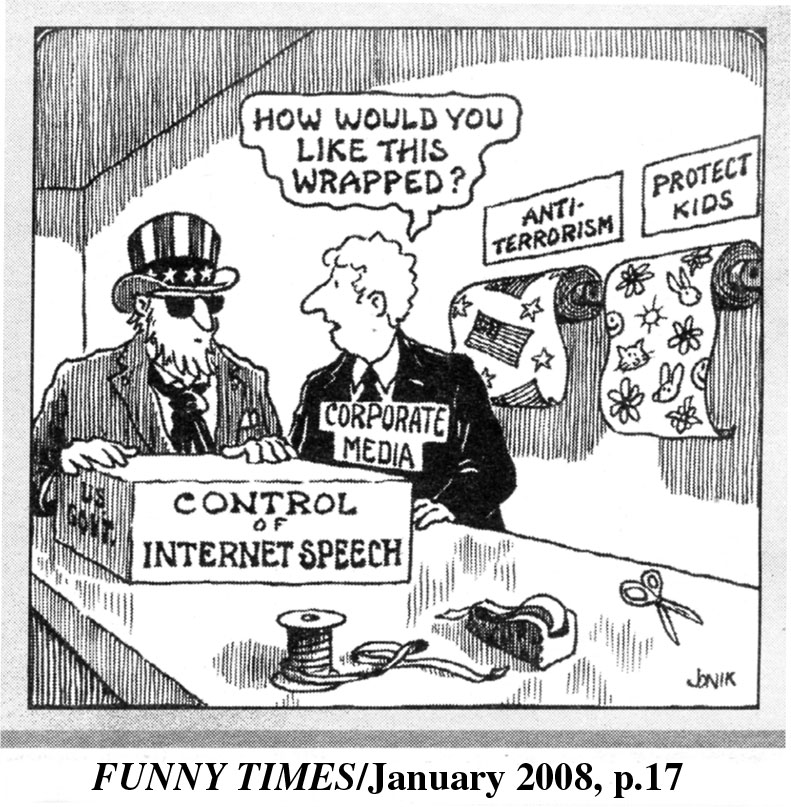
Then yesterday, I happened to find an issue of our local university's student newspaper, in which a first-year law student writes about H.R. 1955, the bill passed by the (U.S.) House of Representatives in October which is now before the Senate. The bill would create a commission to investigate Americans who "adopt or promote an extremist belief system" for the purpose of "planning or threatening the use of force" in order to advance "political, religious or social change".
As the writer of the article points out, this is nothing less than a return to the 1950s House Un-American Activities Committee and the red-baiting led by the infamous Sen Joseph McCarthy.
By the way, the vote in the House to pass the bill was reportedly 404 to 6!, and only two of the current presidential candidates - Ron Paul and Dennis Kucinich - so far have spoken out against it.
18 January 2008
The topic of pedagogical eros (see post for 16 January 2008) is both fascinating and wide-ranging. The term has been credited to Gustav Wyneken, the German educator who lived from 1875 to 1964.
The idea of any sort of love (ερως [eros]) between teacher and student (pedagogical) will no doubt raise 21st Century eyebrows. The word can include sexual desire, but does not need to imply that. Even so, just taken to mean "romantic" or "passionate" (in the sense of intense) love, it still is cause for pause when the pair is a teacher and a student (of any age).
An interesting thing about the term is that the idea is by no means new, and, while it once was common for teacher and student to form a strong, affectionate relationship often lasting entire lifetimes, it is not at all common today. Before I go too far, let me say that just a few months ago I wouldn't have been able to approach an in-depth discussion of this topic. The reading I've been doing lately has been expanding my horizons in this regard, as I mentioned in the 16 January 2008 post. Even this won't be in-depth; the issue is still developing for me.
It seems that, if affection between teacher and student (and, of course, vice versa) was common in former times and is not now, it may just be a factor of the difference in scale. Much of the education of truly ancient times - Greek, Roman, Middle Eastern, for example, before the First Millennium - was carried out in very small groupings, if not on a one-to-one basis. Even more recently, the practice of apprenticeship, as well as the sociology of the boarding schools of the upper classes might still allow or even encourage closeness between the ones imparting and the ones receiving the knowledge. Henry James described the interaction this way:
-
. . . and pupil and master exchanged a longish glance
in which there was a consciousness of many more things
than are usually touched upon, even tacitly, in such
a relation.
--Henry James, The Pupil (1891)
The sheer size of the culture today, coupled with the fact of compulsory education introduced in the last (i.e. 20th) Century, probably makes emotional closeness between teacher and student a drawback, even a relationship to be avoided. Some critics of the Henry James story noted above, in fact, have carped that the "love" mentioned by James so often must be sexual, even though there is no overt hint of that in the story. Their criticism is probably due to the mistake of viewing 19th Century ideas and writing style through today's blinders (!).
The question remains, what are we giving up, if anything, compared with what students - those fortunate enough to have the opportunity of formal education - used to get?
I can relate one personal experience which doesn't answer the question, but certainly puts it in perspective. In 1984, the founder-director of a very famous, and very good, boy's choir was charged with molesting some of his group. (This was during the hysteria of the mid-1980s, which saw the McMartin trials in Los Angeles and the witch-hunts in Bakersfield and elsewhere, almost all of which proved groundless.) He assured the Board of Directors that he would resign if convicted, and he was, and he did, ending nearly 20 years of creative work. (He was, by the way, exonerated on appeal, but not after spending time in prison. The entire charge against him, by the way, involved a kiss on a boy's forehead, and patting a behind, football-player-style, for less than a second.)
Very shortly after the conviction, he conducted his last concert with the group. I was in the audience that afternoon, and the atmosphere was like no other I have ever experienced in a public venue. (Click Here to read the unpublished Op-Ed piece I submitted to the Los Angeles Times.) The music, while not flawless, was certainly world-class, and from the first note until the final, extended, standing ovation, everyone on either side of the podium knew the full meaning of just what we were seeing. It was the classic instance of "not a dry eye in the house".
While the audience was applauding, and weeping, the boys and young men of the choir, in an astounding and apparently spontaneous gesture, gathered around the director and hugged him as if he were their dying grandfather. No doubt that is very much how they felt. They knew they might never see him again. It was as vivid a display of pedagogical eros as I will likely ever see in my lifetime. That scene was the picture used the next day in the local newspaper report.
As I said, this doesn't answer the question of what today's kids might be missing, but for one group of boys and former boys (the lower voices of the choir were sung by choir alumni), they got training, life experience and, apparently, affection that they were reluctant to give up.
16 January 2008
A recurring theme in the journals I've been indexing is pedagogy - education - and I am learning a lot about its history that wasn't taught to me in graduate school. I imagine I'll be writing quite a bit about the topic in the future.
The trend in the delivery of education, at least to children and adolescents, for the last few decades has been toward making it an all-female business. We must have women as teachers. We must not exclude nor discourage men from this profession.
In the United States providing extra help to children from upscale families (i.e., those who can pay for it) has become big business. A nationwide company called Sylvan Learning Centers runs advertisements on television offering their services. I've seen dozens of different commercials for their services and not one shows a male tutor working with a student. It would appear that all Sylvan staffers are females. In addition, all of the parents portrayed in the ads as involved in the hiring or evaluation of Sylvan tutors, or receiving the good report cards from the children, are mothers.
This is unacceptable to me as an educator. I wrote a letter to Educate, Inc., Sylvan's parent company, which you can read by clicking here.
There has been no response, and the 100% female content of their advertising has not changed. Once more: female teachers are a good thing. An all-female teacher corps is not. Just imagine the outcry (justifiably) if men controlled education, and actively marginalized female teachers.
15 January 2008
Anyone who looks beyond the physical world for meaning, inspiration, explanation of what seems mysterious will have images, icons, symbols that help them organize their search. As I was raised in a Christian household, the teachings and stories of Jesus are probably the most accessible and familiar to me. Of course, I am interested, indeed fascinated, with the icons and symbols of other belief systems and respect them without exception. I believe, after all, that they're all describing and symbolising the same thing.
To me, one of the most interesting episodes reported in the Gospels was the occasion of the Christ family's Passover visit to Jerusalem when Jesus was 12. When the family left Jerusalem to return home, Jesus was not with them. Three days later, they found him surrounded by men in the great Temple. Here was a Jewish boy, about to become a man (at 13), discussing ideas with the Doctors - some texts render the Greek term as "Teachers" - and impressing them with his insights. Take whatever you want from this important story. Just be sure to remember it whenever you hear the nonsense that today's pre-adolescents are too young to think for themselves, and are not ready to make any of the decisions that affect their lives.
No, today's pre-adolescents are not Jesus, but like the whole story of Christ's sojourn on earth, this episode is a metaphor for human behavior, human interaction and, in this case, intergenerational respect.
To read the text here, click Luke 2:39-52
Also, many artists have rendered this significant scene. To access thousands of such images, click Jesus.
14 January 2008
A quick note: so far, two full months after writing my letter to Bill O'Reilly and his co-author regarding serious flaws in his book (see details elsewhere on this Web page, mainly my post for 15 November 2007), there has been no response at all, either from the authors or from the others, including their publisher, to whom I cc'd copies. Wait, I know why - it was the Holidays, and everyone was out of town! How much longer do you think I should wait before I realize they don't give a rat's ass?
12 January 2008
After a few weeks of reading and indexing the journals mentioned in my post of 8 January 2008 (the project not yet finished, but well on the way) something important hit me today. The journals deal with a lot of topics - literature, art, psychology, criminology, sociology, frivolity - but center on the issue of what I've called "intergenerational relationships", and they discuss the full range of such interactions, including (but not at all limited to) the naughty bits, as we might say in England.
For most of my academic and professional career I've been struggling to understand why the socialization of boys is so bloody difficult, and getting more so all the time. The reason crystallized for me this afternoon: in the gradual movement of society over the past several thousand years into a much larger and much more complex machine, many rituals and customs associated with coming-of-age have come under suspicion or simply have been forgotten, often in a seeming effort to standardize the socialization of youth and control their innate enthusiasm. In short, they've thrown the adolescent out with the bath water!
At this point let me make it very clear that, as of this moment - Saturday 2007.01.12 01:28 GMT - the highly original phrase just above is mine, alone. If you use it without attribution, I will come and get you! I will explain it fully on these pages and elsewhere, and I will milk it for all it's worth. It's brilliant! if I do say so myself. For now, as to what it means, I'll just leave you with the [rhetorical] question: What ever happened to the genius of apprenticeship?
What we have to do now is re-visit all our knowledge about socialization in all cultures, even other species, throughout history, and separate what we're not willing to accept today from what will still work (and is desperately still needed). I accept the challenge. Put me in, coach.
8 January 2008
Happy New Year.
I've been working on making an index for some very rare scholarly journals from the 1960s-1980s. This means, of course, reading - or at least scanning - each page looking for names, places and ideas to put in alphabetical order with their volume and page references, so that researchers can find information from the journals without reading through each issue themselves.
I've never done this kind of work before, and it's a revelation for many reasons. First, it's bloody time-consuming! But more importantly, it gives me a much different, and deeper understanding of the material than reading alone. In a way, I suppose it's teaching me a new way of reading.
Another result of this particular "exercise" is that I'm having another look at the era when the journals were published. I lived through that era and was pretty involved in a lot of the turmoil and ecstasy, but now I'm looking at it from the vantage point of 30-40 years later. In the articles that deal with the tactics of police and other official agencies against adults who had relationships with children, the details are nothing short of shocking. Leaving aside the eminently debatable question of sexual activity - that's always a conversation-stopper - if you just look at the police abuse of their power, suspension of the usual procedures that preserve the rights of suspects and witnesses, exaggeration and outright lying about the scope and nature of the problem, most thinking people will wonder how they ever got away with it.
It should be noted that public "servants" who abuse their authority, especially when it is for their own advancement or satisfaction, never really get away with it. Coincidentally, just a few days ago I was watching one of the late-night talk shows, and the truth of this situation was presented concisely by the actress Glenn Close, in her character Patty Hewes, speaking some lines from her television show "Damages" (2006-07 season), in which she is referring to the risks inherent in a woman threatening the power held by a man.
- Taking power away from a man is a dangerous thing.
Someone always pays.
(Episode 3, "And My Paralyzing Fear of Death", original air date: 2 August 2007)
Worst of all, perhaps, is the climate of fear they created which remains to this day. Who suffers? Children, of course. During their childhood and adolescence, when their teachers, parents and mentors should be safely and gradually preparing them for adulthood, the establishment is "protecting" them, and keeping them insulated from the society which they will one day enter, totally unprepared.
While I agree with the following point, it is not my original idea; I read it several times in the journals I mentioned above, and will no doubt encounter it again: keeping children ignorant of life, their bodies, their potentials and their feelings until a "magic" age of adulthood - whether it's 21, 18, 16, or whatever - is child abuse and has lifelong negative consequences.
15 November 2007
Wow. I finished reading O'Reilly and Flowers' book (see entry for yesterday, 14 November 2007). I had stopped at p.15 a few days ago, and I no sooner began again at p.16, than I found the following:
-
For openers, the Constitution guarantees all of us, in a
famous phrase, "life, liberty and the pursuit of
happiness."
Geez, that sounds good, and the authors go on to make several points based on that premise throughout the book.
The problem is that this "famous phrase" isn't in the Constitution, it's in the Declaration of Independence! In fact, neither the word "pursuit" nor "happiness" appears anywhere in the Constitution.
I simply felt duty-bound to write them a letter and point out their serious error. Click here if you want to read my entire rant. You'll see that I asked O'Reilly if he could imagine someone claiming "pursuit of happiness" as a Constitutional right. I speculated that he probably wouldn't like that scenario. Understatement.
[NOTE, added 2016.06.08: I never got a response!]
14 November 2007
Yesterday I started reading Bill O'Reilly and Charles Flowers' recently-published book, Kids Are Americans Too (New York: William Morrow, 2007). Why? you might ask. It's the curse of a true academic. I feel I must see for myself what people that I may not agree with are saying.
I am now up to Chapter 3 (page 15), but O'Reilly and Flowers already lost me on page xvi (the "Preface" section, which they call "Welcome") when they talk about a particular court case involving a teenager's rights to privacy, and they introduce their readers to the American Civil Liberties Union (ACLU) in this way:
-
. . . the American Civil Liberties Union . . . sent lawyers
in, mouths blazing, to argue to the court . . .
What ever happened to:
-
I disapprove of what you say, but I will defend to the
death your right to say it.
13 November 2007
Ideas are starting to interrupt my sleep. I write them down, groggily, and then try (usually successfully) to decode them the next morning.
9 November 2007
The first phase of my retirement seems to consits of getting organized for what I plan to do with my time over the next few years. Basically, I intend to do a lot of writing, both here (on this Web site) and perhaps for publication. The kind of writing I do will need lots of books and articles, what we in the Social Sciences call "References". For the past two weeks I've methodically slogged through all the books I own, like a Librarian, entering cataloging information into a data base. Since I'm including Title, Author, Publisher, Date, ISBN and Library of Congress Numbers, Description and Comments, this has been a lot of work.
I must say, however, that it has been fascinating. Many of the books on my shelves (or in boxes or drawers) I have owned for thirty years or more. Often, while reading those books, I would make notes in the margins or mark passages that were meaningful. To revisit those notes and markings has been both a trip back in time and a mind-expanding preparation for whatever writing and thought and conversation comes next. The perspective of thirty years or more is an enrichment of my experience that I simply didn't give much thought to. I'm eagerly looking forward to exploring that perspective.
12 October 2007
I'm becoming more and more aware that, once again like adolescence or entering the working world or going to graduate school, I'm having to re-invent myself. Let me say that differently - I have the glorious opportunity to re-invent myself. New habits, different pacing, dealing with previously-unavailable freedoms. It's very stimulating.
26 September 2007
Retirement begins. As of now, it just seems like a long weekend or short vacation.